Many people mistakenly believe that locusts and grasshoppers are the same insect. Despite their many physical similarities, they are actually two different insects. This article will delve into the differences between grasshoppers and locusts and explain why grasshoppers are not locusts. Understanding these differences is crucial for studying entomology, agricultural management, and the workings of natural ecosystems.
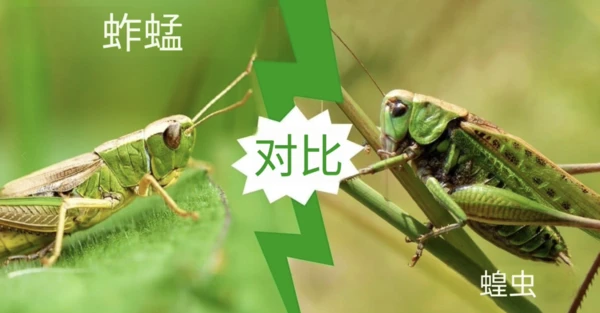
Definitions of grasshoppers and locusts
In scientific classification, grasshoppers and locusts belong to the same family, the Mantisidae (Caelifera), and both belong to the order Orthoptera. However, despite their many similarities, their lifestyles, behaviors, and ecological roles differ.
1. Definition of a grasshopper
Grasshoppers are herbivorous insects widely distributed throughout the world, typically inhabiting grasslands, meadows, and open farmland. They are known for their green or brown appearance, strong hind legs, and jumping ability. Grasshoppers are usually solitary, and when food is plentiful, they tend to maintain a relatively stable population density.
2. Definition of locust
Locusts also belong to the grasshopper family, but their main differences from ordinary grasshoppers lie in their behavior and ecological adaptability. Locusts typically live in relatively arid regions, and under specific environmental conditions, especially when food resources are scarce, they exhibit large-scale swarming behavior. These groups often form huge locust swarms, causing severe agricultural damage.
The main differences between grasshoppers and locusts
Although grasshoppers and locusts are similar in appearance, they differ significantly in behavior, habits, and ecological functions. Here are their main differences:
1. Behavioral differences: group behavior versus individual activity
Grasshoppers are typically solitary insects that primarily inhabit relatively stable habitats and do not form colonies when food is plentiful. In contrast, locusts exhibit drastic behavior when food is scarce. Locusts can sense changes in their environment, and once food becomes scarce, they begin to congregate, forming massive migratory swarms. This migration process can lead to large-scale agricultural destruction.
2. Differences in ecological adaptability
Grasshoppers typically adapt to stable ecological environments and can live in a variety of conditions, but their population changes are relatively gradual. Locusts, on the other hand, can rapidly reproduce in large numbers and swarm in resource-scarce environments, creating a phenomenon known as a "locust plague." The large-scale migration and swarming of locusts pose a significant threat to agriculture and vegetation.
3. Differences in physical appearance
Although grasshoppers and locusts share many similarities in appearance, they differ in body size and wing structure. Generally, grasshoppers have larger wings, enabling them to fly longer distances, which helps them migrate quickly. Grasshoppers, on the other hand, typically have smaller wings, allowing for greater jumping ability, but their flying ability is relatively weaker.
Comparison table of grasshoppers and locusts
| feature | grasshopper | locust |
|---|---|---|
| lifestyle | Independent activities, usually without forming a group | They gather in groups, forming migratory groups. |
| Habitat | Multiple habitats including grasslands, farmland, and meadows | In arid regions, when conditions are harsh, they can gather into disaster groups. |
| food sources | Herbivorous, maintaining a stable diet when food is plentiful. | Herbivorous, but exhibits gregarious behavior when resources are scarce. |
| Flight capability | It mainly relies on jumping and has relatively weak flight ability. | It has strong flight capabilities and is capable of long-distance migration. |
| Ecological impact | Maintaining the ecological balance of plants | It causes serious damage to agricultural crops and may trigger locust plagues. |
| group behavior | Do not exhibit group migration behavior | Mass migration can create massive disasters. |
This table briefly summarizes the main differences between grasshoppers and locusts, helping readers better understand the characteristics of these two insects and their different impacts on the ecological environment.
Ecological impacts of grasshoppers and locusts
1. The ecological role of grasshoppers
Grasshoppers primarily function as a link in the food chain within the ecosystem. They are herbivores that feed on plants, and are preyed upon by many birds, reptiles, and mammals. The presence of grasshoppers helps maintain ecological balance and prevents the overgrowth of certain plant species.
2. Ecological impacts of locusts
Locusts have a far greater impact on agriculture than grasshoppers. Because locusts can form massive swarms, the damage they cause to agricultural crops is extremely severe. Locust swarms can rapidly destroy large areas of farmland, and locust plagues pose a serious threat to food production, especially when factors such as climate change and dry seasons affect their habitat. Locust plagues not only lead to crop losses but can also cause significant economic damage.
Summary: The fundamental difference between grasshoppers and locusts
The main differences between grasshoppers and locusts lie in their behavior, ecological adaptability, and ecological impact. Although they belong to the same family taxon and look similar, the locusts' swarm behavior, migratory abilities, and ecological impacts fundamentally distinguish them from grasshoppers. Understanding these differences not only helps us better understand entomology but also helps us respond to and prevent locust plagues, protecting crops and natural ecosystems.