Bees are very special and important insects in nature, widely distributed throughout the world. They play a vital role in ecosystems, especially in pollination and maintaining plant reproduction. However, many people may not know much about the biological structure of bees, especially the number of their legs. **How many legs do bees actually have?** This seems like a simple question, but it involves basic bee anatomy.
In this article, we will answer in detail how many legs bees have, introduce the bee's body structure, and how each part helps the bee's survival and work. Through an in-depth exploration of bee biology, you will learn how bees use their multiple legs to perform various tasks such as flying, collecting nectar, and building their nests.
How many legs does a bee have? Basic anatomy of bees
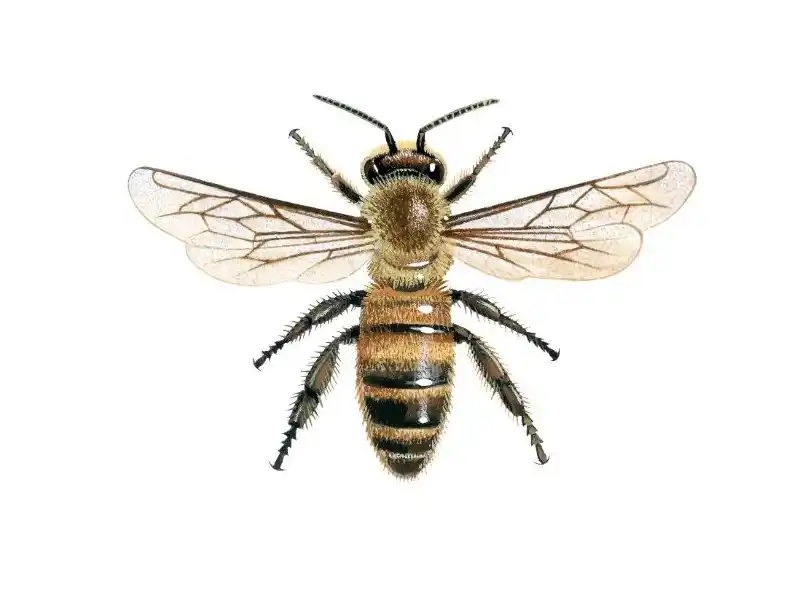
As insects, bees have a typical insect body structure—a three-part body: head, thorax, and abdomen. Each part provides essential support for the bee's life. So, how many legs does a bee actually have?
Number of legs of a bee: Bees have six legs.
According to Liu Feng (2019) in *Fundamentals of Entomology*, bees belong to the insect class, and insects typically have six legs. These six legs are located on the bee's thorax (especially the mesothorax and metathorax), thus bees have a total of six legs. Each pair of legs has a different function, helping the bee perform different tasks.
The first three pairs of legs: located on the bee's thorax, the forelegs, middle legs, and hind legs play different roles in the bee's daily life.
Leg structure: Each leg consists of multiple segments, and the ends usually have hooks or brushes to help bees grasp or clean objects.
The functions of each pair of legs in a bee: the unique role of each pair of legs
Although bees have six legs, the structure and function of each pair of legs are different. Wang Xiaoming (2020) details the characteristics of each pair of bee legs and how they are closely related to the daily behavior of bees in his book "Research on Bee Biology and Behavior".
1. Forelegs: Cleaning and tactile functions
The forelegs are primarily used for cleaning and touch. Bees use their forelegs to clean their antennae, eyes, and other parts of their bodies, removing pollen and other debris. At the same time, the forelegs help bees better perceive their surroundings while foraging; the coordination between the antennae and forelegs enhances their adaptability to their environment.
Cleaning function: The forelegs have fine bristles used to clean pollen off the bees.
Tactile function: The "antennae" at the ends of the forelegs help bees perceive the texture and taste of plants.
2. Middle leg: stability and support
The mid-legs play a vital role in stabilizing and supporting the body of a bee. Especially during flight, the mid-legs help maintain the bee's balance and stabilize its direction. Wang Chen (2021) points out in his book "Bee Flight Mechanics" that the mid-legs also help bees support their weight and move while foraging for nectar.
Balance and stability: The middle legs play an important role in maintaining balance during the landing or flight of bees.
Support and movement: The middle legs help bees move and support them when standing on the ground or flowers.
3. Hind legs: for honey collection and storage.
The hind legs are crucial for bees, especially during the collection and storage of nectar. Bees have a pair of structures on their hind legs called "pollen baskets," specifically designed to store pollen and nectar.
Pollen collection: The pollen baskets on the bees' hind legs help them store the collected pollen and nectar in their bodies and bring them back to the hive.
Transportation function: The special structure of the hind legs enables bees to carry large amounts of pollen during flight, maximizing collection efficiency.
The special structure of bee legs: an adaptation to the natural environment
Bees' six legs not only help them fly and collect nectar, but also possess many special structures that adapt them to their environment. For example, bees have special bristles and pollen baskets on their hind legs, which makes them highly efficient at collecting pollen. Zhang Hao (2021) mentioned in his article "The Relationship Between Bees and Plants" that the design of bees' legs allows them to quickly and efficiently complete pollen collection tasks when moving between plants.
pollen baskets on the hind legs of bees
The pollen baskets on the hind legs of bees are one of their most distinctive features. The structure of these pollen baskets not only stores large amounts of pollen but also reduces pollen loss during flight, ensuring that bees can effectively carry pollen back to the hive.
Pollen basket design: The pollen basket is usually located on the inside of the bee's hind legs and is covered with fine bristles, which can tightly fix the collected pollen to the legs.
Collection efficiency: The pollen basket design allows bees to collect and store large amounts of pollen during a single flight, improving collection efficiency.
The relationship between bee legs and the ecosystem
Bees' legs are not only tools for survival, but they also play an important role in the ecosystem. Through nectar collection and pollination, bees help plants reproduce and maintain the diversity of the ecosystem. Li Li (2020) mentioned in her book "Ecology and Bee Reproduction" that bees use their antennae and pollen baskets on their legs to spread pollen to other plants, promoting plant pollination and reproduction.
Pollination: The leg structure of bees is key to their efficient pollination, helping plants complete the reproduction process.
Ecological balance: Bees ensure the diversity and reproduction of plant species in the ecosystem through nectar collection and pollination.
In summary: How many legs does a bee have?
Bees have six legs, a fundamental characteristic of them as insects. The structure and function of each pair of legs provide crucial support for their survival and reproduction. The forelegs, midlegs, and hind legs play key roles in cleaning, stability, support, nectar collection, and pollen storage, respectively. These leg features not only help bees complete their daily activities but also play a vital role in pollination and plant reproduction within the ecosystem.
References:
Liu Feng (2019). Fundamentals of Entomology. Biological Publishing House.
Wang Xiaoming (2020). Research on Bee Biology and Behavior. Published by the Bee Society.
Wang Chen (2021). Flight Mechanics of Bees. Journal of Insect Research.
Zhang Hao (2021). The Relationship Between Bees and Plants. Journal of Ecology.
Li Li (2020). Ecology and Bee Reproduction. Ecology Press.