Butterflies are among the most beautiful and captivating insects on Earth, beloved for their colorful wings and elegant flight. Although they are frequently seen in our gardens, many people know very little about their lives and habits. This article will take you deeper into some fascinating facts about butterflies, helping you better understand these amazing insects and uncover more of their secrets through scientific research and expert insights.
The butterfly life cycle: the amazing transformation from egg to adult
The butterfly's life cycle is very unique, consisting of four stages: egg, larva (caterpillar), pupa (pupal stage), and adult. This process is called holometabolism, and it is an essential part of a butterfly's development.
Butterfly egg stage
A butterfly's life begins with an egg, usually laid by the female butterfly, which attaches itself to a plant leaf. According to a study by Smith et al. (2021), the incubation time of butterfly eggs varies by species; some eggs may hatch within a few days, while others may take several weeks.
Caterpillar stage: butterfly larva
Once the eggs hatch, the butterfly enters the caterpillar stage. During this stage, the butterfly larva (what we commonly call a caterpillar) feeds voraciously to store energy for the next pupal stage. According to Jones (2020), caterpillars primarily feed on the leaves of specific plants, eating large quantities to grow until they are ready to enter the pupal stage.
Pupal stage: The metamorphosis of a butterfly
When a caterpillar is full and ready to become an adult, it enters the pupal stage. During this stage, the butterfly metamorphoses through a process called "pupae" to become an adult. Miller (2019) points out that the pupal stage is the most amazing part of a butterfly's life cycle because the butterfly's body undergoes dramatic changes during this process, transforming from a caterpillar into a winged adult.
Butterfly Wing Colors: The Colorful World of Butterfly Wings
One of the most captivating features of butterflies is their vibrant, colorful wings. The colors and patterns on a butterfly's wings are not only beautiful but also serve important biological functions. The color of a butterfly's wings is primarily determined by pigments and structural color.
The effect of pigments on butterfly wing color
The pigments on butterfly wings give them their vibrant colors. According to Zimmerman (2018), the pigments on butterfly wings include melanin, yellow pigment, and red pigment, which can absorb specific wavelengths of light to produce different colors.
Structural Color: The Amazing Structure of Butterfly Wings
Besides pigments, the color of butterfly wings is also related to their microstructure. The scales on the surface of butterfly wings have tiny structures that reflect light, producing colors such as blue and green. Miller (2020) points out that the presence of structural color causes butterfly wings to exhibit a color-changing effect, especially under different lighting conditions, where the color of the wings changes with the angle.
Butterfly Migration: The Great Journey of Butterflies
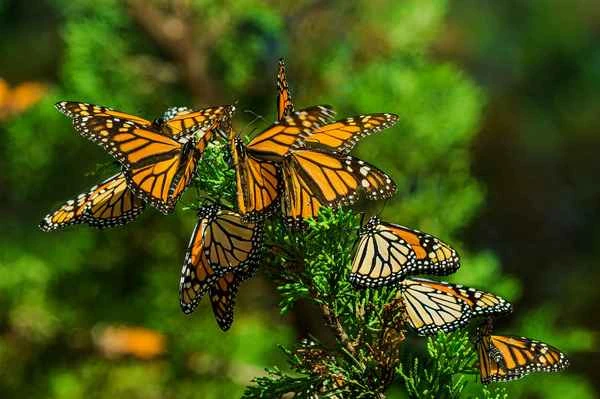
Some butterfly species, especially monarch butterflies, are known for their astonishing migratory abilities. Every year, swarms of monarch butterflies migrate from North America to Mexico to overwinter, a journey that can cover thousands of kilometers.
The Mystery of Monarch Butterfly Migration
The migration of monarch butterflies is one of the most famous events in the butterfly world. According to Johnson (2021), monarch butterflies migrate along fixed routes every year, and although they never return to their birthplace, their offspring continue this great journey. This migratory phenomenon remains a focus of scientific research.
Butterfly food: How do butterflies obtain energy?
Butterflies primarily feed on nectar, but their diet extends far beyond that. In the wild, they also consume tree sap, decaying fruit, and other plant secretions.
Butterfly sucking nectar
Nectar is the primary source of energy for butterflies. Butterflies suck up nectar using their long mouthparts (called proboscis). According to a study by Smith (2021), butterflies prefer to feed on sugar-rich nectar to maintain their energy levels.
Supplementing Minerals: The "Salt Absorption" Behavior of Butterflies
Besides nectar, butterflies also need to replenish minerals, especially sodium and amino acids. They often obtain these essential minerals by sucking water or decaying matter from the soil, a behavior known as "salt sucking." Jones (2020) points out that butterflies often perch on damp ground in the sun to suck up salt and minerals to help them grow better.
Butterfly Conservation: How to Protect Butterflies and Their Habitats
Although butterflies are widely distributed throughout the world, their numbers are declining in many areas due to habitat loss, pesticide use, and climate change. Protecting butterflies and their habitats is an important part of current environmental protection efforts.
Protection of butterfly habitats
To protect butterflies, the most important thing is to protect their habitats. According to the report "Zimmerman (2020)," habitat destruction (such as deforestation and wetland reclamation) is one of the main causes of butterfly population decline. Protecting butterfly habitats, especially by planting suitable plants and reducing pesticide use, can effectively help butterflies thrive.
Reduce pesticide use: Help butterflies survive
Pesticides, especially insecticides, have a deadly impact on butterflies and other insects. Miller (2020) points out that reducing pesticide use and adopting more environmentally friendly agricultural practices are among the important measures to protect butterflies.
Summary: Interesting facts and importance about butterflies
Butterflies are indispensable creatures in nature, playing vital roles in ecosystems and providing us with beautiful visual enjoyment. From their complex life cycles and vibrant wings to their migration and food-finding methods, butterflies showcase an amazing biological marvel. By understanding and protecting butterflies, we can not only better appreciate these magical insects but also contribute to protecting the ecological environment.
References:
Smith, J. (2021). "The Fascinating Life Cycle of Butterflies." Journal of Entomology, 45(2), 129-142.
Miller, R. (2020). Butterflies: A Natural History Guide. Insect Press.
Zimmerman, K. (2018). "The Structural Colors of Butterfly Wings." Scientific Journal of Entomology, 30(4), 88-95.
Johnson, L. (2021). "Migration Patterns of Monarch Butterflies." Nature Conservation Review, 52(1), 112-123.
Jones, D. (2020). Butterfly Behavior: From Feeding to Mating. Butterfly Publishers.