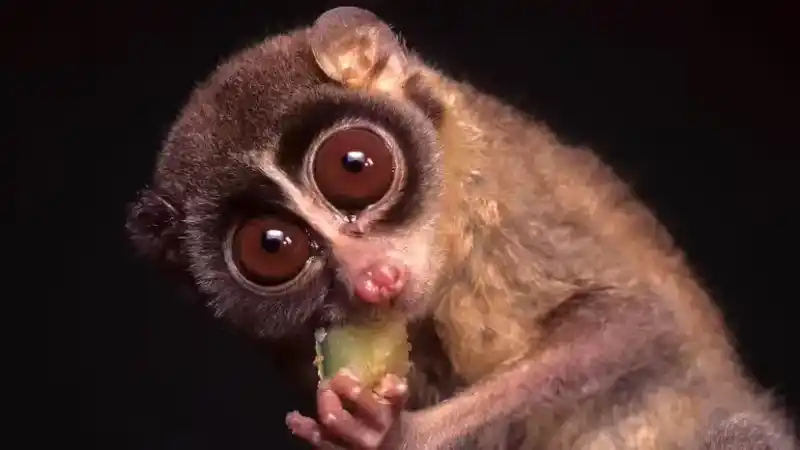
At first glance, the slow loris looks like a "living doll": its round head, large, bright eyes, and soft fur give the impression that it is naturally docile and cuddly. However, this misconception is precisely the main reason why slow loris are abused and illegally kept as pets online.
In fact, the tardigrade is not cute and cuddly, but a nocturnal primate with a highly venomous bite , a cautious and sensitive nature, and an extreme dependence on forest ecology.
The following content will provide a comprehensive analysis of the tardigrade's behavior, toxicity, family structure, ecological status, and why they cannot be kept as pets.
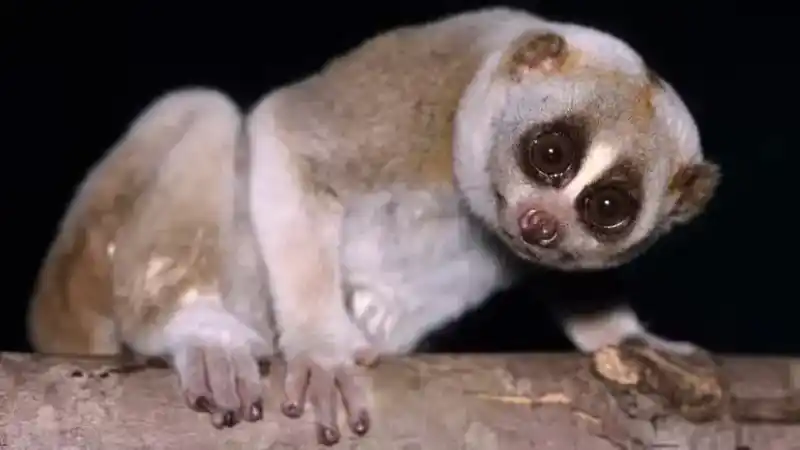
I. What is a tardigrade? It appears innocent but possesses remarkable survival wisdom.
Tardigrades belong to the genus Nycticebus and are a group of small primates distributed in Southeast Asia.
As early as 1891, American zoologist Dean Conant Worcester described them as having "faces like bears, hands like monkeys, and a way of moving like sloths."
The word “Loris” is believed to derive from the Dutch word loeris , meaning clown, possibly from the distinctive “mask”-like markings on their faces.
Main external features
Extra-large forward-facing eyes : equipped with a "tapetum lucidum" that reflects light and improves night vision.
Round head and small ears : The ears are covered by thick hair.
A short tail that is almost invisible : only one tail remnant remains.
A robust and sturdy build : weighing between 265 grams and 2100 grams, with significant differences among species.
Body length : 18–38 cm.
These characteristics make them experts at hunting insects at night and moving silently through the canopy.
II. One of the world's rarest "venomous mammals": Where does the venom in the tardigrade come from?
Tardigrades are among the few known mammals that possess venom .
The way venom is produced is very unique:
When a tardigrade feels threatened, it will raise its arms .
The axillary gland in the upper arm secretes a special venom.
They will lick the venom , mixing it with their saliva.
The mixture flows down the tooth grooves, forming a venomous bite.
The dangers of venom
Causes severe tissue necrosis
It can cause life-threatening anaphylactic shock.
Wounds heal extremely slowly
Highly dangerous to its own kind as well
Many illegally captured tardigrades have their teeth violently pulled out in order to "sell safely," an extremely cruel practice against the animals.
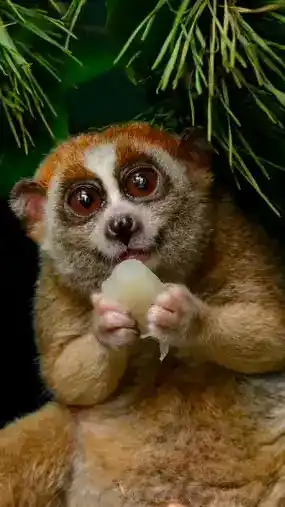
III. Distribution Area and Wild Lifestyle: The Secretive Forest Nocturnal Traveler
Tardigrades are mainly distributed in Southeast Asia, including:
Vietnam
Laos
Eastern Cambodia
Southern Yunnan, China
Parts of Thailand, Malaysia, and Indonesia (depending on species)
living environment
bamboo forest
tropical rainforest
virgin hardwood forest
Tree holes, branches and thick foliage
They will curl up tightly in tree holes or among branches and leaves to rest during the day.
Nocturnal activity and diet
Tardigrades are opportunistic predators , adapting their foraging strategies to the season and environment.
Insects (primary protein source)
Gum, resin and sap
nectar
Small vertebrates
fruit
Dew on leaves in the early morning
This diverse diet gives them a strong ability to adapt to the forest.
IV. Social Behavior: Appears to live alone, but values family inwardly.
Although tarsiers are often considered solitary animals, records from research institutions such as the Duke Lemur Center show that:
Tardigrades are not entirely solitary.
Family members groom each other.
Parents and cubs may live in the same area for many years.
Group size can reach 2–6 individuals.
Foraging usually takes place alone.
Social hierarchy is not obvious, and conflicts are relatively few.
The staff also discovered that each tarsier had a very different personality:
Some are introverted and shy
Some are extroverted and curious
Some even actively approach the zookeepers.
This difference in personality is similar to that of humans and other primates.
V. Reproduction and Family Structure: Very "family-oriented" primates
Based on long-term field observations by Professor Anna Nekaris , a renowned primatologist at Oxford Brookes University in the UK:
Tardigrades can breed year-round.
Young cubs can live with their parents for up to three years.
Family unit stability, mutual protection
Multiple cubs may grow up together.
In artificial breeding, the situation is more complicated:
Not all pairings get along well.
Some females will "drive away" their young (even when they are only 5 months old) earlier.
Breeding facilities must strictly adhere to species conservation plans to avoid overbreeding and genetic degradation.
VI. Why are tardigrades endangered? Humans are the biggest threat.
According to the IUCN (International Union for Conservation of Nature) assessment, all tardigrade species are currently listed as:
Vulnerable
Or Endangered
The main threats include:
① Habitat destruction
Large-scale deforestation
Farmland expansion
Forest fragmentation on the Indonesian island of Java has shrunk the habitat of tardigrades by up to 90% .
② Illegal pet trade
Most of the "cute walking monkeys being tickled" videos on TikTok, YouTube, and Instagram are from illegally captured monkeys.
But what people don't know is:
The tardigrade raising its paws is not a sign of "enjoying being scratched," but rather a defensive posture.
Illegal vendors will cut or pull out teeth, causing extreme pain.
Most wild individuals die before being sold.
Social media fuels illicit demand
③ Folk medicine and hunting
Some regions believe that parts of the tardigrade's body have "medicinal value," but there is no scientific evidence to support this claim.
VII. Conservation Actions: What are scientists doing?
Several organizations are working to protect tardigrades, for example:
Oxford Brookes University Nocturnal Primate Research Team
" Walking monkey canopy bridges " were built in areas of forest cut off by roads to help walking monkeys cross safely.
Rescue and Rehabilitation Center
Responsible:
Receiving tarsiers rescued from illegal trade
Addressing psychological trauma
Wilding training
Carefully released back into the forest
Public welfare education projects
To educate local villagers, tourists, and social media users:
Tardigrades should not be kept as pets.
Don't consume "cute animal videos".
The Importance of Maintaining Forest Integrity
8. Can tardigrades be kept as pets? Absolutely not.
Despite their cute appearance, tarsiers are absolutely unsuitable as pets for the following reasons:
They have venomous bites.
A completely nocturnal lifestyle is not suitable for families.
Extremely dependent on canopy ecology
A strong stress response can lead to death.
Light, noise, and touch can all damage them.
Capturing a wild individual can wipe out an entire population.
Any attempt to breed tardigrades will only fuel the illegal trade and hasten their extinction.
In conclusion: True love means letting them live freely, not turning them into toys for humans.
The existence of tardigrades reminds us that:
"Cute" does not mean "suitable to be kept as a pet".
They are primates with complex social relationships, delicate ecological functions, and are highly vulnerable.
What's needed to protect them is science, ethics, and public awareness, not "internet celebrity pet culture."
Only when we stop treating them like toys will they have the opportunity to continue moving slowly and living quietly in the forest.