Tentacles are specialized, boneless appendages found in a wide variety of animals in both aquatic and terrestrial environments. These versatile appendages play crucial roles in hunting, perception, and even locomotion. Animals with tentacles can be either vertebrates or invertebrates, and these appendages serve multiple purposes. In this article, we will explore some of the most remarkable tentacle-bearing animals and investigate their unique functions.
Cephalopods: Tentacle Masters
When most people think of tentacles, cephalopods immediately come to mind. This group of mollusks, including octopuses , squid , and cuttlefish , is known for its intricate tentacles. Cephalopods are mollusks, and the family also includes snails and mollusks . However, only squid and cuttlefish possess true tentacles.
| type | Tentacle features | The function of tentacles |
|---|---|---|
| squid | Long, retractable shovel-shaped tip | Predation, capturing food |
| squid | Long, retractable shovel-shaped tip | Capture, grasp, and manipulate prey |
| octopus | Arms (not tentacles) | Manipulating objects, hunting, camouflage |
The main difference between arms and tentacles is that the latter are longer, retractable, and equipped with flat or shovel-shaped tips. Furthermore, cephalopods use their tentacles to hunt and capture prey , making them powerful and efficient predators.
Gastropods: Tentacles for sensing
Another group of fascinating animals with tentacles are gastropods , such as snails and slugs . These creatures typically have four tentacles on their heads.
| Gastropod species | Tentacle features | The function of tentacles |
|---|---|---|
| snails | Two eyestalks and two sensory tentacles | Detecting chemicals and enhancing the sense of smell |
| slug | Similar to a snail | Use touch and smell to navigate and find food. |
Two of the tentacles act as eyestalks , with an eye at the end of each tentacle, while the other two act as sensory organs , used to detect chemicals in the environment. These sensory tentacles help gastropods navigate and locate food, and enhance their sense of smell.
Cnidaria: Marine organisms with tentacles
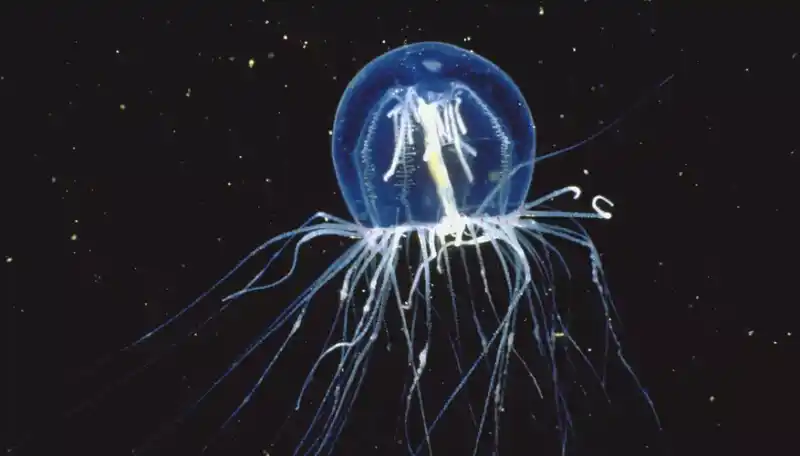
Cnidium formans are a diverse group of marine animals known for using tentacles for defense and to capture prey . This phylum includes jellyfish , sea anemones , and corals .
| Cnidaria species | Touch function | Body structure |
|---|---|---|
| jellyfish | tentacles used to stab and capture aquatic creatures. | Jellyfish form (free-floating) |
| sea anemone | Tentacles used for stinging and attachment | Polyp morphology (attached to the surface) |
| coral | Tentacles used for feeding and protection | Polyp morphology (group structure) |
All cnidarians possess specialized cells called nematocysts on their tentacles. These cells release toxins to paralyze prey or defend against threats. The tentacles are arranged differently in two main body forms: jellyfish (like jellyfish) and polyps (like sea anemones and corals).
Caecilians: Tentacles used for navigation
Although caecilians look like snakes or eels , they are actually amphibians. Caecilians are found all over the world, are typically burrowing , and are elusive. Some species have two sensory tentacles on their heads, used for navigation and prey detection .
| Species of caecilians | Tentacle features | The function of tentacles |
|---|---|---|
| caecilians | There are tentacles on my head | Sensory detection, underground navigation |
These tentacles help caecilians capture prey (such as worms and insects) and navigate underground environments , much like the star-nosed caecilian. (Star-nosed mole: Sensory tentacles for touch)
The star-nosed mole ( Condylura cristata ) is a small mammal native to North America. It has a unique feature: 22 tentacles around its nose, each tentacle being only 1 to 4 millimeters long.
| Species | Tentacle features | The function of tentacles |
|---|---|---|
| Star-nosed mole | 22 tentacles, 25,000 tactile receptors | Among mammals, touch is the most sensitive sense of touch, used for detecting prey. |
Each of these tentacles contains 25,000 tactile receptors , called Amherst's organs , which give the star-nosed mole the ability to perceive touch. It possesses the most sensitive sense of touch of any mammal. This allows it to detect even the slightest changes in texture when searching for food underground.
Conclusion: Diversity of touch objects
Tentacles are highly specialized appendages that enable animals to interact with their environment in extraordinary ways. From cephalopods using tentacles to hunt , to gastropods enhancing their sense of smell, to cnidarians using their stinging tentacles for self-defense, these creatures exhibit a wide variety of tentacle functions . Even mammals like the star-nosed mole utilize tentacles for sensory exploration . Tentacles truly are one of nature's most remarkable adaptations, helping animals survive and reproduce in unique environments.