The oldest living organisms on Earth are lingulae. Lingula, also known as sea bean sprouts, is the oldest known genus of organisms in the world, a famous "living fossil," living in temperate and tropical seas. They are brachiopods of the class Hingelaceae, with a tongue-shaped or elongated oval shell. The shell is composed of chitosan, with a thin, brittle shell wall, and alternating layers of chitosan and apatite. This group of brachiopods includes both extant and extinct types. They were first found in the Cambrian system and likely originated before the Cambrian period.
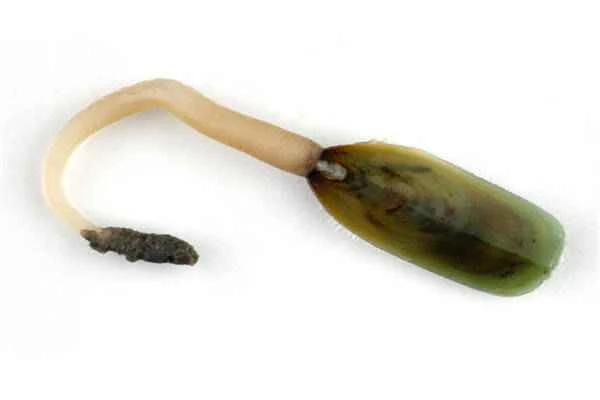
The lingula has a tongue-shaped or oblong-ovate shell with a tapering posterior margin and a straight anterior margin. The two shells are similar in convexity and nearly equal in size, but the ventral shell is slightly longer. The shell wall is thin and brittle, with alternating layers of shell polysaccharides and apatite. The shell surface has a greasy sheen and is decorated with concentric patterns. The pedicle is exceptionally long, extending from between the two shells and deeply embedded in the burrow, leaving a triangular groove on the false hinge surface of the ventral shell, called the pedicle groove. The mantle edge has setae, facilitating water entry into the arm cavity from the anterior sides and exiting from the anterior center. The small lingula has two shells of equal size, oblong-ovate to subtriangular, with rounded anterior margins. The posterior margin of the ventral shell is relatively sharp, with a clear false hinge surface and pedicle groove. The dorsal shell is slightly shorter. The shell surface has concentric patterns, sometimes appearing as discontinuous layers, or with radial patterns.
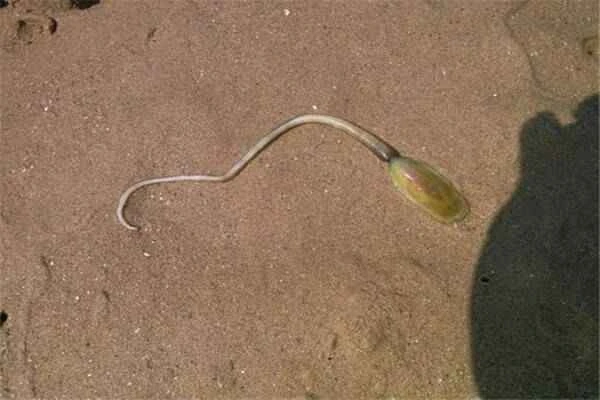
In 2004, it was reported that the Haikou Xishan bream, a new brachiopod of the tongue-shaped mollusks, was discovered in the Chengjiang Fossil Depository.
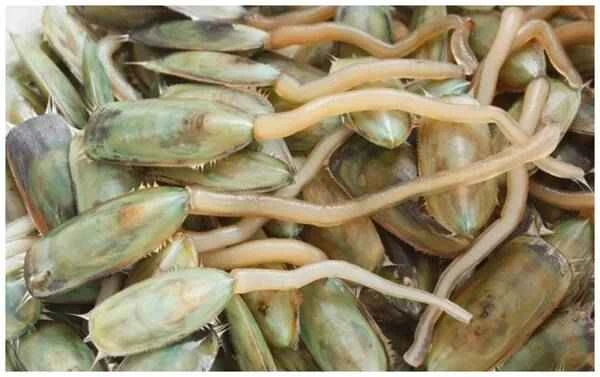
Lingula are hingeless microbrachial molluscs whose shells are composed of chitosan. The extant genus *lingula* is found in normal marine environments, but is more common in muddy, oxygen-deficient brackish waters unsuitable for most organisms. The genus *lingulella* is a Cambrian fossil, similar in appearance and structure to the modern genus *lingulella*. The genus *lingulepis* (generally limited to the Late Cambrian) differs in appearance from other lingula, resembling a teardrop. Lingula are useful fossils providing environmental information; they are not very useful for stratigraphic correlation; and they are important members of the Cambrian brachiopoda.