In traditional culture, proverbs about bird migration are very common, such as: "You will see storks on St. Blas Day; if you don't, it will snow heavily that year" or "Storks begin to fly on San Juan Day." These proverbs are all related to animal migration and reflect people's long-term observation and summarization of nature.
Animal migration is a common phenomenon in nature. Not only storks migrate, but many other animals also undertake periodic long-distance journeys. So, why do animals migrate? Besides birds, what other animals also undertake large-scale migrations? This article will provide a detailed explanation.
What is animal migration?
Animal migration refers to the periodic movement of groups of animals from their original habitat to another region and where they remain for a period of time . This process can span hundreds or even thousands of kilometers and is usually a group activity rather than an individual one.
Migration is crucial for maintaining ecological balance. Migratory animals establish complex energy and food chains between their origin, transit points, and destinations, thereby helping to keep the entire ecosystem stable.
Bird migration : often utilizes trade winds or air currents to save energy.
Amphibians and invertebrates : may use water currents to migrate.
Orientation mechanism : Scientists speculate that birds and other animals navigate using the sun, stars, or the Earth's magnetic field, but the specific mechanisms are still under investigation.
Reasons for animal migration
Migration is an instinct-driven survival strategy with primary objectives including:
Responding to temperature changes
When winters are too cold or summers are too hot, animals migrate to areas with more suitable climates.
For example, many birds migrate to warmer regions to spend the winter.
Reproduction and finding food
Some animals need to migrate to safe places to breed and avoid predation pressure.
Migration also helps them find areas with richer food resources.
Avoiding predators
Some animals migrate to escape predators and find safer habitats.
Examples of migratory animals
1. Bird migration
Birds are the most typical migratory animals, with many species flying across continents every year.
White storks (Ciconia ciconia) : They migrate to Africa in winter, but avoid flying over the Mediterranean Sea because they rely on land-based air currents for flight.
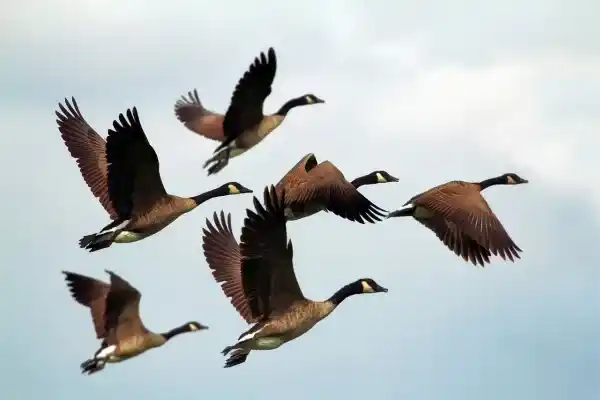
Canada geese (Branta canadensis) : They migrate in flocks, flying in a "V" formation, to warmer regions in search of food.
Seabirds (such as gulls, scissor-billed gulls, and petrels) : can fly hundreds of kilometers every day.
Swallows (Hirundo rustica) : They migrate from Africa to Europe to breed during the summer.
2. Fish migration
Fish migration is usually related to reproduction:
Salmon (Salmoninae) : They spawn in freshwater rivers, and the juveniles migrate to the ocean after growing up. As adults, they swim upstream to return to their birthplace to reproduce.
European eel (Anguilla anguilla) : Adult eels migrate from rivers to the Sargasso Sea in the Atlantic Ocean to reproduce.
Other examples : herring, cod, and flounder also have fixed migration routes.
3. Mammal migration
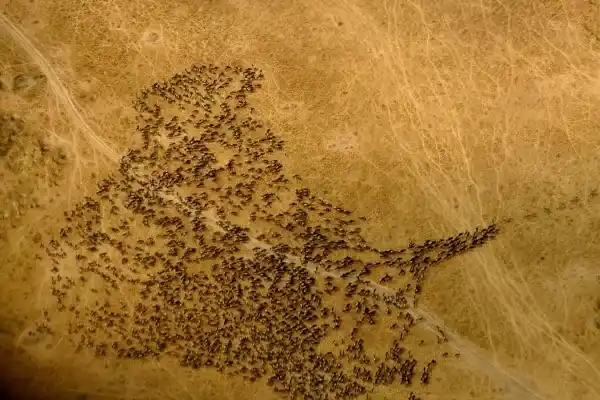
Wildebeest (Connochaetes) : Every year, millions of wildebeest undertake a spectacular large-scale migration across the African savanna in search of grass and water.
Elephants (Elephantidae) : seasonal migration in search of water and food.
Zebras (Equus zebra) and antelopes (Antilope cervicapra) : traveling alongside wildebeest, they form Africa's most famous "Great Migration".
Caribou (Rangifer tarandus) : Migrate thousands of kilometers within the Arctic Circle.
Whales , such as humpback whales, southern right whales, and gray whales, migrate more than 20,000 kilometers every year, foraging in cold waters and breeding in warm waters.
4. Reptile and amphibian migration
sea turtle
Green sea turtles (Chelonia mydas) : They swim from the coast of Brazil to Ascension Island in the Atlantic Ocean to lay their eggs.
Leatherback turtle (Dermochelys coriacea) : undertakes long-distance migrations of over 4,800 kilometers.
Other species include loggerhead turtles and olive ridley sea turtles.
Amphibians
Toads, frogs, and salamanders : Every year they migrate from their hibernation sites back to ponds and rivers to reproduce.
5. Invertebrate Migration
Invertebrate migrations are often overlooked, but they are also quite spectacular:
Plankton : They undergo "vertical migration," diving into deep water during the day and rising to feed at night.
Crab (Brachyura) : Migrates to saltwater areas to lay eggs, and can travel hundreds of kilometers.
Locusts (Palinurus elephas) : They can cause severe damage to crops during large-scale migrations.
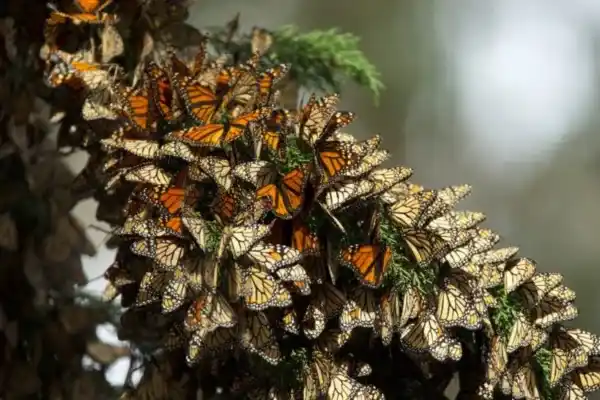
Monarch butterflies (Danaus plexippus) : They migrate from Canada and northern United States to Mexico, flying more than 5,000 kilometers and spanning multiple generations.
Dragonfly (Pantala flavescens) : Completed the world's longest insect migration, crossing India and Africa, a round trip of approximately 15,000 kilometers.
Summarize
Animal migration is an ancient and mysterious natural phenomenon, driven by the needs of survival, reproduction, and ecological balance . Whether it's flocks of birds in the sky, wildebeest on the grasslands, whales in the ocean, or seemingly insignificant plankton, their migrations all contribute to the healthy cycle of Earth's ecosystem.
Protecting migratory animals and their pathways is crucial for maintaining global biodiversity and environmental balance.