1. Species Overview
The Smooth-billed Rhinoceros Cuckoo (scientific name: *Crotophaga ani*), also known as the Flat-billed Rhinoceros Cuckoo or Smooth-billed Rhinoceros Cuckoo, is a bird widely distributed in tropical and subtropical regions of the Americas, belonging to the genus *Crotophaga* in the family Cuculidae. This species is renowned for its smooth, broad, flat beak, strong sociality, and collective chick-rearing behavior, making it an important subject of avian behavioral research.
2. External features
The Smooth-billed Rhinoceros-Cuckoo is a medium-sized bird, measuring approximately 33-36 cm in length and weighing between 90-140 grams. Its most distinctive feature is:
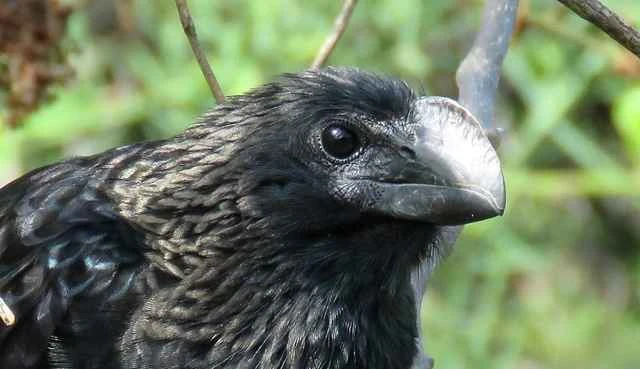
Beak characteristics: The beak of the Smooth-billed Rhinoceros Cuckoo is black, smooth, broad and flat, with a nearly horizontal curve, which is quite different from the curved beaks of other cuckoos.
Feather color: The entire body is covered in black or jet-black feathers with a metallic sheen, which may reflect a bluish-purple light in sunlight.
Tail: The tail feathers are relatively long and often hang downwards, which helps to balance flight and resting.
Feet: The feet are short but powerful, making them suitable for moving among bushes and low trees.
This unique appearance makes the Smooth-billed Rhinoceros Cuckoo easily identifiable in its natural habitat.
3. Ecology and Distribution
3.1. Geographical Distribution
The Smooth-billed Rhinoceros is widely distributed in the tropical and subtropical regions of the Americas, and its range includes:
North America: Southern Florida and parts of Mexico;
Central America: Costa Rica, Nicaragua, Panama, etc.;
South America: Found from Colombia and Venezuela to Brazil, Peru, and northern Argentina;
Caribbean region: islands such as Cuba, Jamaica, and the Dominican Republic.
3.2. Habitat
The Smooth-billed Rhinoceros Cuckoo prefers to live in open lowland environments and is commonly found in:
Secondary forests and shrublands
farmland and pasture
wetland edges and riverbanks
City parks and gardens
This species is highly adaptable to human disturbance, often found in agricultural areas, and uses farmland ecosystems to forage.
4. Behavioral and Ecological Habits
4.1. Migration Patterns
The Smooth-billed Rhinoceros Cuckoo is a partially migratory bird. Some individuals in North America and southern South America undertake short migrations with seasonal changes, while populations living near the equator are usually resident.
4.2. Social behavior and gregariousness
The Smooth-billed Rhinoceros Cuckoo is a typical gregarious bird, usually living in small groups of 5-10 individuals, but sometimes forming large colonies of up to 20. Members of these groups maintain close relationships, cooperating in foraging, nest building, and raising their young, demonstrating a high degree of sociality.
4.3. Diet and Foraging Strategies
The Smooth-billed Rhinoceros Cuckoo is an omnivorous bird, and its diet includes:
Insects (locusts, beetles, caterpillars, grasshoppers)
Lizards, small invertebrates
Fruits, berries, seeds
Human-grown crops (such as corn and wheat)
Smooth-billed rhinoceros cuckoos often follow large mammals such as cattle and horses, catching insects disturbed by them. This foraging method allows them to make efficient use of ecological resources and reduce food competition.
4.4. Vocalizations and Communication
The Smooth-billed Rhinoceros Cuckoo communicates with a low, hoarse sound or a monotonous chirping sound; different tones can convey meaning.
Danger warning
Foraging Information
Group Coordination
This highly socialized vocal communication is crucial for the survival of the Smooth-billed Rhinoceros Begonia's group.
5. Breeding and raising chicks
5.1. Breeding Season
The breeding season of the Smooth-billed Rhinoceros Cuckoo varies depending on geographical location, generally occurring during the rainy season or when food resources are abundant, and in the Northern Hemisphere it is mostly from April to August.
5.2. Cooperative Brooding Model
The breeding behavior of the Smooth-billed Rhinoceros Cuckoo is highly distinctive, employing a cooperative breeding model where multiple females lay eggs in the same nest, and all adult birds jointly incubate and raise the chicks. This strategy significantly increases the survival rate of the chicks.
5.3. Reproduction Process
Nest building: They usually choose tree branches, bushes, or the edge of farmland and use dead branches and leaves to build a bowl-shaped nest.
Egg laying: Each female bird lays an average of 3-5 eggs, and the nest can hold up to 15-20 eggs.
Incubation period: approximately 13-15 days, with incubation carried out by group members in turn.
Brooding: After hatching, the chicks are fed by all the adult birds. After 3 weeks, their feathers are fully grown and they gradually begin to move independently.
This unique collective method of raising chicks is an important strategy for the Smooth-billed Rhinoceros Cuckoo to adapt to its environment.
6. Preservation Status Quo and Human Impact
6.1. Protection Level
According to the IUCN Red List, the Smooth-billed Rhinoceros is listed as "Least Concern" (LC). Due to its adaptability, it does not face serious threats to its survival.
6.2. Major Threats
Habitat loss (deforestation, urban sprawl)
Pesticide pollution (affects insect populations and reduces food sources)
Humans capture (and keep them as pets in some areas).
Although the current population of the Smooth-billed Rhinoceros is stable, changes in its habitat still need to be monitored.
7. Conclusion
The Smooth-billed Rhinoceros Cuckoo (Crotophaga ani), with its distinctive smooth, flat beak, strong sociality, and cooperative parenting behavior, has become an important member of the tropical ecosystems of the Americas. Widely distributed and highly adaptable, it does not face serious threats to its survival. However, with increasing human activity, the species' habitat still needs attention and protection. Future ecological research and conservation measures will help maintain the thriving population of this remarkable bird.