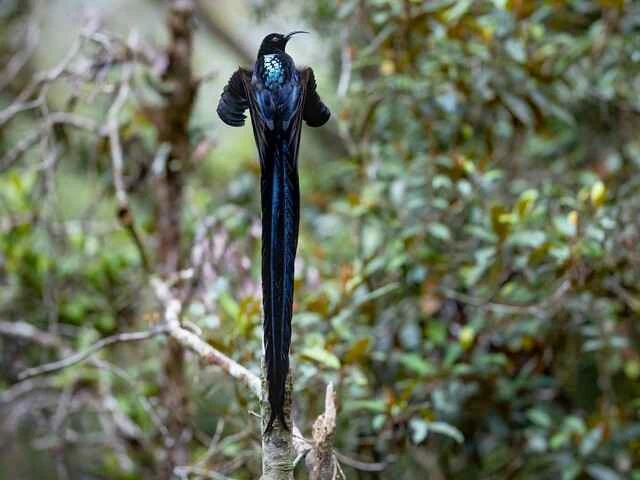
Hidden in the high-altitude forests of New Guinea, the Black Scythe-billed Bird (Epimachus fastosus), also known as the Black Scythe-billed Windbird, is an exceptionally unique bird of paradise. It is renowned not only for its magnificent plumage and exaggeratedly long tail but also for its extraordinary courtship dance. This article will take you on a journey to understand this mysterious and captivating bird, from its physical characteristics and ecological habits to its intriguing hybridization, unveiling its mysteries!
1. Species Overview: Large Members of the Bird of Paradise Family
The Black Sickle-billed Bird (Epimachus) is a member of the genus Epimachus in the family Paradisaeidae, and is one of the larger members of the family. It is mainly distributed in the Vogelkop region of central and northwestern New Guinea, inhabiting mountain forests at altitudes of 1,800 to 2,150 meters (5,900 to 7,100 feet). This habitat, far removed from human activity, has allowed the Black Sickle-billed Bird to maintain its mystique to this day.
Etymology Unveiled: The Story Behind the Name
The genus name "Epimachus" means "fully equipped and ready for battle," which vividly describes its unique appearance, especially its powerful call, which sounds like a machine gun.
The species name "fastosus" means "proud," vividly depicting the confident posture of the male bird during courtship.
Subspecies nomenclature:
atratus (meaning "black")
ultimus (meaning "last," possibly referring to it being the last subspecies of the species to be discovered)
stresemanni (in memory of the German naturalist Erwin Stresemann)
2. Appearance characteristics: Metallic luster beneath the black exterior
The Black Sickle-billed Bird is the second longest member of the bird-of-paradise family (after the Ribbon-tailed Bird-of-paradise). The male can reach a total length of 110 cm (43 inches), with its exaggeratedly long tail making up a large part of that. The female is smaller, with a body length of about 53 cm (21 inches).
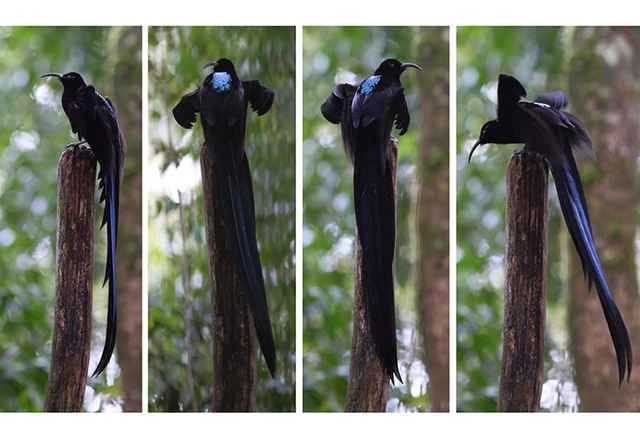
Male bird: A cool black warrior
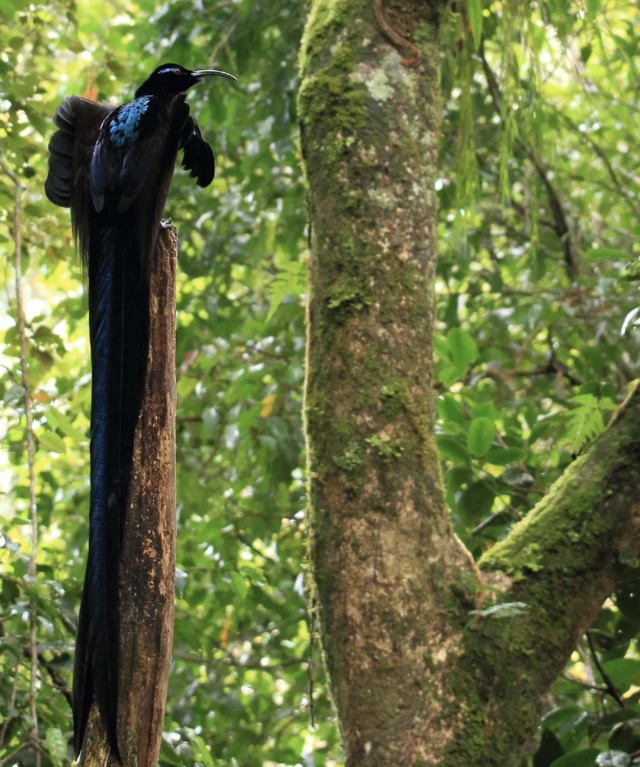
Head: Black feathers cover the entire head, the beak is silver and slightly curved, the mouth is bright yellow, the eyes are scarlet, and the area is surrounded by blue-green iridescent scale-like feathers.
Body: The back and wings are jet black with a metallic blue or greenish-blue sheen. The feathers on the abdomen are softer and silkier, with longer lateral feathers.
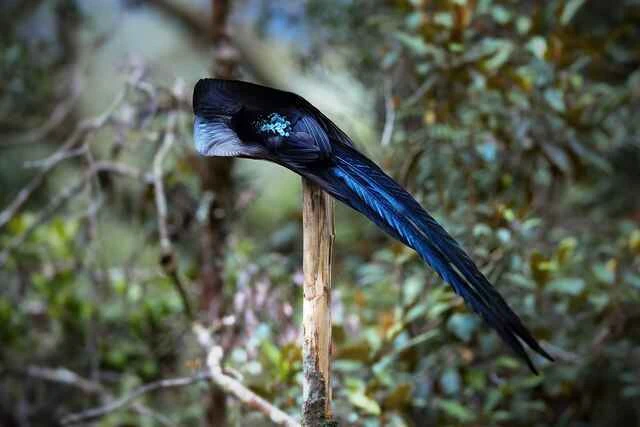
Chest fan: The most important adornment during courtship. The feathers are almost entirely black, but the tips of the feathers have a metallic blue-green sheen, forming a magnificent "comet" shape when unfolded.
Tail feathers: The tail is extremely long, with blue iridescence that shimmers in the sunlight.
Female bird: The unassuming guardian
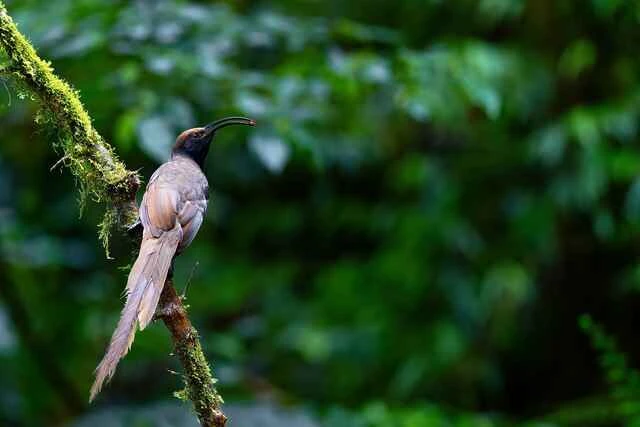
Compared to the male, the female's colors are more understated, primarily olive-brown with some orange hues on the upper body, and a creamy-white belly covered with black horizontal stripes. While her tail is still long, it is far less exaggerated than the male's. Furthermore, her eyes are brown, unlike the white eyes of the Brown Sickle-billed Finch.
3. A peculiar sound: Nature's machine gun.
The Black Sickle-billed Bird has a very distinctive call; its loud, deep "kwit-it kwit-it" sound can travel far through the forest. Its close relative, the Brown Sickle-billed Bird (Epimachus meyeri), has an even more peculiar call, making them unique among birds of paradise.
4. Courtship and Reproduction: A Magnificent Dance Feast
Courtship Showcase: Black Comet Makes its Appearance
The Black Sickle-billed Bird's courtship season is from September to October and from February to April each year. The male chooses a tall, upright branch as his stage and displays his charm. The courtship process is quite dramatic:
To attract a female bird: The male bird first uses a loud call to attract the female bird's attention.
Unfurling its magnificent breast fan: When the female approaches, the male raises its black breast fan with a blue-green sheen, forming a comet shape.
Flight performance: The male bird will suddenly take off vertically and slowly circle around the female bird, while rubbing its flight feathers to make a "slapping" sound, as if imitating the sound of a woodpecker tapping a tree trunk.
If the female is attracted, the two will mate. However, the male does not participate in raising the chicks; all the chick-raising work, including nest building, incubation, and feeding, is done by the female alone.
5. Hybridization: Mysterious "New Species"
The Black Sickle-billed Bird and the Alfaque Bird of Paradise (Astrapia nigra) interbred in the wild, producing two "offspring" that were once mistakenly identified as separate species:
Elliott Sickle-billed Bird (Epimachus ellioti)
Astrapius astrapioides
Although most ornithologists believe that these two "species" are actually hybrids, some still think that the Elliott Sickle-billed Bird may be a truly independent species. Furthermore, the Black Sickle-billed Bird has also hybridized with species such as the Long-tailed Bird of Paradise (Paradigalla carunculata) and the Bird of Paradise (Lophorina superba), demonstrating the complex evolutionary relationships within the bird of paradise family.
6. Ecology and Conservation: The Challenges
Diet: Omnivore
The Black Sickle-billed Bird is an omnivorous bird, with a diet consisting of fruits and insects in roughly equal proportions. They often forage alone, but occasionally join mixed foraging groups to search for food with other birds.
Preserve the status quo
The population of the Black Sickle-billed Bird is estimated to be between 2,000 and 10,000 individuals. Although it is still listed as "Least Concern" by the IUCN, its numbers are declining due to habitat destruction, deforestation, and human hunting. In particular, in some areas, Black Sickle-billed Birds are hunted for food or to collect their beautiful tail feathers.
Fortunately, the Black Sickle-billed Bird is listed in Appendix II of the Convention on International Trade in Endangered Species of Wild Fauna and Flora (CITES), which means that trade in it is subject to certain restrictions, which helps to protect the future of the species.
Conclusion: The Black Dancer in the Forest
The Black Sickle-billed Bird is not only a magnificent bird of paradise, but also a mysterious dancer in the rainforest. Its unique courtship rituals, distinctive calls, and legendary hybridization stories make it one of the most captivating members of the bird of paradise family. In the future, it is hoped that through further conservation efforts, this mysterious and beautiful bird can continue to dance gracefully in the forests of New Guinea!