A natural history museum in Argentina displays a dinosaur vertebra. It is 1.6 meters long and requires a forklift to lift, while a human vertebra could be lifted with just one hand.
1. Dinosaurs were the largest land animals.
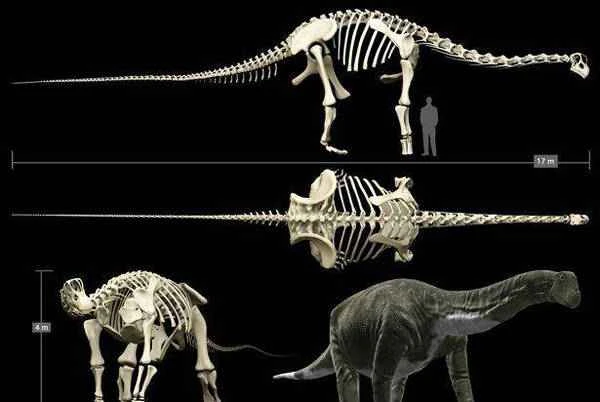
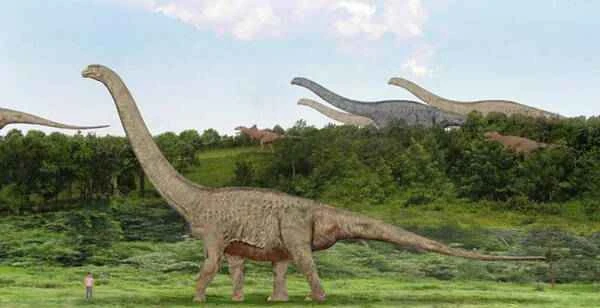
This vertebra belongs to Argentinosaurus. This dinosaur lived approximately 100 million years ago and, to our current knowledge, was the largest land animal ever known. During its lifetime, it could grow to approximately 35 meters long and weigh 80 tons.
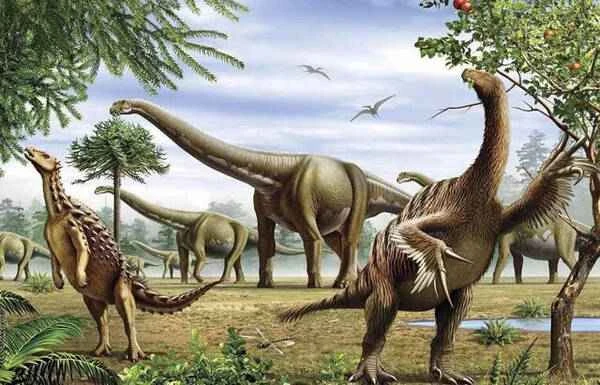
Argentinosaurus is a type of sauropod dinosaur, others including Diplodocus, Brachiosaurus, and Brontosaurus. Sauropods are easily recognizable by their long necks, long tails, barrel-shaped torsos, and thick legs. While not all sauropods were enormous, the large ones were indeed incredibly large.
No land animal has ever come close to the size of Argentinosaurus. The largest land animal living on Earth today is the African elephant, with males typically weighing up to 6 tons. The largest land mammal ever discovered was the giant rhinoceros, standing 6 meters tall and weighing 15 tons, living 30 million years ago. But none of these can compare to sauropod dinosaurs. Even among dinosaurs, sauropods are considered giants. An adult Tyrannosaurus Rex weighed only 7 tons, and the largest non-sauropod dinosaur ever unearthed is a hadrosaur, weighing 16 tons.
For a long time, the enormous size of sauropod dinosaurs has been a mystery to biologists. How could they grow so big? Why were there no other land animals before or after them that could reach their size? These questions have remained unanswered for a long time.
But now, a theory can finally provide a fairly satisfactory explanation for how they evolved.
2. Oviparous laying helped dinosaurs push their limits.
As early as the 19th century, British paleontologist Edward Copper noticed a phenomenon: animals of a species tend to become larger as they evolve. This was later known as Copper's rule.
From an evolutionary perspective, larger individuals are less vulnerable to predators and are more likely to defeat rivals in the search for food and mates. However, this also brings some disadvantages. Larger animals are more prone to extinction because they consume more food and reproduce more slowly than smaller animals, making them more likely to go extinct during times of food scarcity.
Therefore, on the one hand, natural selection encourages animals to grow larger and larger, but on the other hand, they ultimately have to pay a price for it. These two forces counterbalance each other, resulting in most terrestrial animals generally not exceeding 10 tons.
Their large size also presented other challenges. For example, how did they support such a massive weight? How did they get enough food and oxygen? How did they prevent overheating? Incredibly, sauropod dinosaurs overcame all these challenges.
What's going on here? In the 1990s, an American paleontologist proposed that a key factor was the reproductive method of sauropod dinosaurs. Like all dinosaurs, they were oviparous, while almost all mammals are viviparous.
We know that the larger a mammal is, the fewer offspring it lays, and the longer the intervals between pregnancies. However, because they are oviparous, large dinosaurs could lay clutches of eggs continuously, resulting in a vast number of offspring. Elephants give birth only once every four years; in the same amount of time, a large dinosaur could lay hundreds of eggs. As dinosaurs grew larger, their offspring numbers did not decrease. In this way, they avoided the risk of extinction that often plagues large animals due to their slow reproduction rates. And in the event of danger, their populations recovered much faster than those of large mammals.
Evidence of sauropod dinosaurs' prodigious reproductive capabilities comes from the remarkably detailed fossil record they left behind. Sauropods left behind numerous fossils of dinosaur eggs and nests. These eggs were typically only the size of ostrich eggs, and clutches could contain up to eight eggs; sometimes, even the embryos inside were completely preserved.
What impressed paleontologists most was the disproportionately large size of adult sauropod dinosaurs compared to the tiny size of their eggs! Typically, a large portion of an animal's energy is devoted to reproduction; however, a female sauropod dinosaur, weighing at least 5 tons, laid eggs weighing no more than 24 kilograms at a time, meaning she must have laid several clutches a year. Furthermore, evidence suggests that sauropod dinosaurs did not have the instinct to care for their eggs and young, a practice that further enhanced their reproductive capacity.
3. Dinosaurs breathed like birds.
But being oviparous and not needing parental care doesn't seem to be the whole story, because all dinosaurs were oviparous and rarely cared for their offspring, yet some were relatively small. So there may be other reasons why sauropod dinosaurs could grow so large.
To grow so large, dinosaurs had to grow rapidly within their limited lifespan. To understand the growth rate of dinosaurs, scientists examined bone sections under a microscope. Most dinosaur skeletons have growth lines, similar to tree rings, a characteristic of animals with slow metabolisms. However, sauropod dinosaurs lacked growth lines, similar to mammals and birds. This indicates that sauropod dinosaurs had a high metabolic rate, which allowed them to reach their size limit in a shorter time. For example, paleontologists' research on an Asian sauropod dinosaur weighing over 30 tons showed that this dinosaur grew 2 tons per year, while African elephants gain a maximum of 200 kilograms per year.
However, a rapid metabolism inevitably raises a series of questions, such as how to obtain enough oxygen and how to dissipate heat. How were these problems solved? Some scholars believe that the secret lies in the unique body structure of sauropod dinosaurs.
In 2003, an American scholar pointed out that sauropod dinosaurs possessed a respiratory system similar to that of birds. Birds breathe more efficiently than mammals because they have not only lungs but also air sacs. When they inhale, air simultaneously fills both their lungs and the air sacs in their body. During exhalation, although air flows out of the lungs, fresh air from the air sacs simultaneously enters the lungs (our lungs are empty during exhalation). Therefore, their lungs are always full of fresh air. It has been calculated that in a single breath, the capillaries in a bird's lungs can inhale 2.5 times more oxygen than a mammal with the same lung capacity. There is evidence that sauropod dinosaurs also possessed air sacs like birds.
This breathing method also helped support a massive body in several ways. First, it solved the problem of obtaining enough oxygen; second, the air sacs, located near the vertebrae in their bodies, acted like soft sponges, greatly reducing the pressure on the vertebrae; furthermore, to adapt to this breathing method, sauropod dinosaurs had many hollow air sac cavities within their vertebrae, which reduced the weight of the vertebrae; finally, this breathing method also facilitated heat dissipation through panting, thus solving the heat dissipation problem as well.
4. Tips for eating dinosaurs
The largest land animals on Earth today are all herbivores, surviving on large quantities of leaves and grasses with little nutritional value. This is because there are not enough highly nutritious foods like fruits and seeds on land to satisfy the appetites of such a large creature, while grasses, leaves, and branches are plentiful. This is likely true for those extinct megafauna.
However, relying on low-nutrient forage means that an animal needs to eat a lot. The ability to eat enough within a limited time to meet its body's needs is a crucial factor in determining an animal's size. An elephant needs to eat continuously for 18 hours a day, consuming approximately 200 kilograms of plants daily.
Large sauropod dinosaurs needed to eat about 1 ton of plants a day. How did they manage to do that? Paleontologists believe that their crane-like long necks and small heads are key to understanding this problem.
As mentioned earlier, the hollow vertebrae of sauropod dinosaurs made them relatively light, allowing for longer necks. This, in turn, broadened their feeding range. They could stand still, accomplishing everything by twisting their necks, while also minimizing energy expenditure.
Furthermore, when eating, they don't chew; instead, they use their teeth to gather leaves and twigs, stuffing their mouths full before swallowing them. This allows them to eat more food each day than they would spend chewing. It also means they don't need bulky molars and the corresponding muscles, reducing the weight of their heads and allowing their necks to stretch longer.
Nutrients obtained from a uncooked meal require a long fermentation process by microorganisms in the body before they can be absorbed. However, this raises a new problem: since flowering plants had not yet evolved during the time when sauropod dinosaurs ruled the earth, their diet was limited to relatively primitive gymnosperms such as fir, ginkgo, and pine. According to past views of animal nutritionists, this type of feed was particularly low in nutritional value. So how did sauropod dinosaurs survive on these plants?
To this end, in 2008 a German paleontologist extracted and cultured microorganisms from the digestive tract of sheep, then fed these microorganisms with primitive plants to simulate dinosaur digestion. The results showed that the nutritional value of these plants was far higher than previously thought. Given enough time, these primitive plants were digested and absorbed quite thoroughly. Therefore, it can be inferred that the food ingested by sauropod dinosaurs must have remained in their bodies for a very long time.
Through their unique advantages in reproduction, physiology, and lifestyle, sauropod dinosaurs overcame the unfavorable conditions that limited the growth of other terrestrial animals, growing into unprecedented behemoths. They survived for 145 million years until they went extinct 65 million years ago.