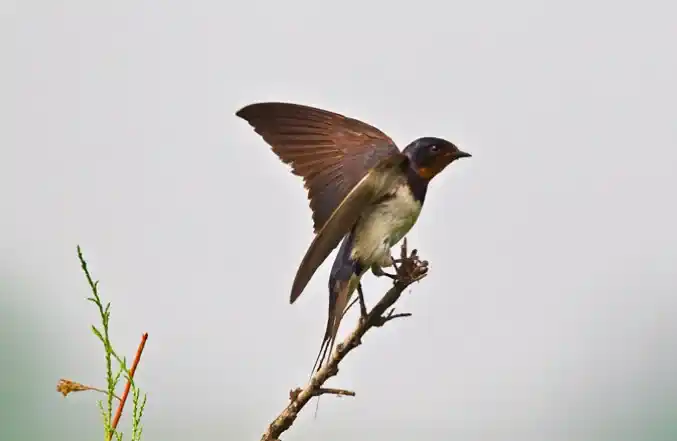
Swallows, belonging to the Hirundinidae family , are a group of birds typically adapted to flight, renowned for their elegant flight, unique nest-building methods, and migratory behavior . Swallows are widely distributed across most parts of the world, with a particular preference for open farmland, wetlands, and human settlements. This article will delve into the physiological characteristics, behavioral features, ecological adaptability, reproductive habits, and impacts on humans of swallows , providing an in-depth analysis of this fascinating bird species.
I. Physiological characteristics of swallows
1.1 Body structure and appearance
Swallows have slender bodies, typically ranging from 10 to 23 centimeters in length, with a wingspan of 30 to 35 centimeters . Their physique exhibits distinct flight adaptations.
Streamlined body : Reduces air resistance, making flight more efficient.
Long, narrow, and pointed wings : suitable for long-duration gliding and agile turns, increasing flight speed.
Forked tail (swallowtail): Increases flight stability and maneuverability, and helps catch insects in the air.
1.2 Feather characteristics
Swallows' feathers are generally black, dark blue, or brown with a metallic sheen, which helps them absorb sunlight and maintain body temperature.
The abdomen is often light-colored, such as white or pale yellow , creating a contrast between the upper and lower body colors, which helps with camouflage in the air.
1.3 Beak and Predation Adaptations
Swallows have short, wide beaks with large openings, ideal for catching insects in flight. Sensory feathers around their beaks help them detect tiny flying prey such as mosquitoes, flies, and moths.
1.4 Visual and perceptual abilities
Swallows have extremely keen eyesight , enabling them to accurately catch prey in the air while flying at high speeds. They also have a good sense of direction, ensuring they can accurately locate their destination during migration.
II. Behavioral Characteristics of Swallows
2.1 Excellent flight capabilities
Swallows are typical long-distance flying birds , and their flight methods include:
Rapid wing flapping during flight (when catching insects)
Gliding (energy-saving, commonly used for long-distance flights)
Sharp turns and rapid changes of direction (adapted for catching insects flying at high speeds)
When hunting, swallows can suddenly change direction in mid-air and even skim low over the water to drink, demonstrating extremely high flying skills.
2.2 Migration Behavior
Swallows are typical migratory birds , especially those in the Northern Hemisphere, which undertake large-scale migrations every year.
Spring migration : from the warm south (such as Africa and South America) back to the northern breeding grounds (such as Europe and northern Asia).
Autumn migration : After breeding in the summer, they migrate to warmer regions to avoid food shortages caused by cold weather.
Some swallows fly thousands of kilometers during their migration, relying on the Earth's magnetic field, the sun's position, and topographical landmarks for navigation.
2.3 Social Behavior of Swallows
Swallows are highly gregarious birds, usually living in family or small groups , especially during migration and nocturnal roosting, when thousands of swallows may gather in the same wetland or forest to spend the night.
III. Ecological Adaptability of Swallows
3.1 Diet and Ecological Functions
Swallows are insectivorous birds , and their diet mainly includes:
mosquito
fly
moth
beetle
flying insects such as bees
Ecological role : Since swallows mainly feed on insects, they play a biological control role in nature, helping to reduce the number of pests and maintain ecological balance.
3.2 Habitat Selection
Swallows mainly inhabit:
Open farmland and grassland (abundant foraging grounds for insects)
Near rivers and lakes (suitable for nesting and drinking).
Human settlements (eaves, bridges, etc. provide nesting sites)
Swallows can adapt to both urban and rural environments, and even form a symbiotic relationship with humans.
IV. Swallow's Reproductive Habits
4.1 Nest Building Methods
Swallows have a unique way of building nests. They often choose vertical surfaces such as building eaves, bridges, and rock walls , and use materials such as mud, grass stems, and feathers to build hemispherical nests .
Some species, such as the rock swift (Ptyonoprogne) , nest in caves or on cliff edges, while the barn swallow (Hirundo rustica) prefers to nest under human-made structures.
4.2 Reproductive Cycle
Swallows breed 1-2 times a year, and up to 3 times in warmer regions.
Each nest typically contains 4-6 eggs, with an incubation period of 14-16 days . The chicks will leave the nest after 20-25 days .
Swallow parents will feed their chicks until they can fly and forage independently.
4.3 Parental bird brooding behavior
Swallow parents feed their chicks insects hundreds of times a day to ensure the chicks get enough energy to grow quickly.
V. The Relationship Between Swallows and Humans
5.1 The symbolic meaning of swallows in culture
Swallows hold significant symbolic meaning in cultures around the world due to their image of loyalty, diligence, and good fortune .
In Chinese culture , swallows symbolize spring, happiness, and good fortune . The proverb "When the swallows come, it's the new year; when the pear blossoms fall, it's Qingming Festival" describes the scene of swallows returning in spring.
In European culture , swallows are seen as a symbol of freedom and family , and are associated with good fortune for sailors.
In Japanese culture , swallows symbolize family and safety and frequently appear in poetry and paintings.
5.2 The benefits of swallows to agriculture
Because swallows prey on a large number of pests, they are extremely beneficial to agriculture, helping to reduce the number of pests such as mosquitoes, flies, and aphids. Therefore, in many rural areas, people protect swallows and welcome them to build their nests.
5.3 The impact of the modern environment on swallows
Although swallows play an important role in the ecosystem, global environmental change and human activities are affecting their population size:
Climate change is affecting the migration and reproduction of swallows.
The use of pesticides has reduced the number of insects, thus decreasing the food source for swallows.
Urbanization has led to a reduction in nesting sites , resulting in a significant decline in the number of swallows in some areas.
Protecting swallows and their habitat helps maintain ecological balance and promotes harmonious coexistence between humans and nature.
VI. Conclusion: Swallows are highly valuable flying birds with significant ecological value.
Swallows, with their superior flying ability, migratory habits, nest-building wisdom, and ecological contributions, are among the most representative bird species. They play a vital role not only in controlling pests but also occupy an important place in human culture and the ecological environment. Through scientific research and environmental protection measures, we can better understand and protect these amazing fliers, allowing them to continue soaring freely in the skies in the future.