Hyraxes are a type of African hyrax mammal. They live in Africa, have a lifespan of 10 to 15 years, feed on leaves, and are viviparous. Hyraxes are a unique type of mammal; although they look like rodents, they are not. They are not related to animals like squirrels, but are closely related to manatees, elephants, and aardvarks. They actually belong to a separate group: the order Hyraxidae. According to this classification, they belong to the superorder African Hyraxidae, a group of animals native to Africa. If you would like to learn more about hyraxes, including their habitat, lifespan, diet, and reproduction, please continue reading this article.
Characteristics of the hyrax
The distinctive feature of the hyrax is that it has a pair of sharp teeth in its mouth, which are actually very long and thin incisors.
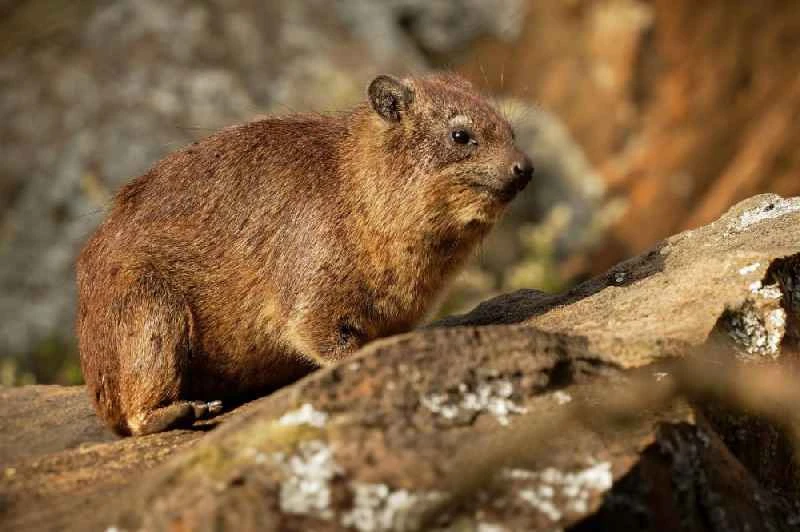
They have compact bodies and short necks and noses. Their body length ranges from 30 to 60 centimeters.
They have small, round ears and large, forward-facing eyes.
Despite being mammals, they have a weak ability to regulate their body temperature and cannot keep their bodies warm. Therefore, they can only lie in the sun to keep their metabolism running normally.
They have a sticky substance on the soles of their feet that helps them resist the heat, and some species can also use it to climb trees or rocks.
They are classified as semi-ungulates, meaning they are almost entirely ungulates. Agulates are characterized by walking on their toes, which are covered by hooves. For example, we can see elephants walking on their toes, but not like goats. Therefore, we cannot say that "ungulate elephants" exist. They are close relatives of hyraxes, which are plantigrade animals with flat, hoof-like nails on each toe.
To better understand hyraxes, let's review other similarities between Proboscidea and hyraxes. Proboscidea is the order Elephant, while Sirenia is the order Manatee. In all these groups, the testes are located near the kidneys. They also have axillary milk. But the most obvious similarity is that both elephants and hyraxes have tusk-like incisors. For all these reasons, these animals are classified as ungulates.
Other names for them include hyrax or hyrax, referring to the order Hyraxales, or Protohyraidae, the latter being a lower taxonomic level referring to Protohyraidae.
Habitat
Currently, there are only three genera of hyraxes, which vary depending on their preferred habitats. They are:
Rock hyrax (Procavia spp.): Lives on boulders and rocks. It is the largest and most common hyrax.
Tree hooves (Dendrohyrax spp.): They are characterized by living in trees, where they inhabit corners or burrows, especially in dry trees.
Grey hooves (Heterohyrax spp.): Also known as the blue hooves or bush hooves because they typically seek shelter. They are slightly smaller than rock hooves.
Geographically, hyraxes are mainly found in Africa (remember, they belong to the order Dicynodontia), and also in a small part of West Asia.
Hare's diet
They are primarily herbivorous. They mainly feed on plant leaves, but also eat fruits, tender branches, buds, or bark.
They possess strong, crowned molars similar to those of rhinoceroses, and have multi-cavity stomachs to maximize the digestion of food, particularly the large amounts of lignin found in plants. They also have a fully functional microbiome that helps them break down their food.
Hare behavior
They are very good at making sounds; some chirp and some bark.
They live in groups, usually around 100 individuals per group. We recommend you read this article about sociality: What is Sociality, Examples, and Characteristics.
They are shy around animals other than their own kind.
Depending on the species, hyraxes can be divided into diurnal and nocturnal.
Hare breeding
They are viviparous mammals, meaning the young are raised by the female. They have a very unique characteristic: the females have a double uterus, meaning the uterus is divided into two. This is a typical feature of primitive mammals. This is why seahorses have a long gestation period, up to 7 months. They give birth to an average of 3 offspring per litter, with a maximum of 8. They are born with their eyes open, ready to return to the wild.
Threats and Protection of Hare
Hyraxes are not currently in danger of extinction, but they do face certain threats, such as habitat loss. Habitat loss leads to community fragmentation, hinders reproduction, and increases genetic variability. Habitat loss also affects their habitat and food sources.
Interesting facts about hyraxes
As a unique species, the hyrax has many distinctive characteristics. They possess the body of a guinea pig, the incisors of a bat, the hind teeth of a rhinoceros, the body temperature of a reptile, and the stomach of a cow.
Their lifespan is 10 to 15 years.
While there are no hyraxes in Spain, there is a connection between the two. When the Phoenicians traveled to Spain, they saw hyraxes in Africa, but when they saw hares in Spain, they mistook them for the same animal. They named the place "I-span-ya," meaning "land of the hyrax."
They have a very long claw that they use to scratch their bodies.