What is a caribou or North American caribou?
Caribou (Rangifer tarandus) is an even-toed ungulate mammal belonging to the family Cervidae. In North America, wild populations are generally referred to as "Caribou," while in Eurasia, domesticated or semi-domesticated populations are called "Reno." Within its wide distribution area, several subspecies exist, differing significantly in size and coat color. Currently, four subspecies are found in Eurasia and five in North America.
Characteristics of reindeer
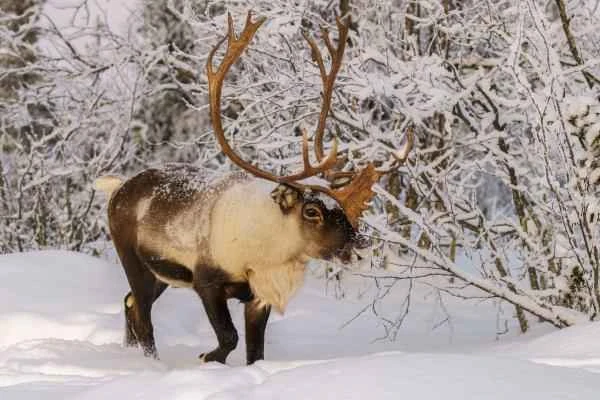
Size : Reindeer are large, with a stocky build and a short tail. Males typically weigh between 150 and 300 kilograms, while females weigh between 80 and 120 kilograms; their shoulder height can reach 120 centimeters.
Antlers : Both males and females have antlers, a rare phenomenon among deer. Male antlers are long and intricately branched (52–130 cm), while female antlers are shorter (23–50 cm).
Fur : Reindeer have thick, abundant fur that effectively protects them from extremely cold environments. Fur color ranges from dark brown to nearly white, depending on the region, sex, and season.
Hooves : Large hooves are suitable for walking in the snow and digging for food.
Types (subspecies) of reindeer

Eurasian mountain reindeer (R. t. tarandus): a domesticated species found in Scandinavia and Russia.
Tundra caribou (R. t. groenlandicus): Found in the North American Arctic and Greenland.
Forest caribou : Inhabits the forests of northern Canada and the northeastern United States.
Pearyi caribou : a small subspecies that lives in the Canadian Arctic archipelago.
Reindeer habitat
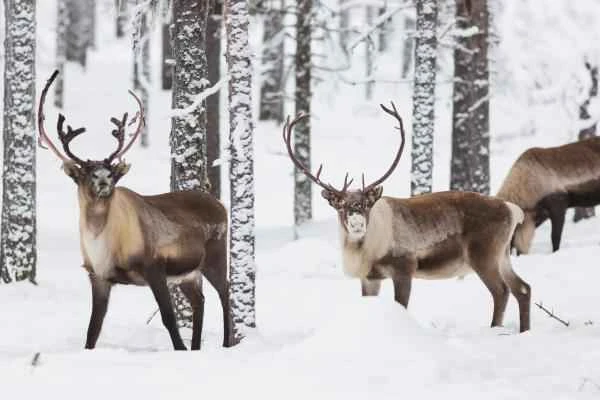
Reindeer are distributed in various ecological zones in the Northern Hemisphere:
Arctic tundra : From polar deserts to humid shrubland tundra;
Coastal plains : lowland herbaceous tundra in North America and Russia;
Treeline transition zone : The area where the tundra transitions to the subarctic forest;
High mountain area : the boundary between the mountain treeline and the alpine tundra;
Southwest coast of Greenland : Tundra zone separated by fjords and glaciers.
Reindeer diet
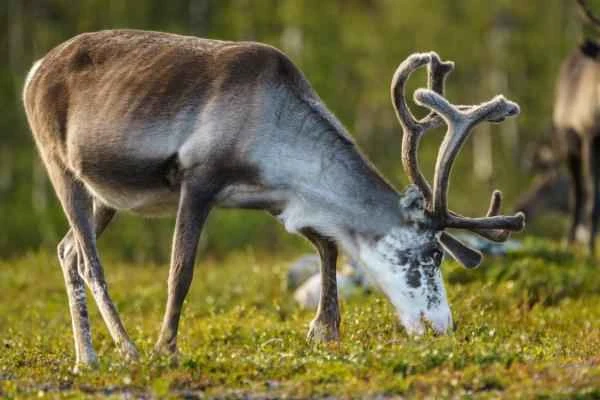
Reindeer are herbivorous ruminants whose main diet consists of willow and birch leaves, as well as moss and lichen. They consume an average of 5 kilograms of food per day. Depending on the season, they select the most nutritious plant parts, such as tender leaves and buds.
Reproduction
The mating season is in the fall, during which males fight for mates and form a harem of 5–15 females. The gestation period is approximately 230 days, with one calf typically born in the spring, though twins are occasionally born. Newborn fawns weigh 11–16 kg and are able to follow their mothers within two to three days of birth.
Threats and Protection
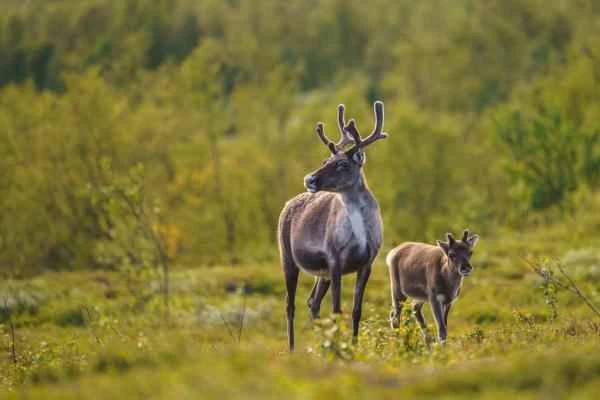
Caribou face multiple threats:
Habitat change : Forestry and infrastructure development destroy habitats;
Habitat fragmentation : Highways, power plants, tourism, etc., hinder migration;
Unregulated hunting : impacts tundra populations and competes with domesticated caribou for resources;
Climate change : alters plant growth, and the frequency of snow and ice formation.
According to the International Union for Conservation of Nature (IUCN), caribou are currently listed as a "vulnerable" species. Management measures have been implemented in various regions, including hunting regulation, the establishment of protected areas, and the promotion of adaptation strategies to address climate change.