The Great Auk (scientific name Pinguinus impennis) was an extinct seabird. It went extinct due to overhunting. They lived in the North Atlantic and fed on fish.
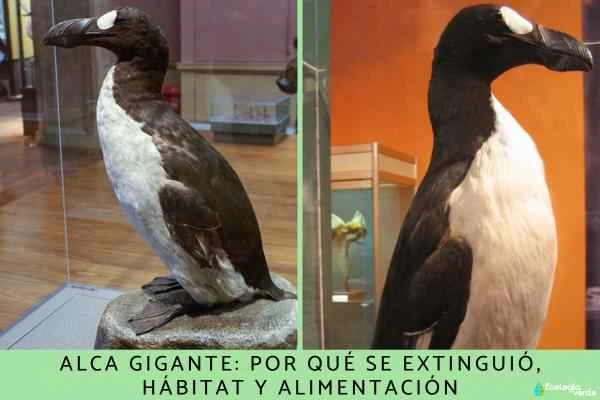
Auks resemble penguins, but differ in that they possess some flight ability (though very limited), are more capable walkers, and have larger beaks. However, the Great Auk is the only flightless species in the aukididae family, and flight is a very important characteristic of this species. If you would like to learn more about the reasons for the Great Auk's extinction, its habitat, diet, and other related information, we invite you to read this article.
Table of contents
Why did the Great Auk become extinct?
Great Auk's habitat
Great Auk's Diet
Morphological characteristics of the Great Auk
The relationship between the Great Auk and humans
1. Why did the Great Auk become extinct?
The Great Auk was an extinct seabird. Its extinction was primarily caused by overhunting. As early as the 17th and 18th centuries, the Great Auk, unable to fly, was easily captured by humans, not only for its meat and oil, but also for its feathers and large eggs. Furthermore, its feathers and bones were often collected as symbolic "trophies," further accelerating its population decline.
During the breeding season, great auks often nested on rocks to avoid the tides, but this resulted in extremely scarce suitable breeding grounds. The last major breeding ground sank to the sea in 1830 due to a volcanic eruption, and the remaining individuals migrated to nearby islands, but were all captured by humans in 1835. The last record appears in 1852, when the great auk was officially declared extinct.
2. Habitat of the Great Auk
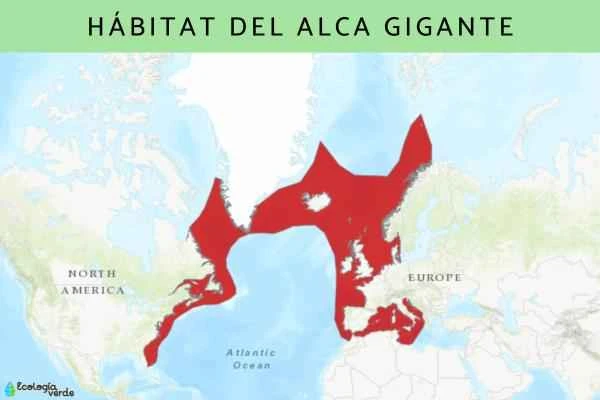
The Great Auk is a typical seabird, living along the North Atlantic coast, including Italy, Greenland, and the east coast of America, with its distribution extending as far south as Florida, Italy, and Spain. Its breeding grounds are concentrated in Canada, Greenland, the Faroe Islands, Iceland, Ireland, and the United Kingdom. During the winter, it migrates south to New England in the United States and southern Spain.
These birds are adept swimmers and divers, and can skillfully hunt for prey in the water. Unable to fly, they only walk and roost on land.
3. The diet of the Great Auk
Great auks are typical fish-eating birds. Adults primarily prey on fish about 20 cm long, with the most common prey being capelin (Mallotus villosus) and Atlantic herring (Brevoortia tyrannus). Juveniles and subadults mainly feed on plankton and fish brought back by the adults.
4. Morphological characteristics of the Great Auk
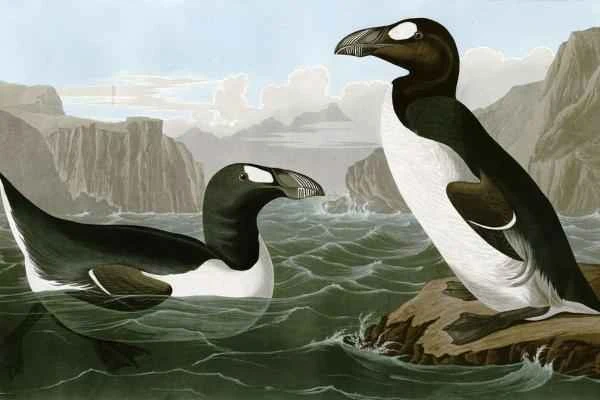
The feathers on its back are black, and its belly is white.
Its wings are too short to fly.
Able to stand on two legs
There is a white patch under each eye, and the iris is red.
The beak is large and curves downwards, with a straight lower jaw edge.
Streamlined body shape, suitable for swimming
Short and thick neck
Height 70-85 cm
The feet are webbed, which facilitates diving.
There is a black and white dividing band between the head and neck.
5. The relationship between the Great Auk and humans
The great auk has been of great significance to human society since ancient times. Early Neanderthals relied heavily on its meat and eggs for food, and its image has been depicted in cave paintings in Spain. Archaeological discoveries have also revealed that its bones and beaks were used as symbolic items or clothing materials.
Later, the great auk became a "navigational marker" for seafarers, its appearance indicating the approach of land. However, excessive human exploitation ultimately led to the extinction of the great auk, serving as a warning to cherish and rationally utilize existing natural resources to prevent history from repeating itself.
Conclusion
This article has taught you about the reasons for the Great Auk's extinction, its distribution, diet, morphology, and its relationship with humans. If you are interested in the stories of other extinct bird species (such as the Dodo), you are welcome to continue reading related popular science articles.