"Dolphin" is not a single species, but a collective term for a large group of toothed whales (Odontoceti). We can see them in the vast oceans as well as in the murky, narrow tropical rivers where they are often referred to as "freshwater dolphins/finless porpoises." They are famous for their intelligence, sociality, and playfulness ; but from an ecological perspective, dolphins are even more impressive for their adaptation to their environment:
They navigate and hunt using echolocation (sonar) in rivers with very poor visibility.
In the sea, teamwork can be used to hunt schools of fish.
Body size, snout length, and flipper shape all vary significantly depending on habitat.
If you want to quickly understand "what types of dolphins there are," the clearest way is to categorize them by **family**. This article, following the structure of your original text, introduces 5 main categories:
The text describes the following families : Iniidae (Amazon River Dolphins), Delphinidae (Marine Dolphins), Platanistidae (Ganges-Indus River Dolphins), Pontoporiidae (La Plata Dolphins), and Lipotidae (Yangtze River Dolphins) , with more detailed explanations of representative species.
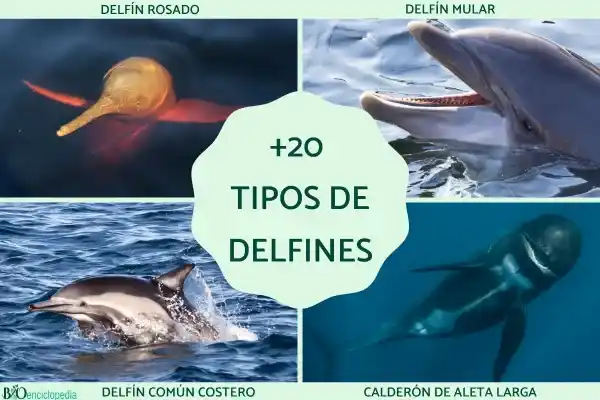
Understand in one minute: The difference between pufferfish and marine dolphins
Freshwater pufferfish (river type)
Common features: longer snout, more agile body, wider pectoral fins
Reasons for adaptation: meandering river channels, numerous tree roots/obstacles, and turbid water.
Hunting methods: relying more on echolocation and close-range maneuvering
Ocean dolphins (outer/inshore type)
Common features: more streamlined body, faster speed, more prominent dorsal fin
Reasons for adaptation: Requires long-distance patrols and chasing fast-moving schools of fish
Hunting methods: Common methods include cooperative hunting , driving schools of fish, and taking turns feeding.
Family 1: Iniidae (Amazonian Dolphinidae | Typical "pufferfish")
Iniidae are often called " Amazonian dolphins (boto) ". They live in the large freshwater systems of South America and are best at navigating narrow, murky, and obstructed river channels and rainforests flooded during the rainy season.
Typical adaptations include:
The pectoral fins are wide , acting like "rudders" to facilitate sharp turns.
The neck is relatively flexible : it can change direction better between roots and branches.
A longer snout makes it easier to "find" prey in complex waters.
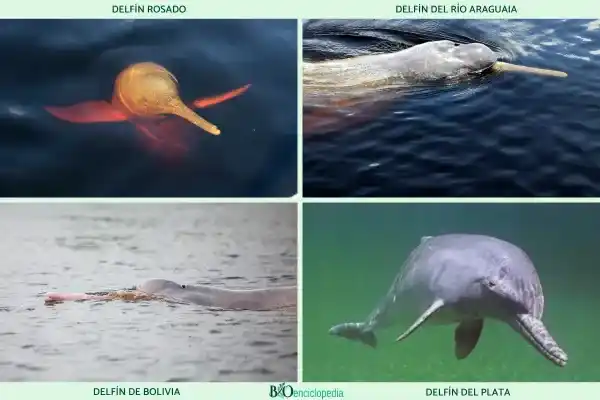
1) Pink River Pufferfish / Amazon River Pufferfish ( Inia geoffrensis )
Distribution : Freshwater systems represented by the Amazon and Orinoco basins
Identification features : Adult individuals often have a pinkish tinge (more pronounced in males); they are sturdy, agile, and have a long snout.
Diet : Primarily feeds on fish, but also preys on other small aquatic animals.
Highlights : Unlike many ocean dolphins that love to "chase boats and surf," it quietly surfaces its back, takes short breaths, and then dives back down.
2) Araguaia River Dolphin ( Inia araguaiaensis )
Distribution : Araguaia–Tocantins basin, Brazil
Habitat : Slow-flowing river sections, lakes, and rainforests flooded during the rainy season
Characteristics : The back is often described by a "dorsal ridge/spinal spine" structure; the snout is long; it primarily preys on fish.
Key behavioral points : He is more "cautious" in personality, and his vocalizations and communication with his mother are often described as more complex.
3) Bolivian river dolphin (commonly spelled Inia boliviensis , and often considered a subspecies of Inia geoffrensis )
Distribution : Bolivia, upper reaches of the Upper Madeira River system, etc.
Distinguishing features : Skin often has a grayish-pink or pinkish-gray hue; muzzle is relatively long.
Why are they difficult to spot ? Because the water is turbid, the waves are small, the buoyancy is not obvious, and the behavior is rather covert.
Diet : Primarily fish (commonly bottom-dwelling or riverine fish).
Note: In your original text, you also mentioned the "La Plata dolphin" in Iniidae, but more information would place it separately in Pontoporiidae (see below) because it is more like a "coastal/estuary type" rather than a typical river dolphin.
Family 2: Delphinidae (Dolphinidae family | The dolphins we are most familiar with)
Delphinidae is the most common dolphin family: they generally have a more streamlined body, adapted for high-speed swimming, and many members live in large groups , using echolocation and formation hunting. Their diet typically consists of fish and squid , while larger members can also prey on seals, seabirds, and even other whales.
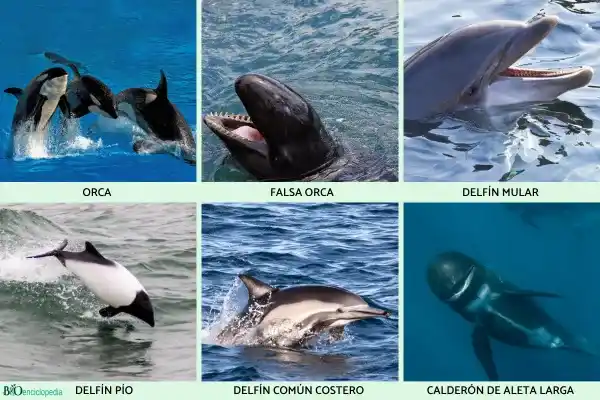
4) Killer whale ( Orcinus orca )
Key fact : Orcas are actually the largest dolphins in the world (many people mistakenly believe they are "whales" rather than "dolphins").
Distribution : Found in oceans worldwide, from polar regions to tropical zones, but often prefers highly productive waters.
Identifying features : strong black and white contrast + exceptionally high dorsal fin (more pronounced in adult males).
Diet : Top predators; different groups specialize in fish, seals, seabirds, and even large whales.
Highlights : Orcas have a "group culture," with vastly different hunting habits among different groups.
5) False killer whale/Black killer whale ( Pseudorca crassidens )
Distribution : Found in tropical and subtropical seas worldwide, mostly in offshore areas.
Distinguishing features : Dark gray to black, slender body, curved dorsal fin
Diet : Fish and squid
Key behavioral characteristics : Highly social, often engages in group activities, and has strong group bonds.
6) Bottlenose dolphin ( Tursiops truncatus )
Distribution : Found in temperate to tropical waters worldwide, with both nearshore and offshore populations.
Distinguishing features : Stout body, gray color, short and rounded "bottlenose" snout
Diet : Fish, squid
Highlights of its intelligence : It possesses strong learning capabilities and rich vocal communication abilities; in some areas, it even exhibits "cooperative hunting" and utilizes its environment for more efficient feeding.
7) Commerson Dolphin ( Cephalorhynchus commersonii )
Distribution : Often described as two separate regions: the southern coast of South America (such as near Tierra del Fuego) and near some islands in the Indian Ocean.
Identification features : High contrast between black and white blocks, relatively small size.
Habitat : Cold, shallow coastal waters
Behavioral highlights : Active and energetic, often near boats, giving the impression of being "very playful".
8) Common coastal dolphin (commonly spelled Delphinus capensis )
Distribution : Mostly found in temperate and tropical coastal waters (the original text mentions the Atlantic Ocean and the eastern Pacific Ocean, etc.)
Distinguishing features : Long, slender body with a long snout; distinctive hourglass/bell-shaped color bands along the sides of the body.
Key behavioral characteristics : Large groups, strong coordination, high speed, commonly seen in "wave chasing, surfing, and riding the first wave of a boat".
9) Longfin pilot whale ( Globicephala melas )
Distribution : North Atlantic and some temperate to subarctic seas in the Southern Hemisphere
Distinguishing features : rounded head, robust body, dark plumage, and curved dorsal fin.
Body length : can reach approximately 6 meters.
Diet : Primarily feeds on cephalopods such as squid.
Key behavioral characteristics : The group has very close-knit relationships, with a clear family-like community.
Other common examples of marine dolphins (listed in the original text):
Short-finned pilot whales, pygmy killer whales, Irrawaddy dolphins (bay/estuary type dolphins), long-beaked spinner dolphins, oceanic common dolphins, Pacific white-sided dolphins, Chilean dolphins, etc.
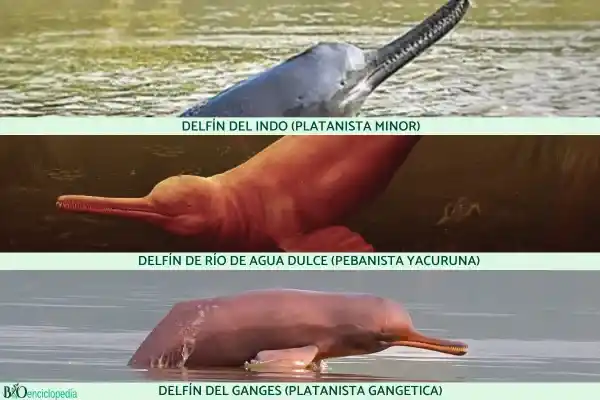
Family 3: Platanistidae (South Asian river dolphins | "blind river dolphins" of the Ganges and Indus rivers)
This type of pufferfish lives in large river systems in South Asia, where the water is turbid year-round and visibility is extremely poor. Therefore, they are widely described as having very weak or almost non-functional eyesight and relying heavily on echolocation.
Typical characteristics:
Its long, pointed snout , covered in many teeth, makes it well-suited for catching fish and shrimp in waterways.
They enjoy activities in deep channels, backwaters, and river bends.
10) Indus River Pufferfish ( Platanista minor )
Distribution : Centered around the Indus River in Pakistan
Body length : Approximately 2.5 meters
Behavioral highlights : They are often seen in small groups, frequently active in deeper waters, and their surfacing for air is not obvious.
11) Ganges River dolphin ( Platanista gangetica )
Distribution : Ganges-Brahmaputra river system and other river systems
Aliases : In some regions, it is also called shushuk / susu (various spellings exist).
Highlights : A typical "sonar hunter," creating "maps" in unseen rivers using sound.
12) Pebanista ( Pebanista yacuruna , an extinct freshwater dolphin)
Nature : An extinct river dolphin that lived in prehistoric waterways (similar to the "Ancient Amazon"), estimated to have reached a length of 3–3.5 meters.
Significance : This reminds us that pufferfish have evolved to include larger and more diverse forms throughout their evolutionary history.
Family 4: Pontoporiidae (L'Aplata family | Estuarine-coastal type "pufferfish relatives")
Some articles refer to it as a "pufferfish," but it is more accurately described as a small, specialized cetacean that lives in shallow coastal and estuarine waters near the east coast of South America and is highly sensitive to fishing activities.
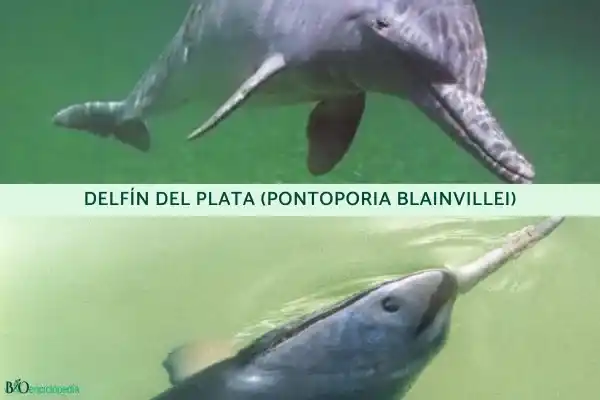
13) River Plata dolphin/Franciscan dolphin ( Pontoporia blainvillei )
Distribution : Shallow seas and estuaries along the eastern coast of South America, including the La Plata estuary and the coasts of Brazil, Uruguay, and Argentina.
Distinguishing features : slender snout, grayish body color, not very conspicuous on the sea surface.
Habitat depth : Usually active in shallow waters near the shore (the original text mentions a depth of 30–50 meters).
Diet : Fish, octopus, squid, shrimp, and other crustaceans
Reproduction/Social : Often described as "continuous monogamy/sequential monogamy," meaning that while they may change partners in different breeding seasons, they maintain a stable pairing at a certain stage.
Family 5: Lipotidae (Yangtze River dolphin)
The most famous, and also the most regrettable, member of this family is:
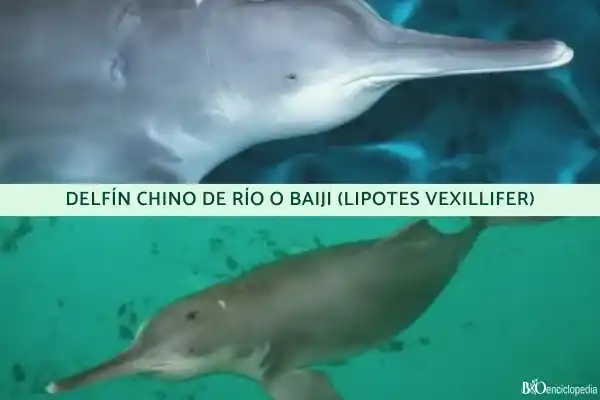
Baiji dolphin ( Lipotes vexillifer , generally considered functionally extinct)
Historical distribution : Yangtze River system, China
Characteristics : long snout, conical teeth, low dorsal fin; relies on echolocation in turbid river water.
Community : Daytime activities, in small groups
Diet : Primarily fish
Current situation highlights : Due to the combined effects of shipping, industrialization, habitat change and fisheries pressure, it was widely considered to be "functionally extinct" in the early 21st century (meaning that even if very few individuals may exist, it is difficult to form a sustainable breeding population).
Finally: How can you quickly understand dolphin types "by scenario"?
Tropical rivers, rain-soaked forests : more likely an Iniidae (pink river dolphin).
The Ganges/Indus River, being a turbid river , is more likely to be inhabited by Platanistidae (Ganges River dolphin, Indus River dolphin).
South American estuaries + nearshore shallow waters : Focus on Pontoporiidae (La Plata dolphin).
Significant group activities are observed in the ocean, offshore, and coastal areas : mostly by Delphinidae (bottlenose dolphins, common dolphins, killer whales, pilot whales, etc.).
Historical background of the Yangtze River : Lipotidae (Baiji dolphin)