Cephalopods are a group of mollusks that live entirely in the ocean, distributed throughout the world's oceans, with a particular preference for warm and temperate waters. They possess highly developed brains and flexible tentacles that encircle their mouths, aiding them in swimming and hunting. Octopuses and squids are the most well-known representatives of this group, renowned for their high intelligence and complex behaviors.
This article will take you on an in-depth journey through the definition, main characteristics, common species, habitats, dietary habits, and reproductive methods of cephalopods.
What are cephalopods?
Cephalopods belong to the phylum Mollusca and are members of the class Cephalopoda. Their name comes from the Greek words "kephalē" (head) and "pous" (foot), meaning "the fusion of head and foot." This class is closely related to snails (Gastropoda) and bivalves (such as clams), among other mollusks.
Despite their similar origins, cephalopods are far more intelligent than other mollusks. They possess a number of neurons comparable to those of canines and some primates, with the majority of these neurons located in their tentacles rather than solely in the brain.
Main characteristics of cephalopods
Complex body structure : It has two eyes, a soft membrane covering its body (capsule), a water jet (siphon), and 8 to 10 tentacles (some nautilus species can have up to 90).
Evolution of shells : Octopuses have completely lost their shells, while squid and cuttlefish have retained their internal structures, and nautiluses have a distinct shell.
The tentacles are retractable, used to capture prey, and covered with suction cups to aid in gripping.
Highly developed eyesight : Cephalopods have complex eye structures, similar to human eyes, with an iris, pupil, and lens. Research suggests they may possess the ability to distinguish colors.
Jet propulsion : high-speed movement is achieved by siphoning water jets; some octopuses also use their tentacles to crawl on the seabed.
Color-changing camouflage : Possesses pigment cells (pigment cells) and regulatory muscles, enabling it to rapidly change skin color and texture to adapt to the environment.
Ink defense : Except for nautiluses and some octopuses, cephalopods can spray ink to create a smoke screen, confuse predators, and escape.
Representative species of cephalopods
1. Octopodiformes
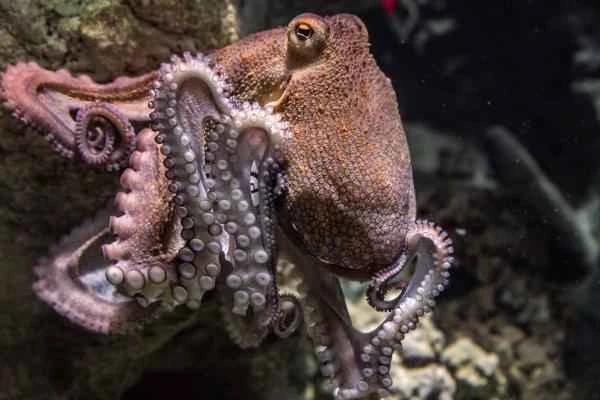
The octopus is a representative species, possessing eight shell-less tentacles and a flexible body capable of squeezing into crevices in rocks. The inner sides of the tentacles are covered with suckers, allowing them to both walk and grasp objects. Octopuses are highly intelligent and exhibit complex behaviors.
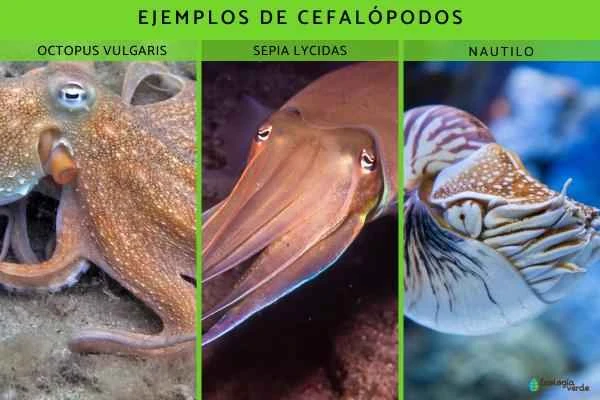
Representative species : Common octopus ( Octopus vulgaris ), Two-spotted octopus ( Octopus bimaculoides ), Giant octopus ( Enteroctopus dofleini )
2. Decapodiformes
Including squid and cuttlefish, they have five pairs of tentacles, one pair of which are specialized long tentacles used for hunting. Cuttlefish have an internal shell to regulate buoyancy.
Cuttlefish : They have broad, flat bodies and live on sandy or rocky bottoms, generally at depths not exceeding 250 meters. Representative species include the sea fan cuttlefish ( Sepiadarium auritum ), the glossy cuttlefish ( Sepia lycidas ), and the European cuttlefish ( Sepia officinalis ).
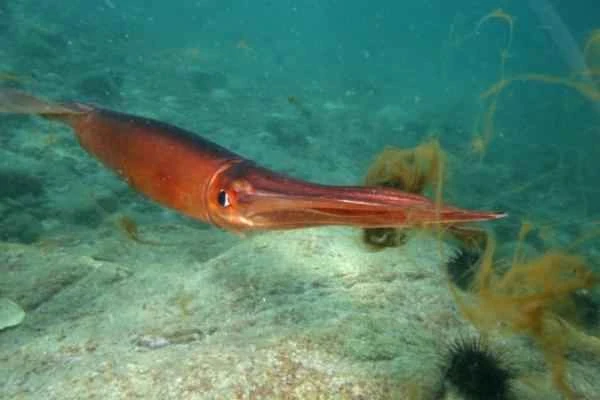
Squid : Slender in shape with a pen-like internal skeletal structure, they can dive to depths of 3,000 meters. Representative species include the common squid ( Loligo vulgaris ), the Pere squid ( Doryteuthis pealeii ), and the giant squid ( Dosidicus gigas ).
3. Nautiloidea
The only cephalopod to retain an exoskeleton, which is divided into multiple air chambers to regulate buoyancy. The body occupies only the last chamber, surrounded by 60 to 90 tentacles.
Habitat of cephalopods
Cephalopods are found in oceans all over the world and live in diverse environments:
Nearshore bottom : such as European squid, inhabiting sandy or rocky bottoms.
Deep-sea open waters : such as some squid species.
Coastal saltwater lakes : for example, the blue-ringed octopus.
Dietary habits of cephalopods
Cephalopods are all carnivorous, possessing a hard, scissor-like beak and a tongue-like structure (radula) covered with fine teeth, used to tear prey.
Those who enjoy eating include:
Crustaceans
worm
Other mollusks
The suckers on the squid's tentacles have hook-shaped ends, enhancing their ability to catch prey.
Cephalopod reproductive methods
The male transfers a spermatophore containing a seminal vesicle to the female using specialized tentacles. Most cephalopods lay their eggs on rocks or the bottom of shells, and the octopus cares for the eggs until they hatch.
The larvae do not have a distinct larval stage, and some larvae have different morphologies from the adults, which once led scientists to mistakenly believe they were different species.
References
Alexander L. Stubbs, Christopher W. Stubbs. Identifying the spectrum of colorblind animals by color difference and pupil shape. (2016). Accessible: https://doi.org/10.1073/pnas.1524578113
Hall, D. (sf). Cephalopod. Smosenian Ocean. Accessible at: https://ocean.si.edu/ocean-life/invertebrates/cephalopods
Jann Vendetti, UCMP. (2006). Crown-rotophytes: Mollusks. Cephalopods. Squid, octopus, nautilus, and ammonite. Accessible at: https://ucmp.berkeley.edu/taxa/inverts/mollusca/cephalopod.php