"Antelope" is not a strictly defined taxonomic term, but rather a general collective name used to encompass a variety of similar-looking, ungulates (mostly belonging to the Bovidae family). Generally, antelopes are herbivorous , and many species are gregarious . Furthermore, many males possess permanent antlers —composed of a bony core and sheath—which typically do not branch and do not shed annually like deer antlers.
To better understand the different types of antelopes, they are often classified by subfamily . Below, we will introduce the eight most common subfamilies (or groups closely related to antelopes) and provide typical examples to help you build a complete framework for antelope classification.
What common characteristics do antelopes share?
Hoofed and herbivorous: They mainly feed on grass, leaves, tender branches, and herbaceous plants.
Skilled at escaping: They often have long limbs, a nimble physique, and outstanding speed or endurance.
Antlers are mostly permanent: they usually do not branch and do not fall off seasonally (unlike deer antlers).
Commonly social animals: Antelopes in open areas rely more on forming groups to increase their vigilance and chances of survival.
Exceptions exist: forest-type antelopes (such as some duikers) may be more timid and secretive, and not very gregarious.
Subfamily Antilopinae (“typical antelope/true antelope” group)
This subfamily is often thought to contain the most classic "antelope appearance": relatively light body, slender legs, adapted to open environments, and strong running and turning abilities.
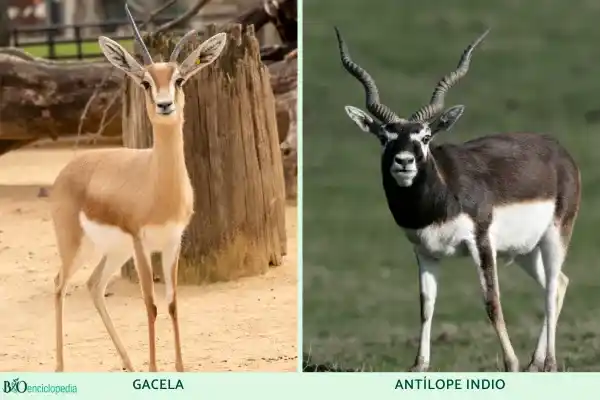
Gazella ( Gazella spp.)
Gazelles are renowned for their speed and agility , with short sprint speeds often described as approaching 100 km/h . They are mostly small antelopes , with many species not exceeding 1 meter in length. Their distribution is primarily in parts of Africa and Asia (such as Turkey, Pakistan, and Israel). Different gazelle species are often strongly correlated with specific geographical regions and habitat types.
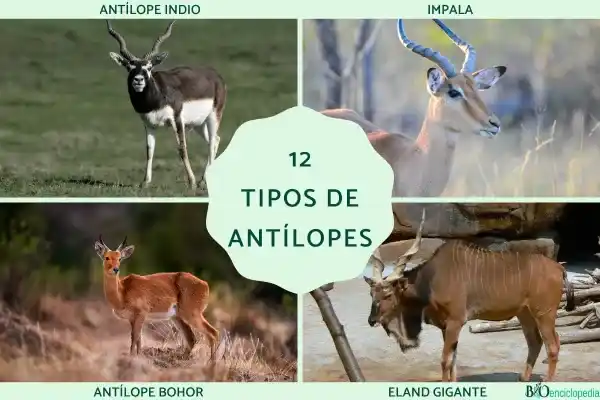
Indian antelope/blackbuck ( Antilope cervicapra )
Indian antelopes are medium-sized, with the most striking feature being the spiral-shaped "bottle opener" horns on the males. Their facial coloration is also quite contrasting: the area around their eyes and chin is whiter, while the rest of their face is darker or browner, creating a unique "mask-like" appearance.
Subfamily Aepycerotinae (Impala: extant representatives are relatively concentrated)
This group is highly representative among extant animals, characterized by its long horns , strong jumping ability, and frequent fighting behavior among males.
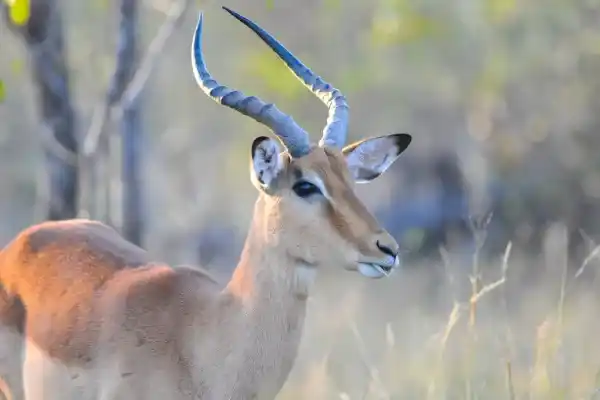
Impala ( Aepyceros melampus , Impala)
Impala are medium-sized animals with light brown limbs, a reddish-brown back, dark stripes on their hind legs, and mostly black horns. The male's horns are particularly prominent, often described as reaching up to 90 centimeters in length , and curved like "hooks," which helps the male to push or subdue opponents during territorial disputes or breeding seasons.
Body length: Commonly around 130 cm
Uses of horns: male fighting, dominance competition, and territorial defense.
Subfamily Caprinae (Goats and closely related groups: including "antelope-goat type" animals)
Caprinae includes groups of goats and sheep, as well as some animals known as "goat-antelopes." They are often adapted to mountainous or high-altitude environments, and their horns differ from those of typical sheep and goats: some have longer, thinner horns that are more advantageous for movement in specific environments.
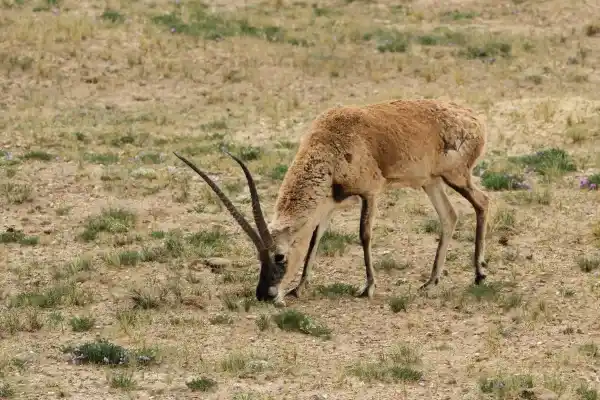
Tibetan antelope ( Pantholops hodgsonii )
The Tibetan antelope lives on the Qinghai-Tibet Plateau and is a typical high-altitude adapted animal, able to survive at an altitude of approximately 5,000 meters . It is medium-sized with exceptionally long legs, giving it a tall and slender appearance. Its body is relatively compact, and its fur has a woolly texture, which helps it withstand the cold and strong winds of the high altitude. Its horns are often described as reaching approximately 60 centimeters in length, making them remarkably prominent relative to its body proportions.
Subfamily Reduncinae (watery and near-water steppe antelope)
This group is often associated with environments near water sources such as rivers, lakes, wetlands, and floodplains . They require both water and waterside grasslands as their primary foraging grounds.
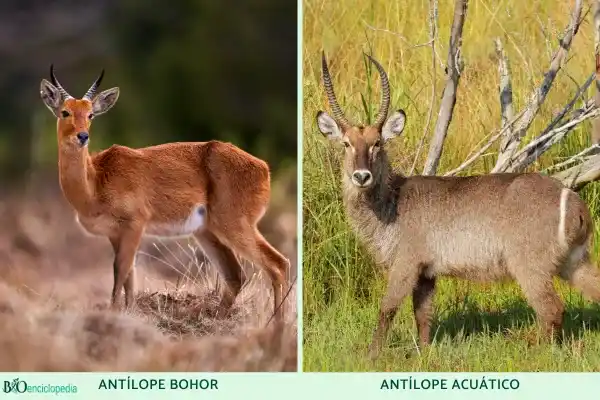
Redunca redunca
They mainly live in Central Africa and other regions, and their horns are relatively small, often described as being in the range of about 30 centimeters . Their fur is mostly between brown and reddish-brown.
Waterbuck ( Kobus ellipsiprymnus )
Waterbuck are large antelopes, typically described as ranging from 1.7 to 2.3 meters in length. Their horns often have a spiral pattern . Waterbuck are highly dependent on water sources, often staying near rivers and lakes, and may even spend most of the day near water to lower their body temperature and reduce predation risk by taking advantage of the fact that their predators don't like to go into the water. However, they still need surrounding grasslands to forage.
Hippotraginae (large herbivorous antelopes: a tall group resembling horses)
This group consists mostly of herding antelopes that primarily feed on grass . They have very long legs, well-developed muscles, and their overall appearance is often described as "tall and strong like a horse."
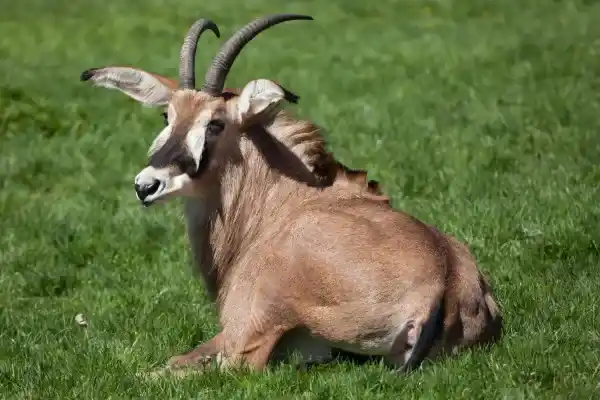
Roan Antelope ( Hippotragus equinus )
"Ruano" is often used to describe a mixed-color coat: a combination of white fur mixed with brown or black fur. In antelope, it is mostly a brownish Ruano color. The face has a distinct dark "mask," and the ears are long and prominent, often drooping forward. Females in this group may also have horns , but they are usually shorter than those of the males.
Subfamily Alcelaphinae (cattle-like antelopes: both males and females have horns)
Many members of this group have horns, both male and female, and have relatively long and thin heads and faces. Their overall outline, from certain angles, is reminiscent of cattle.
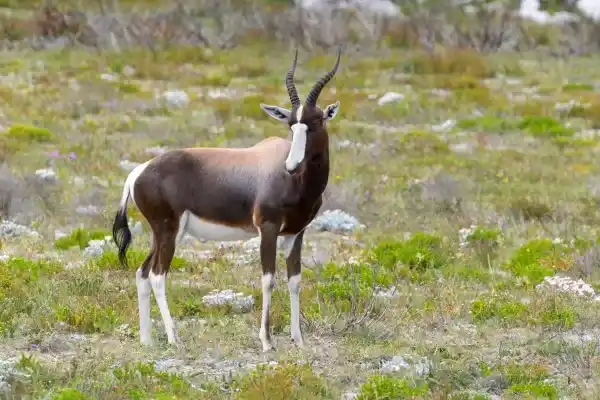
Bontebok ( Damaliscus pygargus , Bontebok)
The Bontbok is a medium-sized animal, typically described as measuring 1.2–2.1 meters in length. Its most distinctive feature is a prominent white mask on its face, which contrasts sharply with its dark brown body; it also often has a striking white area on its rump.
Subfamily Cephalopheinae (duiker: African forest antelope)
Cephalophinae are mainly distributed in sub-Saharan Africa and include several species of forest antelope known as "duikers." They are generally timid and secretive , preferring to live in forests or scrublands. They have small horns and are not typically as social as prairie antelopes . Due to their elusive behavior, human understanding of some of these species is relatively limited.
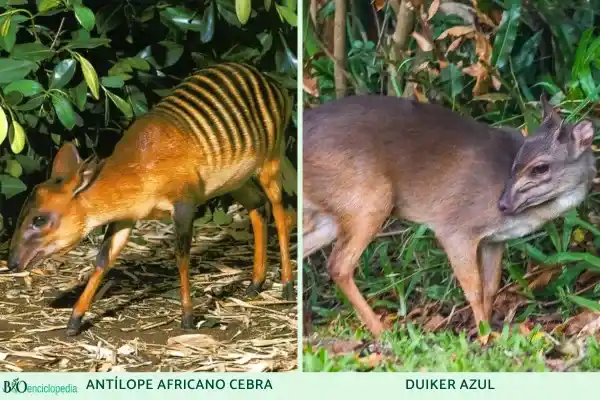
zebra antelope ( Cephalophus zebra )
This species has a distinctive black stripe on the posterior half of its back, covering a coppery-red or reddish-brown undercoat. It is relatively small, often described as being about 90 cm in length; its horns are short, about 5 cm , and both males and females may have horns. Its distribution is narrow (described in the text as a narrow area from Sierra Leone to Liberia). Due to various stressors, it is often assessed as facing a high risk.
Blue Duiker ( Philantomba monticola )
The blue antelope is one of the smallest antelopes, standing about 30 centimeters tall at the shoulder, with short horns of about 5 centimeters . Its fur is grayish, allowing it to blend well into the shady understory environment.
Subfamily Bovinae (the "antelope-type bovidae" within the Bovininae subfamily: including the largest antelope representative)
Bovinae (subfamily Bovinae) includes domestic cattle, bison, etc., but many members of the tribe Tragelaphini resemble "antelopes" in appearance and lifestyle. They are generally more robust and have relatively longer necks, and are often considered to encompass the largest antelope types in the world .
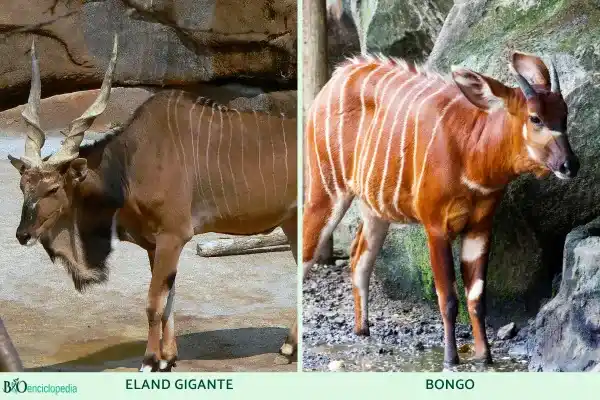
Giant Eland ( Taurotragus derbianus )
The giant eland is often described as the largest antelope , averaging about 2.9 meters in length. Its body is mostly brown with fine, light white stripes. It is native to parts of West and Central Africa . Females may also have horns, which are often spiral-shaped and form a V-shape; large dewlaps are commonly found under the neck (similar to some bovids).
Bongo ( Tragelaphus eurycerus , Bongo)
The Bongo antelope also has a brown base coat with white stripes, but the stripes are thicker and clearer . Its horns are also V-shaped, but usually lack the pronounced spiral twist of the giant antelope. A dark "mask" is commonly seen on its face, and it generally lacks prominent large dewlaps. It lives in the dense forests of Central Africa , relying on vegetation for cover to avoid predators. Its body length is often described as about 2.1 meters , with some individuals exceeding this.
A quick overview of antelope types (for easy memorization by group)
Antilopinae: Typical steppe antelope, fast (gazelle, Indian antelope)
Aepycerotinae: Impala (existing representative group)
Caprinae: High-altitude/mountain adapted type (Tibetan antelope)
Reduncinae: Waterbuck, steppe antelope (reedbuck, waterbuck)
Hippotraginae: Tall and strong herding antelope (horse antelope)
Alcelaphinae: A type of ox-like antelope, both males and females often have horns (Bondbok antelope).
Cephalophinae: forest ibex/duiker, timid and secretive (zebra ibex, blue ibex)
Bovinae (Tragelaphini): The largest group of antelope-type bovines (giant ibex, ibex)