"Big rat, big rat, don't eat my millet! ... I'm leaving you and going to that happy land."
"The rats in the government granary are as big as buckets, and they won't run away when they see people opening the granary."
These verses are all ancient poems satirizing corrupt officials who are like large, grain-stealing rats. Are there really rats that big? The answer is yes. "Not only are there, but there are also rats as big as small rhinoceroses in the world. However, they are distant relatives of house mice." More than 3 million years ago, a species of guinea pig lived in Uruguay, with a head as large as a bull and a body like a wild boar. Its close relative, the modern South American guinea pig, is also 1.3 meters long and weighs 50 kilograms. But it is also a rodent; the smallest can build a nest on an ear of wheat and weighs only 20 grams.
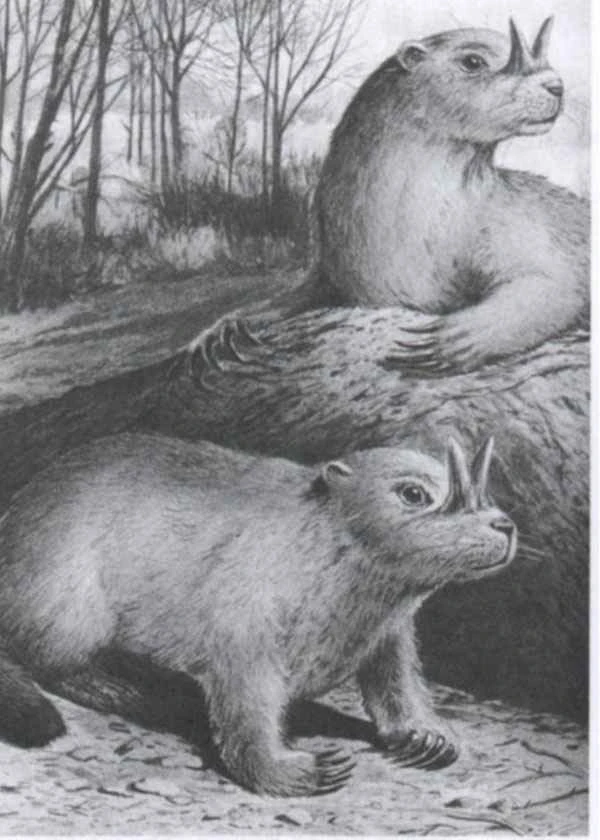
Ancient Rats
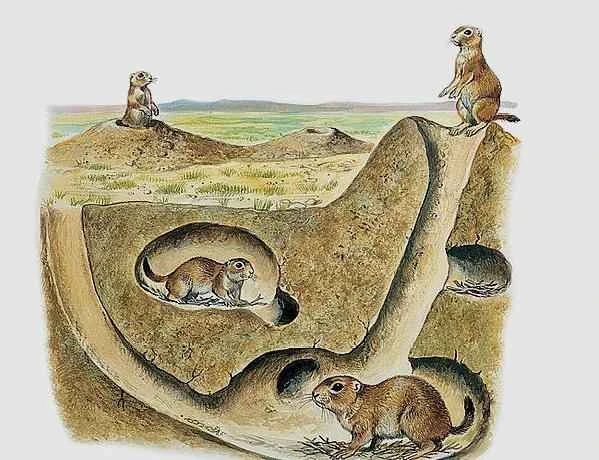
Rats are incredibly resourceful animals. Since their emergence on Earth 53 million years ago, there are now 29 families, 430 genera, and 1814 species living on the planet today, accounting for about 40% of all mammal genera and species in the world. Their numbers are astonishing; it's said that one in every six mammals in the world is a rat. Rats inhabit every corner of the world except Antarctica. On land, there are running mice, jumping jerboas, and burrowing mole rats; in water, there are beavers, and flying squirrels that fly among trees. Rats vary greatly in appearance, from the adorable squirrel to the pesky house mouse, and the ancient horned rat. But regardless of these differences, they are all biologically classified into the order Rodentia. Their common characteristic is a pair of permanently growing incisors that are constantly gnawed at. These incisors grow continuously, and if left unchecked, they eventually stretch the mouth so long that it can't close properly. This is why rats gnaw on wooden boxes—not for food, but simply for grinding. It is said that some people kept house mice in porcelain jars and fed them soft food. After a few days, the mice died because their mouths were pushed open by their incisors, making it impossible for them to close their mouths to eat. In fact, when mice eat, they use their incisors to bite off the food and then move it to their molars to chew it. At this time, the incisors are open, a characteristic unique to mice. To facilitate chewing, mice have lost their canines, and the number of cheek teeth has also been greatly reduced.
Rodents are very important to human life. They steal grain, spread plague, and damage farmland and grasslands. However, their fur is usable, and they reproduce quickly and in large numbers. They are often used as laboratory animals and are called "the fruit fly of mammals".
The population of rodents appears to fluctuate cyclically with the abundance or scarcity of the food chain. Lemmings in Northern Europe typically live in mountains and grasslands, but every 10 years or so, when food becomes scarce, they migrate north in large groups. When they are unable to cross the Arctic Ocean, they collectively jump into the sea and drown. After the migration, their population declines drastically.
The diverse order of rodents is broadly classified into four groups based on their teeth and masseter muscle structure: *Earthropoda* (now only one species remains in North America—the mountain beaver), *Squirrels* (including squirrels and beavers), *Mice* (house mice, hamsters, and jerboas), and *Guinea Pigs* (guinea pigs and capybaras). Recent molecular biology research suggests that South American guinea pigs are less similar to other rodents than to primates or other mammals, thus arguing that they are not rodents and challenging the traditional concept of rodents.
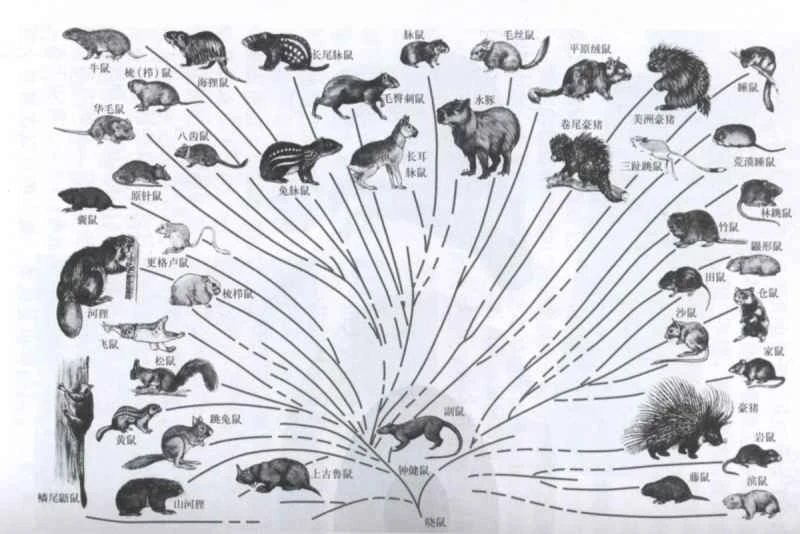
Rodent family diagram
Early rodents flourished during the Paleogene, but became virtually extinct during the Oligocene epoch when the Earth cooled rapidly. After a major hiatus, some extant families emerged, such as beavers, squirrels, jerboas, and guinea pigs. The Muridae family is the largest, encompassing several major groups (subfamilies) including hamsters, mice, and voles. The most primitive is the hamster, discovered nearly 40 million years ago in the Eocene, flourishing during the Oligocene and Miocene epochs; it was gradually replaced by its descendants—rats—when they appeared 15 million years ago. Today, the Murinae subfamily comprises about 120 genera and nearly 530 species, while the Cricetinae subfamily has only 5 genera and 22 species. The Volvininae subfamily is another descendant of hamsters, appearing approximately 5 million years ago.
Because rodents are numerous and evolve rapidly, they are the most effective indicator fossils for determining the age of geological strata. Take, for example, a type of vole called the voles *Mammillaria*. In less than 3 million years, their teeth evolved from having roots to being rootless, and the patterns on their tooth surfaces gradually changed. If a particular type of *Mammillaria* is found in a stratum, the age of that stratum can be inferred.
The origin of rodents has been a long-standing unsolved question. In the past, the *Paramis* species from the Early Eocene of North America was used as a model, suggesting that rodents originated from Paleocene primates. However, recent discoveries in my country have confirmed that rodents should have originated in Central Asia: the *Oriental Dawn Rat* from the Paleocene strata of Qianshan, Anhui, is an ancestral type of rodent, while the *Mossula pulcherrima* from Inner Mongolia is the most primitive type of rodent.
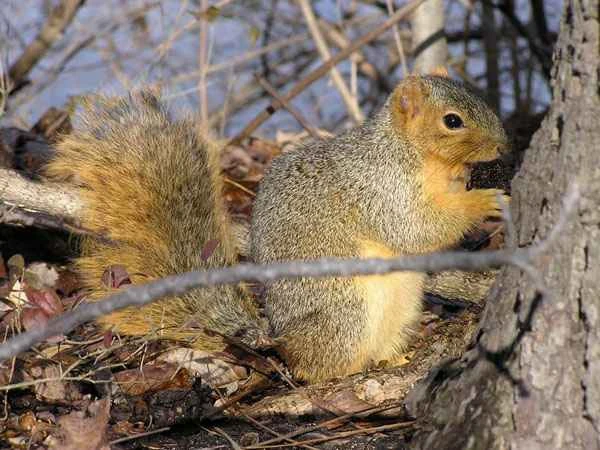
squirrel
Since the 1920s, zoologists believed that mice and rabbits were not systematically related, and that rabbits might have originated from even-toed ungulates, ancient ankyloids, or saurolophus. It wasn't until the 1970s, with the discovery of the *Pikachus molluscica*, an ancestor of lagomorphs, in Qianshan, Anhui, alongside the common mouse, that the kinship between mice and rabbits was reconfirmed, and both were classified into the same superorder—Rodentia. Both rabbits and mice have a pair of rootless incisors, but rabbits also have a pair of smaller incisors behind their incisors. Therefore, in classification, rabbits are also called Diprotodontia, while rodents are called Monoprotodontia.
The order Lagomorpha contains only two families—Leporidae and Leporidae. The extant Leporidae family has 9 genera and 40 species. They are large, with long ears, and excrete two types of feces: dry pellets and wet feces. The wet feces, secreted from a long cecum, are rich in vitamins and are eaten by the rabbits, preventing nutritional loss. The domestic rabbits widely raised today are descended from the European European rabbit and are unrelated to the wild rabbits found in my country. European rabbits burrow, and the young are born in the burrow; newborn rabbits are naked, hairless, and blind. Wild rabbits in my country all belong to the genus Leporus; they do not burrow, and the young are born on dry ground, are furry, and have open eyes; they can run shortly after birth. The genus Leporidae contains only one genus with fewer than 20 species. They are small, with small, round ears and short tails, and mostly inhabit grasslands and mountains. The earliest rabbit in the world was the Lu's rabbit, discovered in Henan, my country, during the Eocene epoch.

Mice and rabbits are among the most evolutionarily successful groups of mammals, but most of them are more harmful than helpful to human development. If humans do not cherish and protect their living environment, then perhaps in a few years the earth will belong to them. This is not an exaggeration, because these animals have an astonishingly high reproductive rate and an exceptionally strong ability to adapt to their environment.