Ancient fish, living 436 million years ago, swam gracefully in the ancient ocean—a scene reconstructed by Chinese researchers based on a batch of fish fossil specimens discovered in the Chongqing Special Fossil Site and the Shiqian Fossil Site in Guizhou. Among the newly discovered fossil specimens, researchers found the world's oldest jawed vertebrate teeth fossils, as well as a number of ancient fish fossils, including the oldest known jawed vertebrate, *Miracle Xiushanfish*, revealing the rise of jawed vertebrates. On September 29th, the journal *Nature* published four academic papers from the team as a cover article, simultaneously reporting these research findings on the origin and earliest evolution of jawed vertebrates.
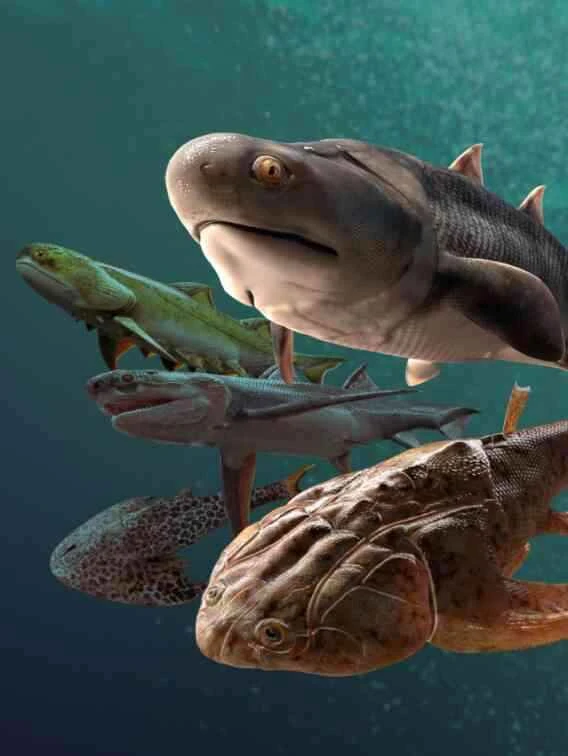
Three-dimensional artistic reconstructions of five newly discovered genera and species of Silurian fish, from top to bottom: *Shenacanthus vermiformis*, *Fanjingshania renovata*, *Qianodus duplicis*, *Tujiaaspis vividus*, and *Xiushanosteus mirabilis*. These fish fossils date back 436 million and 439 million years respectively. (Produced by Simistone Technology)
Including humans, 99.8% of vertebrates currently existing on Earth possess jawbones and are collectively known as jawed vertebrates or jawed animals. The emergence and rise of jawed animals is one of the most crucial leaps in the evolutionary history of vertebrates, from fish to humans. However, globally, jawed animal fossils discovered during the Silurian period, 440 to 410 million years ago, are extremely rare, leaving a 35-million-year gap in the fossil record regarding early jawed organisms.
Over the past decade, Zhu Min, an academician of the Chinese Academy of Sciences and a researcher at the Institute of Vertebrate Paleontology and Paleoanthropology of the Chinese Academy of Sciences, has led a team that has traversed more than 200 sites in my country's Silurian strata that may contain fish. The discovery of the Chongqing Special Fossil Deposit provides important evidence to fill this gap. The discovery process was somewhat "lucky." In 2019, the research team carefully searched along a newly built mountain road in Chongqing. In a random pile of rocks by the roadside, a geological hammer accidentally struck the key to unlocking this "treasure trove" of fish fossils.
On a fossil slab no bigger than the palm of your hand, dozens of fish fossils are clearly visible and lifelike. "We never expected to find such complete and exquisite fossil specimens in such ancient strata," Zhu Min exclaimed.
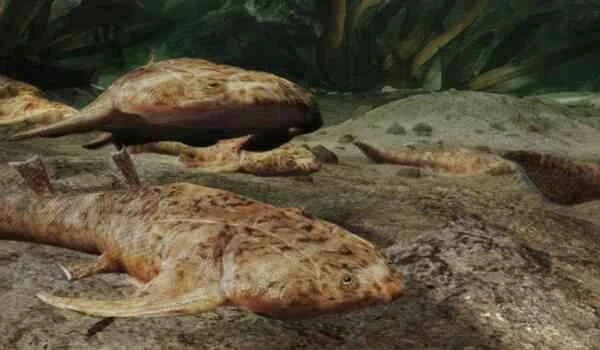
Miracle Xiushan Fish
Using high-precision CT scans, detailed 3D reconstruction, scanning electron microscopy elemental analysis, and full-spectrum imaging, researchers discovered the miraculous *Xiushan fish* in fossils. This is the oldest jawed fish discovered to date, pushing back the fossil record of complete jawed fish by a significant 11 million years and tracing the origins of several human body structures back to fossil fish dating back 436 million years. The oldest completely preserved spinyfish, *Shen's spinyfish*, was also discovered. This is the world's earliest known large fossil of a well-preserved, associated cartilaginous fish, proving that sharks evolved from armored ancestors. The jawless, armored fish *Tujia fish* provides crucial fossil evidence for the origin of paired appendages in vertebrates.
Zhu Min stated that the Chongqing Extraordinary Fossil Deposit is another world-class extraordinary fossil deposit discovered in my country, following the Chengjiang Biota and the Jehol Biota, providing a wealth of crucial evidence for exploring important nodes in the evolution of the tree of life. It confirms that by at least 440 million years ago, major groups of jawed fish were already thriving in southern my country. By the Late Silurian period, more diverse and larger jawed fish genera and species appeared and began to spread globally, initiating the process of fish venturing onto land and ultimately evolving into humans.
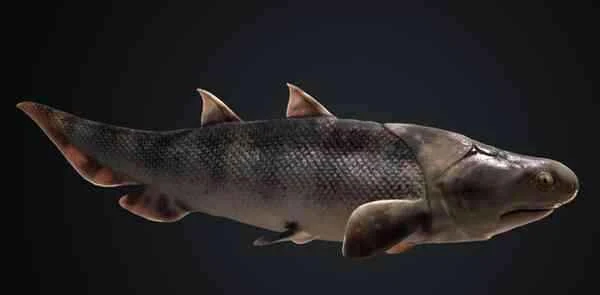
Spiny sea bass with worm-like patterns
Important discoveries have also been made hundreds of kilometers away at the Shiqian Fossil Site in Guizhou. Researchers found 23 jawed dinosaur teeth, each only about 2.5 millimeters long, from a fossil sample weighing approximately 4 tons. These teeth belong to the Dilophosaurus chinensis. These are the oldest jawed dinosaur teeth fossils discovered globally, pushing back the earliest fossil record of teeth by 14 million years.
The research team's fieldwork continues. Zhu Min stated that detailed studies of the two newly discovered fossil sites will continue to change our understanding of jaw origins and the earliest evolution of jawed animals. "This series of publications is just the beginning. I believe that surprises will continue to emerge in the future, and we will continue to explore and search."
(Source: Beijing News Network; Editor: Wu Xiaowen)