The Tibetan wild ass (scientific name: *Equus kiang*; Tibetan: རྐྱང་།, Wylie transliteration: khyang), also known as the Tibetan wild ass, is a large equine mammal found in the Qinghai-Tibet Plateau at altitudes of 4000-7000 meters. It is the largest of all wild asses, with an average shoulder height of 140 cm. They are related to the Persian wild ass, and some taxonomists classify it as a subspecies of the Persian wild ass. The Tibetan wild ass, also known as the Asian wild ass, closely resembles a mule, a hybrid of a donkey and a horse. Because its tail is somewhat horse-like, it is sometimes called a "wild horse."
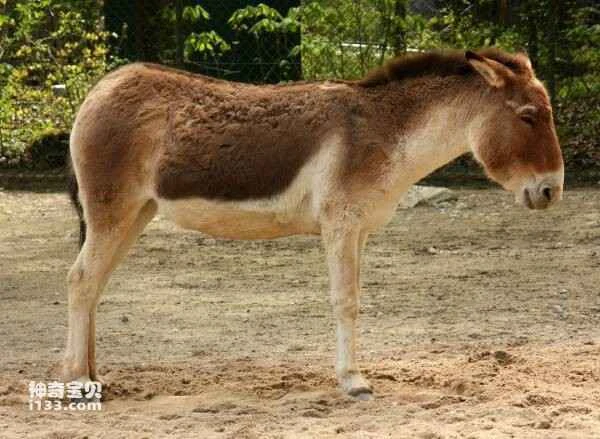
The Tibetan wild ass has a short, broad head with a slightly rounded muzzle. Its ears are over 170 mm long, its mane is short and straight, and its tail mane grows from the posterior half of the tail or one-third of the way from the tip. Its limbs are thick, with round calluses on the inner sides of its forelimbs, commonly known as "night eyes." Its hooves are relatively narrow and high. The muzzle is creamy white, the back is brown or dark brown (summer coat is slightly blackish), and the flank hair is darker, ranging from dark brown to dark brown. From the rear of the neck mane on the shoulders, along the spine to the tail, there is a distinct, narrow, brownish-black or dark brown stripe, commonly known as "back hair." There is a distinct brown stripe on the outer side of each shoulder blade, and a typical white wedge-shaped patch on the posterior side of the shoulder. The anterior ventral angle of this patch is arc-shaped. The abdomen and inner sides of the limbs are white, with the lighter-colored area on the abdomen clearly extending laterally. The outer sides of the limbs are light brown, and the white on the buttocks blends with the surrounding body color without a clear boundary. Adults have darker summer coats and lighter winter coats. Juveniles have darker coats, which are sandy yellow, and have very long downy hairs. After molting in the second summer, their coat color resembles that of adults.
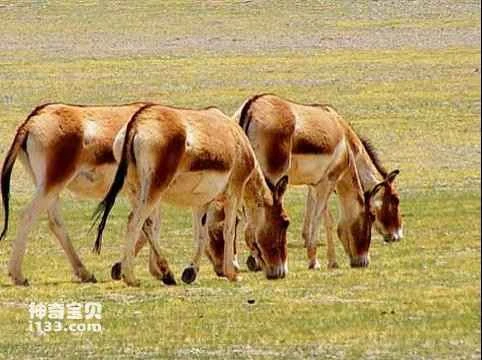
The Tibetan wild ass is a high-altitude animal, inhabiting areas between 3,600 and 5,400 meters above sea level. They live in groups and possess exceptional tolerance to cold, sun, and snow. They typically form small groups of 5 or 6 individuals, with larger groups reaching 10 or more, and the largest groups exceeding 100. Each small group is led by a male ass, and they lead a nomadic lifestyle. They migrate from the desert or hilly areas to water sources in the early morning, and spend most of the day foraging and resting on grasslands near the water sources, returning to the depths of the desert in the evening. Tibetan wild asses move in single file, rarely disorganized, with the male leading, the calves in the middle, and the females bringing up the rear. The paths they traverse often leave distinct "paths," and large piles of dung are left in their tracks, making their routes easily identifiable. From their lodgings to water sources and pastures, Tibetan wild asses run more than 20 kilometers a day, exhibiting a high degree of migratory behavior. Sometimes they live in the same place as even-toed ungulates such as Tibetan antelopes, feeding on alpine plants and able to go without water for several days.