The Himalayan blue sheep (scientific name: *Pseudois nayaur*) is a herbivorous mountain mammal belonging to the family Bovidae and the genus *Pseudois*. Also known as the cliff sheep, stone sheep, blue sheep, Chinese blue sheep, Helan Mountain blue sheep, and Himalayan blue sheep, it is mainly found in the mountainous regions of western China, northern India, Nepal, and Bhutan. It is a Class II protected animal in China. The Helan Mountains in Ningxia, China, have the highest population density, averaging 15 individuals per square kilometer, with a total population of approximately 30,000.
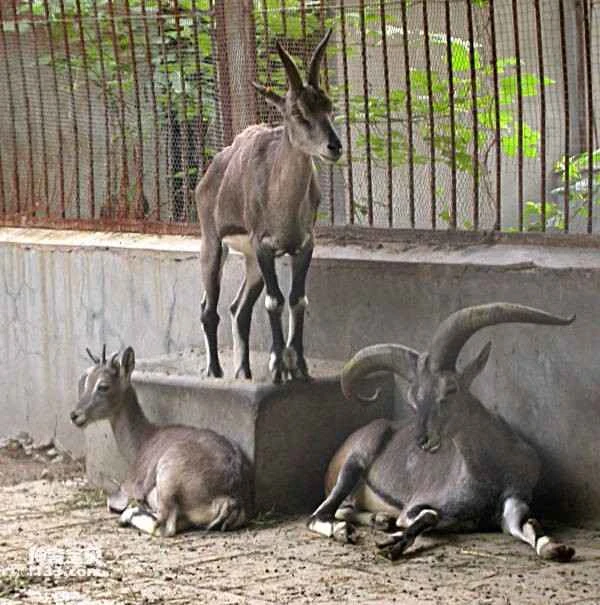
The Himalayan blue sheep is agile and adept at climbing and jumping, making it a primary prey for snow leopards.
The blue sheep is brownish-gray, sometimes with a slight bluish sheen, which blends well with the surrounding cliffs and rocky cliffs, providing excellent camouflage. Its limbs, abdomen, and face have black, dark gray, and white markings. Both sexes have horns but no beards. The male's horns curve backward and can exceed 60 centimeters in length, while the female's horns are short and straight, reaching a maximum of about 20 centimeters.
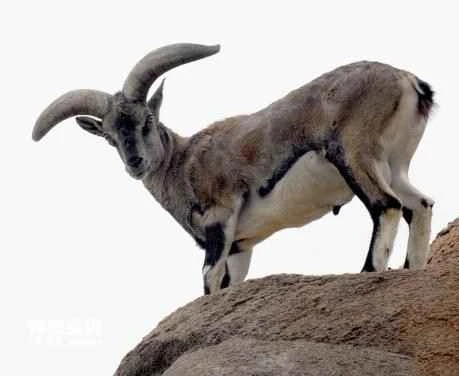
The argali, somewhat resembling a goat, is now endemic to the Tibetan Plateau, preferring to live in mountainous areas above the treeline at altitudes between 4,000 and 6,000 meters. Previous records of argali are known to have been distributed in North China during the Middle and Late Pleistocene, reaching as far as Liaoning in Northeast China, more than 1,800 kilometers northeast of the Tibetan Plateau. However, its Pleistocene records are all from mountainous or cave-like areas; this preference for rocky terrain is the main reason why argali could not expand further north like the woolly rhinoceros. Near the woolly rhinoceros fossil site in the Zanda Basin, a complete horn core fossil, possibly representing an ancestral type of argali, was discovered. Argali exhibit mixed traits of goats and sheep, but are more closely related to goats. The Zanda specimen's horn core is split to both sides, with a semi-circular cross-section and a fairly smooth surface, making it the closest living argali to the argali among bovids of the Tibetan Plateau. However, the direction of its horn core still shows a significant backward tendency, unlike modern and Pleistocene species which point completely outward, indicating that the Pliocene Tibetan species were more primitive. If this horn does indeed belong to the blue sheep, or its more primitive relatives, then the blue sheep is yet another example of an Ice Age animal originating from the Tibetan Plateau.