The argali sheep (scientific name Ovis ammon), also known as the big-headed sheep or big-horned sheep, is a wild sheep species that lives on the Central Asian plateau and is the largest sheep species. It can be divided into nine subspecies depending on its distribution area.
I. Distribution
Argali sheep live in many mountain ranges in Central Asia, ranging from the Altai Mountains, southern Siberia, Mongolia, Tibet, the Tian Shan Mountains to Nepal and the Pamir Plateau. They can survive at altitudes of up to 7,000 meters.
Due to hunting and competition from livestock, argali sheep have become increasingly rare almost everywhere, and in some areas have even disappeared completely. They are extinct in Northeast China, parts of Mongolia, southern Siberia, and much of Kazakhstan and Uzbekistan. Today, they are very few in the Himalayas, much of Inner Mongolia, Tibet, and Xinjiang. Only a small number survive in the Altai Mountains of Russia.
The numbers of all subspecies have declined, with the total number of argali sheep in Asia estimated to be less than 80,000. Currently, their main distribution areas are in Tajikistan, Kyrgyzstan, and parts of Mongolia.
II. Characteristics
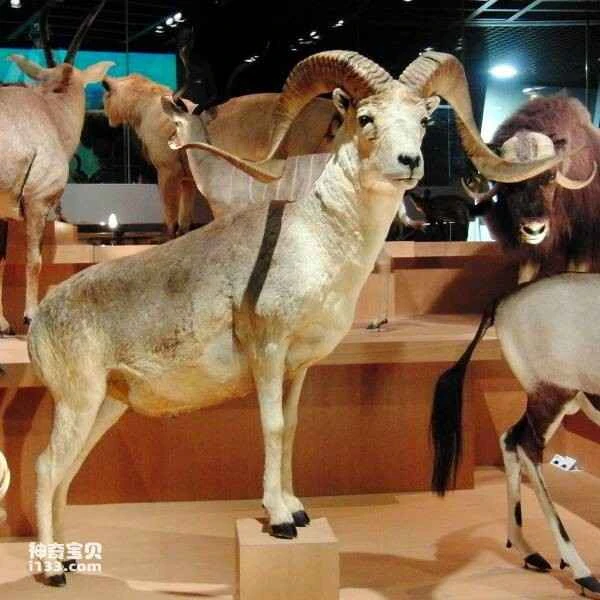
In the northeastern region, males can reach a shoulder height of 120 cm and a weight of up to 200 kg. Animals in the southwestern region are generally smaller.
The color of the wool from the ram ranges from light brown to grayish-white, with lighter shades on the chest and abdomen. Most subspecies of males have white necks. They lack the mane of the red ram.
The male's horns are thick and long, over 1 meter in length, twisting downwards in a spiral shape, with ring ridges on the outside; the female's horns are very short and have a shallower curve.
III. Habits
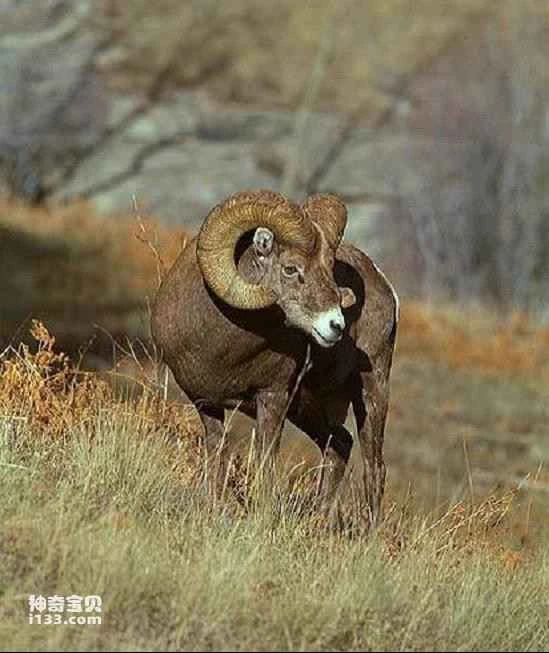
Argali sheep are gregarious animals, and their habits are similar to those of other wild sheep. Outside of estrus, rams and ewes each form groups of about five to ten sheep. Estrus occurs in winter, so that lambs can be born in the spring.
Argali sheep feed on grass and leaves.
Argali sheep have relatively long legs and a slender build. Compared to other wild sheep, they are less skilled at climbing mountains, so they generally avoid escaping to steep slopes when fleeing.
IV. Origin
Argali sheep are the basal species of the North American Bighorn sheep (Ovis dalli) and the Canada argali (Ovis canadensis), with the transitional type being the East Siberian snow mountain argali (Ovis nivicola). These sheep arrived in North America during the last migration wave of the Late Pleistocene. Similar to the sister herd relationship between bison and yaks, a fondness for cold and high-altitude environments appears to be a significant connection among these sheep. Argali sheep are now distributed across the Tibetan Plateau and the mountains to its west and north, but during the Pleistocene their range was much wider, possibly extending westward as far as France, and they are also considered a cold-climate animal of the Ice Age.