Among the large bears of the Miocene-Pliocene epochs, the most famous are the Indian bear (Indarctos) and the coyote bear (Agriotherium). Both were enormous, widely distributed, and have a long history of discovery, representing the Miocene-Pliocene epochs. Although they share many similarities, there has been no direct evidence linking them. Therefore, their evolutionary relationship has been highly debated. Some scholars believe they are very closely related, direct relatives (e.g., Hendey), while others believe they are unrelated, placing the Indian bear in the subfamily Ailuropodinae and the coyote bear in the subfamily Abella (e.g., Abella).
Recently, Jiang Zuoqigao, a doctoral student at the Institute of Vertebrate Paleontology and Paleoanthropology, Chinese Academy of Sciences, and John J. Flynn of the American Museum of Natural History, collaborated to describe a fossil of a coyote from the Quibrius Formation in Arizona, USA, in the international journal *Journal of Mammalian Evolution*. After detailed comparison, the specimen was confirmed as a new species of the genus *Agriotherium*, namely *Agriotherium hendeyi* sp. nov. This species is significantly smaller than its contemporaneous North American counterpart, *Agriotherium schneideri*, and also smaller than most Old World coyotes, making it one of the smallest known coyotes. More importantly, the lower carnassial tooth of this specimen exhibits transitional characteristics between the Indian bear and the coyote, providing an excellent opportunity to resolve the relationship between the two. By reviewing the variation patterns of the lower carnassial tooth in African coyotes, the researchers have offered new insights into the origin of coyotes.
The most obvious difference between Indian bears and African coyotes lies in the pattern of the inner cusp of their lower carnassial teeth. In Indian bears, this region has three cusps: the largest, anterior posterior cusp, and two posterior inner cusps. Generally, the anterior cusp is larger than the posterior one, resulting in a series of decreasing cusps from front to back. In African coyotes, this region has only two cusps: the larger anterior one and the smaller posterior one. Traditionally, it is believed that the two cusps in African coyotes correspond to the anterior inner cusp in Indian bears, while the posterior inner cusp is degenerate and disappears. However, no specimens support this hypothesis; no specimen with an intermediate morphology has been found (theoretically, the posterior cusp should be larger, while the posterior inner cusp should be significantly smaller). Hendey, in describing the African coyote *Agriotherium africanum*, discovered a series of variations that do not conform to the above hypothesis. In some African coyote bears, the normally largest posterior cusp becomes unusually small, while the anterior medial cusp enlarges, and the posterior medial cusp also slightly enlarges. This led to the proposal that the two medial cusps in coyote bears should be the result of simultaneous enlargement of both medial cusps, while the original posterior cusp disappears and degenerates. Unfortunately, Hendey's argument was too simplistic, and his views did not receive a response from international peers. The coyote bear Hendey discovered in North America recently exhibits morphology similar to some individuals of African coyote bears, with a very small posterior cusp and simultaneous enlargement of both medial cusps. This suggests that this variation is not unique to African coyote bears but may be a widespread variation pattern in early coyote bears. Taking this opportunity, researchers reviewed the dental variations of African coyote bears in detail. Using geometric morphology methods, combined with knowledge of dental arch homology and dental development, they demonstrated that Hendey's view was correct: the two cusps in this region of the coyote bear should be two enlarged medial cusps, while the posterior cusp degenerates and disappears. The species name of this new species is dedicated to Mr. Hendey. The authors also found that the lower carnassial structure of the North American “Agriotherium” schneideri is very similar to that of the Indian bear, but quite different from that of the coyote, so its phylogenetic position needs further study.
After demonstrating the homology of the lower carnassial cusps in the suburban bear, the relationship between the suburban bear and the Indian bear has become clearer, namely that the suburban bear likely originated from the Indian bear, and both belong to the subfamily Ailuropodinae. However, the specific evolutionary relationship, the earliest time and place of this process, still need further discussion.
Original link
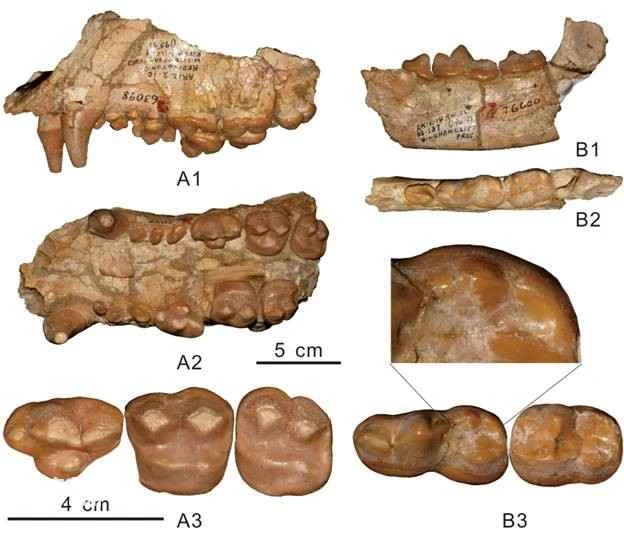
Figure 1. Fossil of Agriotherium hendeyi sp. nov. (Photo provided by Jiang Zuoqigao)
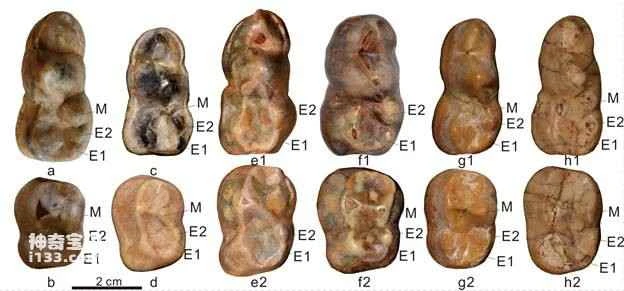
Figure 2. Comparison of dental structural variations among African subterranean bear (af), Heinz subterranean bear (g), and Indian bear (h). In the figure, M represents the posterior inferior cusp, E1 is the posterior inferior medial cusp, and E2 is the anterior inferior medial cusp (image provided by Jiang Zuoqigao). 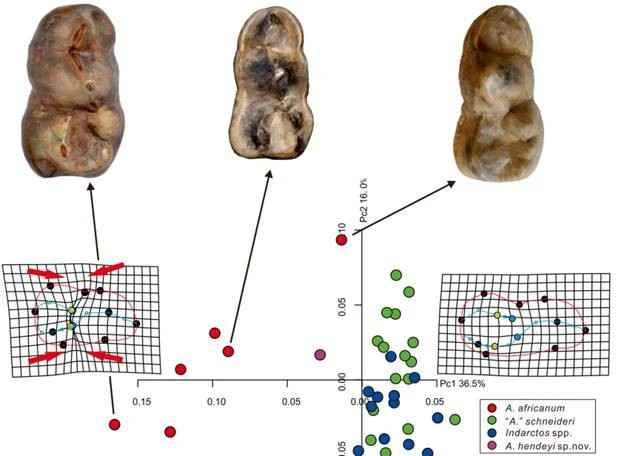
Figure 3. Distinguishing dental structures between Indian bears and suburban bears (Image provided by Jiang Zuoqigao)
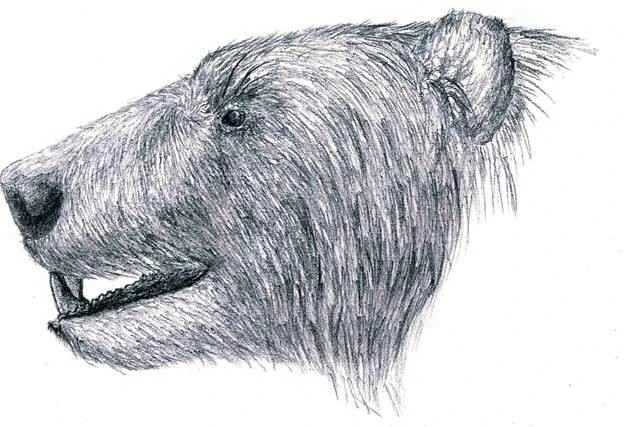
Figure 4. Reconstruction of Heinz's cod (Image provided by Jiang Zuoqigao)