The human brain, both in absolute and relative size, is larger than that of other primates, and its sulci and gyri structure is also more complex. The traditional view is that the enlarged human brain is the result of gradual accumulation during the evolutionary process, generally continuing the trend of gradually increasing relative brain size and gradually more complex sulci and gyri structure among primates.
In the long history of ape evolution, there were no clear answers to questions about when the human brain began to differentiate itself from other apes, at what rate it enlarged, and when it could be called the human brain. Recently, a research team led by Ni Xijun at the Institute of Vertebrate Paleontology and Paleoanthropology, Chinese Academy of Sciences, published a new study in *Science Advances*, a sub-journal of *Science*. Using the fossil of the proboscis monkey *Chilecebus carrascoensis*, a basal proboscis monkey living in South America, as a "correction point," they reconstructed the brain characteristics of proboscis monkey and stenoscis monkey ancestral types of apes, analyzed the process of ape brain enlargement, and thus attempted to answer the aforementioned questions about human brain evolution.
Fossils are essential evidence for understanding the evolutionary history of any organism. While the brain of an animal is soft tissue and decomposes rapidly after death, making it impossible to fossilize, the brain of a mammal is a significantly enlarged organ. During growth and development, imprints of the brain are left on the inner wall of the skull. Apes, often possessing larger brains than other mammals of similar weight, exhibit this enlargement more pronounced, resulting in clearer imprints on the skull wall. These imprints frequently preserve large blood vessels and major gyri, and are remarkably similar in overall morphology to the brain enclosed by the dura mater.
Using high-precision CT scans, the research team digitally reconstructed the brain imprint on the inner wall of the skull of the Carrasco macaque in three dimensions. They found that it has a relatively flat frontal lobe, but a well-developed occipital lobe, a relatively small olfactory bulb, and multiple pairs of sulci and gyri. Its overall morphology is even comparable to that of the extant proboscis marmoset.
The Chilean monkey fossil was discovered about 100 kilometers southeast of Santiago, the capital of Chile, buried in hard volcanic breccia. It is the best-preserved basal proboscis monkey known to date, dating back approximately 20 million years.
Proboscis monkeys are one of the two major branches of the crested ape group. As early as 40 million years ago, they began to diverge from another major branch of apes, namely the apes (including humans). Proboscis monkeys then evolved independently, developing many advanced brain features parallel to both humans and apes. The relative size of the brains of some proboscis monkeys has also significantly increased, becoming comparable to that of apes belonging to the ape family (apes belonging to the ape family). Some proboscis monkeys, such as capuchin monkeys, can use simple tools, and some believe that capuchin monkeys even possess intelligence surpassing that of chimpanzees.
Undoubtedly, proboscis monkeys serve as a natural frame of reference for studying the brain evolution of stenoptera, including humans, and the Carrasco monkey is currently the most crucial known reference point within this frame of reference.
In studies on the evolutionary lineage of primates, particularly apes, the research team, building upon previous work and integrating fossil evidence, morphological characteristics, and molecular biological features, has established a stable phylogenetic lineage for primates and apes. In this new study, researchers employed cutting-edge statistical methods and fully utilized the supercomputing capabilities of the supercomputing platform at the Key Laboratory of Vertebrate Evolution and Human Origins, Chinese Academy of Sciences, to further accurately estimate the divergence time, brain volume, and evolutionary patterns of various ape lineages. They also proposed the Phylogenetic Encephalization Quotient, a new indicator for measuring brain volume evolution.
Researchers have discovered that the ancestors of proboscis monkeys and stenoscissors had brains of relatively similar size but different structures. Over the course of more than 40 million years of evolution, both groups have shown a trend of increasing brain volume. Except for the human lineage, the increase rates are very similar, and they have evolved macroscopic features such as shrinking olfactory bulbs and increased sulci and gyri.
Since diverging from great apes 7 million years ago, the increase in brain volume of the human lineage has been entirely different from that of other apes. Relative to body weight, and after accounting for evolutionary accumulation, the relative brain volume of humans is more than three times that of apes. It can be said that since the divergence between humans and apes 7 million years ago, the most significant characteristic of the human lineage has been the rapid development of the brain following an evolutionary pattern distinct from that of other apes.
Numerous studies have shown that humans possess many new genes compared to our close relatives, chimpanzees, and these new genes are often related to brain development. Based on this, researchers believe that this study has found the evolutionary reason for this phenomenon.
Using Chilean monkeys as a reference, this study reveals that while brain evolution follows similar trends across different ape lineages, the evolutionary trends in the human lineage differ significantly. To put it humorously, if nature is rational, then the human brain must be bordering on madness.
Original link
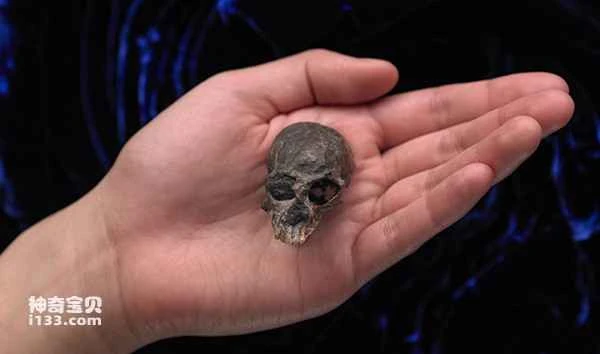
Figure 1: A fossilized skull of a Carrasco monkey resting in the palm of a hand. (Photo courtesy of AMNH/N. Wong and M. Ellison)
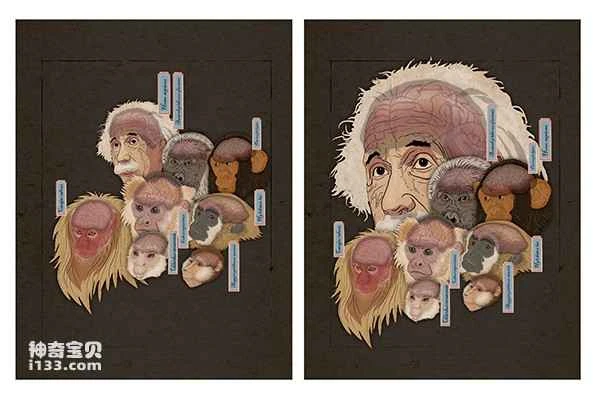
Figure 2: The size of each head represents relative brain volume. Left side: Without considering evolutionary accumulation, the relative size of the human brain is not significantly different from that of other apes; Right side: After removing the factor of evolutionary accumulation, the relative size of the human lineage brain is significantly different from that of other apes. (IVPP/Guo Xiaocong, Ni Xijun provided images)