The Lyncodontini tribe, now found only in South America, is a small mustelid family. However, during the Quaternary period, these tribes were widespread across Eurasia, with the European sea otter mink (Enhydrictis) and Pannonictis being particularly notable. Relatively few Lyncodontini specimens have been found in East Asia; previously, only the sable weasel (Eirictis), which lived in the Early Pleistocene, has been reported. Fossils of this animal have been found in Longdan, Gansu; Renzidong, Fanchang, Anhui; and Tuozidong, Nanjing, Jiangsu. In 1934, when reporting on carnivorous fossils from the Zhoukoudian "Peking Man" site, Pei Wenzhong frequently encountered a type of otter-like but different medium-sized mustelid, which he named the badger-type otter, but noted that it might not be a true otter. Later, Ogino Shintaro, in revising the study of the Japanese otter in Kyushu, Japan, argued that both the Japanese otter and the badger-type otter from Zhoukoudian belonged to the Lyncodontini tribe and established a new genus, *Oriensictis*. Unfortunately, the materials from Zhoukoudian are too fragmented, with only a few scattered teeth, so scholars still have some controversy regarding the true classification of this type of animal.
In recent years, the Dalian Field Expedition Team of the Institute of Vertebrate Paleontology and Paleoanthropology, Chinese Academy of Sciences, led by Researcher Jin Changzhu and Associate Researcher Wang Yuan, has collaborated with the Dalian Puwan Economic Zone and the Dalian Natural History Museum, among other institutions, to conduct over five years of field excavations at Jinyuan Cave on Camel Mountain in Puwan, Dalian, collecting a diverse and abundant number of Pleistocene mammal fossils. Recently, Jiang Zuoqigao, a doctoral student from the Institute of Vertebrate Paleontology and Paleoanthropology, along with his supervisor Researcher Liu Jinyi and colleagues from the Dalian Natural History Museum and the Dalian Puwan Economic Zone, reported a complete medium-sized mustelid skull from the upper deposits of Jinyuan Cave on Camel Mountain in Puwan, Dalian. The dental features of this skull fossil are highly consistent with those of the badger-like otter from Zhoukoudian, belonging to the same species, while its skull features are very similar to those of the sea otter-mink endemic to Sardinia in the Middle to Late Pleistocene of Europe. Through detailed comparative studies and phylogenetic analysis, researchers discovered that the mustelids from Jinyuan Cave, Zhoukoudian, and Japan can all be classified under the genus *Durophagous*, but belong to different species: the badger-type sea otter (Jinyuan Cave, Zhoukoudian) and the Japanese sea otter (Japan). The badger-type sea otter is the largest and strongest member of the genus *Durophagous* (estimated weight 5-10 kg), possessing robust canines and molars (a characteristic of *durophagous*), possibly indicating its ability to hunt larger prey. This finding has been published online in *Quaternary International*.
The discovery at Jinyuan Cave on Camel Mountain in Puwan not only confirms that the "badger-type otter" does indeed belong to the steppe weasel tribe, enriching the fossil record of steppe weasels in East Asia, but also reveals two important facts:
1. The upper layer of Jinyuan Cave is likely contemporaneous with or very close to the Zhoukoudian Peking Man Site. Jinyuan Cave is a large cave deposit discovered in recent years in the Puwan area of Dalian. The sediments extend over 30 meters from bottom to top. The lower layer contains evidence of both three-toed horses and true horses, dating to the Early Pleistocene. The discovery of sea otter-mink in this study confirms the upper layer's age as the Middle Pleistocene. Thus, Jinyuan Cave becomes the first single-section deposit in northern China spanning almost continuously from the Early Pleistocene to the Middle Pleistocene.
2. Among the European animals first appearing in northern China during the Middle Pleistocene, besides sea otters and minks, were the *Xenocyon* sp. discovered at Zhoukoudian and the *Panthera youngi* (possibly closely related to the European cave lion). At the same time, some East Asian-specific species also first appeared in Europe: the dhole *Cuon spp.* and the Asiatic black bear *Ursus thibetanus*. This large-scale biodiversity exchange event is likely related to climate change during the Middle Pleistocene transition. During this transition, the global climate fluctuation cycle shifted from 40,000 years to 100,000 years. This shift significantly increased the intervals between glacial and interglacial periods. Therefore, during interglacial periods, the corridors for biodiversity exchange across Eurasia existed for a longer period, allowing these fast-migrating carnivores to migrate from one end of Eurasia to the other.
This research was supported by the National Natural Science Foundation of China, the Dalian Puwan Economic Zone horizontal project, the Strategic Priority Research Program of the Chinese Academy of Sciences, and the China-Czech Cooperation Project.
Original link
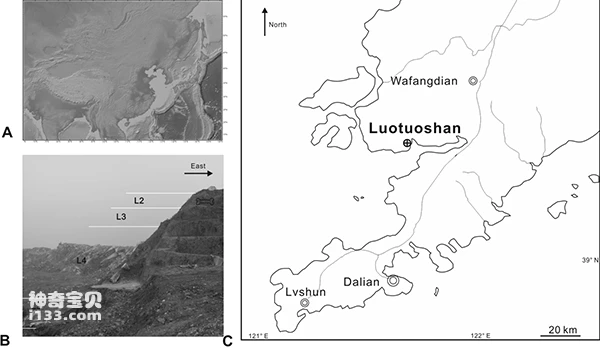
Figure 1. Location and cross-section of Jinyuan Cave in Luotuo Mountain, Dalian (Photo provided by Jiang Zuoqigao)
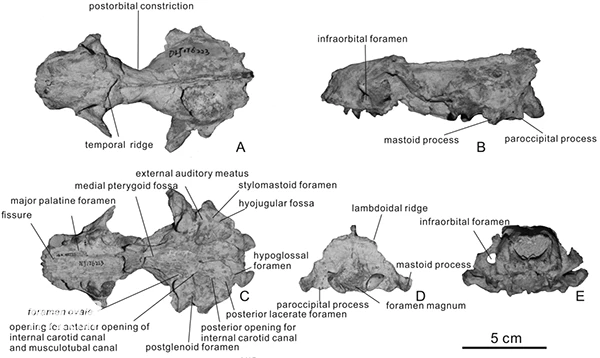
Figure 2. Badger-shaped sea otter skull (Photo provided by Jiang Zuoqigao)
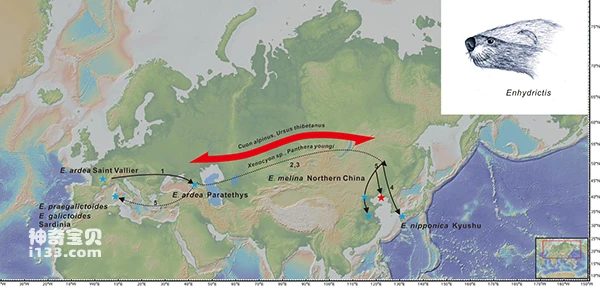
Figure 3. Migration route of the badger-type sea otter-mink, reconstruction and schematic diagram of biological exchange during the Middle Pleistocene transition (Image provided by Jiang Zuoqigao)