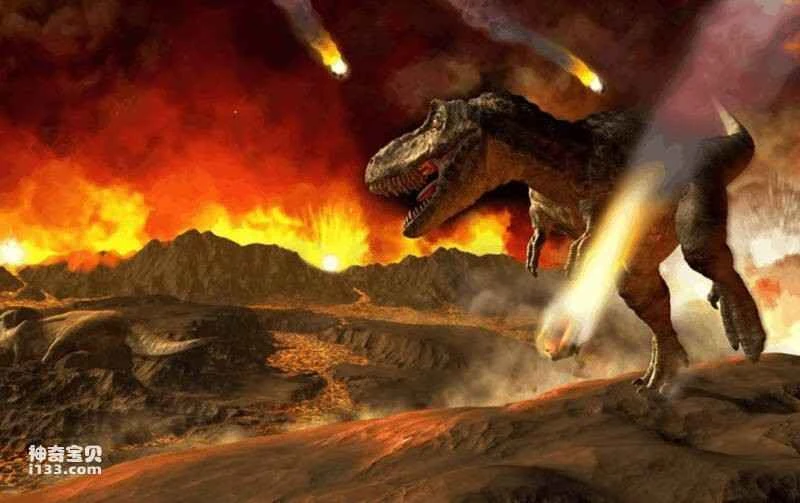
Dinosaurs first appeared on Earth around 230 million years ago during the Triassic period. Their mass extinction at the end of the Triassic led to their gradual dominance in the biological world. However, this vast group of animals, which ruled the Earth for 160 million years, suddenly went extinct around 65 million years ago at the Cretaceous-Tertiary boundary. Why did the dinosaurs, at the height of their prosperity, become extinct in such a short time? Curiosity has spurred extensive research by scholars both in China and abroad.
Scientists have discovered that the content of the trace element iridium in the clay layers of strata from the Late Cretaceous period increased dramatically by 30 to 160 times compared to other periods. Iridium is a rare element in the Earth's crust but is widely found in asteroids. Therefore, the most popular and influential view is that 65 million years ago, a meteorite impacted Earth, creating dust that blocked out the sun, causing drastic climate change, mass plant death, and the extinction of dinosaurs due to food scarcity. There are actually many other explanations and theories about the mystery of dinosaur extinction, with over a hundred publicly published.
Various theories about the extinction of dinosaurs
1. The theory of a sudden drop in oxygen
65 million years ago, Earth's climate changed abruptly, with a sharp drop in temperature causing a decrease in atmospheric oxygen levels, making it impossible for dinosaurs to survive. The question is: if this was the case, how did the oxygen content drop so drastically at that time?
2. The theory of temperature drop
Dinosaurs were cold-blooded animals, lacking fur or other insulating organs, and unable to adapt to the decreasing Earth's temperature, they all froze to death. But why did frogs, crocodiles, and many other animals equally sensitive to temperature survive, while dinosaurs did not?
3. Gender Imbalance Theory
Due to the cold weather, most dinosaur mothers hatched male cubs, leading to a severe imbalance in the male-to-female ratio in the dinosaur world. As the number of female dinosaurs gradually decreased, the dinosaur family eventually went extinct. However, the sex of sea turtles is also regulated by temperature, so why did drastic climate change show a preference for them?
4. Acid Rain Theory
Intense acid rain may have fallen at the end of the Cretaceous period, dissolving trace elements, including strontium, in the soil. Dinosaurs ingested strontium directly or indirectly through drinking water and food, resulting in acute or chronic poisoning, and eventually died off in droves. But it's hard to imagine that Earth ever experienced such severe environmental pollution.
5. The theory of poisoning
There was once a period on Earth when angiosperms existed. These plants contained toxins, and dinosaurs ate too many of them, causing an excessive accumulation of toxins in their bodies, ultimately poisoning them to death. However, it's puzzling that plants couldn't have killed all the dinosaurs scattered across different regions at once. Although some fossils show dinosaurs with their necks pulled back in what appears to be a poisoning reaction, this was likely due to their bodies drying and shrinking after death.
6. The theory of Earth's expansion
Intense crustal movements caused the Earth's mass to expand outwards, increasing its volume. Dinosaurs and many other creatures went extinct because they couldn't adapt to the reduced gravitational field at the Earth's surface. However, this explanation lacks persuasiveness because changes in gravity don't occur overnight; dinosaurs and other organisms should have developed adaptive mechanisms during their evolution. Other theories include "thicker eggshells," "ocean shrinkage," and "marsh gas eruptions." But these theories, taken individually, seem insufficient to explain the sudden disappearance of dinosaurs and other animals. Currently, many scientists believe that the extinction of dinosaurs and other contemporary species was likely the result of a combination of factors.