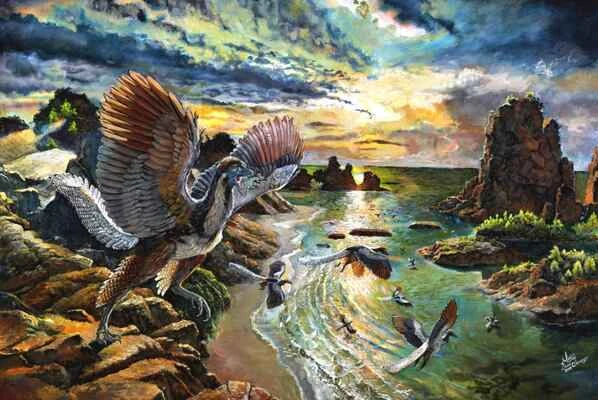
Archaeological research shows that dinosaurs lived during the Triassic, Jurassic, and Cretaceous periods, which together lasted about 160 million years. This means that dinosaurs ruled the Earth for 160 million years , reaching the top of the food chain thanks to their large size and strength. If it weren't for the asteroid impact 65 million years ago, dinosaurs might have continued to exist. Scientists speculate that an asteroid with a diameter of 10,000 meters struck Earth 65 million years ago. This impact drastically altered the Earth's environment, causing numerous volcanic eruptions. These eruptions produced large amounts of carbon dioxide, which permeated the atmosphere and posed a significant threat to life on Earth.
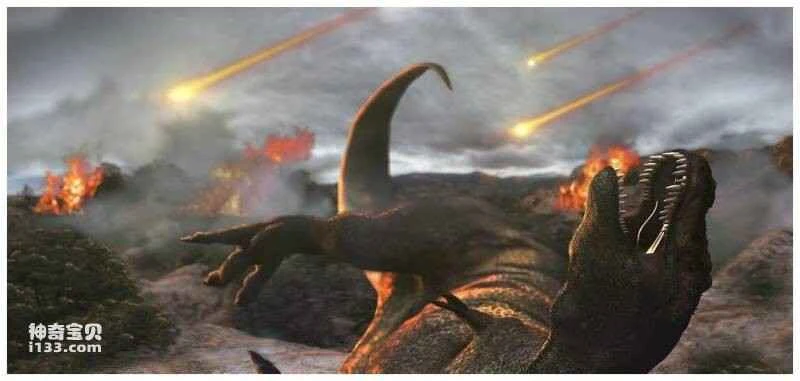
We know that carbon dioxide concentrations are very high. Large amounts of carbon dioxide in the air block sunlight. Because sunlight cannot reach the Earth's surface for a long time, plants cannot perform photosynthesis. Over time, a large number of plants on Earth will die. After a large number of plants die, the oxygen content on Earth will decrease. In addition, the greenhouse effect caused by carbon dioxide makes the Earth's temperature rise higher and higher. This is one of the reasons for the extinction of dinosaurs. Besides this reason, there are other reasons, such as the huge impact force causing forest fires. In the tens of thousands of years after the asteroid impact, the Earth's environment changed dramatically. Because dinosaurs could not adapt to such a harsh Earth environment, they eventually became extinct.
Fortunately, humans emerged after the extinction of dinosaurs. Scientists believe that humans evolved from apes. If dinosaurs had not gone extinct 65 million years ago, given their dominance on Earth at the time, apes would never have evolved into humans. As the saying goes, survival of the fittest, after the extinction of dinosaurs, many new creatures emerged on Earth. Among these new creatures, humans are the most intelligent. The birth of humans has added much brilliance to the Earth. If humans had not appeared, the mysteries of the Earth and the universe might never have been revealed.

How long can humanity rule the Earth?
As the most intelligent life form on Earth, humans have shouldered the responsibility of exploring the universe since their birth. We now know that there are many celestial bodies in the universe, such as stars, planets, comets, white dwarfs, neutron stars, and black holes. Besides these, there are many other mysterious celestial bodies we don't yet know about. Although humans are much smaller than dinosaurs, their intelligence is the highest among Earth's creatures. Humans have used their intelligence to reach the top of the food chain. Humans have existed for millions of years; so how long will humans dominate the Earth?

With current human technology, other life forms on Earth pose no threat to humanity. The only threats are asteroids, extraterrestrial life, and Earth's ecosystem. Let's first discuss the threat of asteroids. If an asteroid were to collide with Earth again in the near future, it could lead to human extinction. However, humans can now observe the movements of asteroids within the solar system using telescopes, and no asteroids have yet been detected heading towards Earth. Moreover, human technology is constantly advancing, and with this progress, we will have ways to defend against asteroid impacts in the future. For example, we could use spacecraft to collide with asteroids, deflecting them from their orbits, or use nuclear weapons to shatter them. These methods can eliminate the danger posed by asteroid impacts.
Currently, the greatest threat to humanity is still extraterrestrial life. The question of whether extraterrestrial life exists in the universe has been explored since humanity left Earth. To date, humanity has not discovered any trace of extraterrestrial life in the universe. If we follow scientists' definition of the origin of life, then there should be many extraterrestrials in the universe. Scientists believe that if a planet is located in the habitable zone of its star system and has water and air, then the possibility of life arising on that planet is very high. There are countless planets in the universe, and many should be located in the habitable zone of their star systems. Why haven't humans discovered extraterrestrial life yet?

Many people believe that the reason why extraterrestrial life poses a greater threat to humanity is because human technology is not advanced enough. Although humans can observe the universe through astronomical telescopes, these telescopes can only show the approximate location of planets. To know whether there is life on a planet, humans would have to land on it themselves. Currently, humans cannot even leave the solar system, let alone land on other planets. If human technology develops to a certain level in the future, we might be able to find extraterrestrial life. So why do people say that extraterrestrial life poses a greater threat to humanity?
If alien technology is more advanced than human technology, then if they discover Earth and launch an attack, humanity will be powerless to resist. Many people have read the novel "The Three-Body Problem," which tells the story of how the Trisolaran civilization attacked Earth after its location was exposed. Because of their advanced technology, the Trisolarans quickly conquered Earth. Currently, we haven't discovered any aliens, which may be good news for humanity. However, what's coming will eventually come. What humanity can do now is strive to develop its own technology to prepare for the arrival of aliens.

Besides asteroid impacts and the threat of extraterrestrial life, another major threat is Earth's ecological environment. The extinction of dinosaurs, who ruled the Earth for 160 million years, was caused by drastic changes in the Earth's environment. Now, with the advancement of human technology, the damage to Earth's ecological environment is becoming increasingly serious. Currently, the global greenhouse effect is severe, and the Earth's temperature is rising year by year. Scientists predict that in about 1,000 years, the glaciers in Antarctica and the Arctic will melt completely. At that time, sea levels will rise by more than 60 meters, and many coastal cities will be submerged. This is the most dangerous thing for human survival.

If humanity continues to damage Earth's environment, in a few hundred years, the Earth's ecosystem may become uninhabitable. At that point, humanity will have to find a new home. Although many scientists have discovered Earth-like planets outside our solar system, these planets are too far away for current human travel speeds. Within our solar system, only Mars is relatively suitable for colonization, but Mars lacks a magnetic field and atmosphere, so colonization would require terraforming it. Terraforming a planet is different from building a house; many factors need to be considered. Currently, human technology makes terraforming Mars virtually impossible. Therefore, the best way for humanity to develop sustainably is to protect Earth's environment. This is the only way for human civilization to continue to thrive. So, how long do you think humanity can maintain its dominance over Earth?