During the Pliocene, the average altitude of the Tibetan Plateau region was only a few hundred meters to a few thousand meters. Scientists found fossils of the three-toed horse fauna that lived 10 to 3 million years ago in the thick river and lacustrine deposits at an altitude of more than 4,000 meters in the Gyirong Basin on the north side of Shishapangma Peak (8012 meters above sea level).
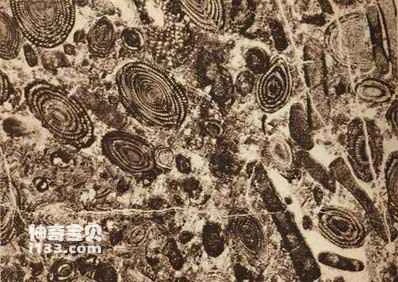
Marine invertebrate fossils dating from approximately 40 million to 100 million years ago
The three-toed horse is an ancestor of the modern horse. It was relatively small and had three toes. During the Pliocene epoch, it lived in low-lying tropical and subtropical forest-steppes and savannas. Its distribution was extremely wide, with traces found in Eurasia, North America, and Africa, making it a typical Pliocene animal. It coexisted with animals such as rhinoceroses, giraffes, antelopes, and bamboo rats, collectively known as the three-toed horse fauna. Fossils of the three-toed horse fauna are common in Pliocene strata in North my country, Northwest China, and northern India. Intriguingly, except for the Qinghai-Tibet Plateau, all these fossil sites are at altitudes of only a few hundred meters, at most a few thousand meters, indicating that the areas inhabited by the three-toed horse fauna at that time were relatively low-lying and had a warm and humid climate.
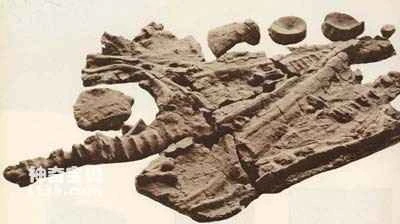
Tibetan Himalayan ichthyosaur fossil, dating back approximately 180 million years.
In the past, the absence of three-toed horse fossils on the Qinghai-Tibet Plateau was often cited as evidence against the ancient existence of the plateau. It was believed that the migration route of three-toed horses from China to South Asia passed through Afghanistan and Iran, reaching Pakistan and India. However, now, numerous fossil sites of three-toed horses have been discovered not only in the Gyirong Basin of the plateau but also in Nyalam, Zanda, and Biru. These locations are all at altitudes exceeding 4,000 meters, with average annual temperatures below 1°C and annual precipitation around 400 millimeters. Clearly, three-toed horses could not survive under these climatic conditions. This proves that until the Pliocene epoch, the present-day plateau was not high enough to constitute a barrier to the free movement of three-toed horse fauna.
It can be said that the era in which the three-toed horse fauna lived was a prosperous period in the geological history of the Tibetan Plateau. This period was a stable phase after the retreat and closure of the Tethys Sea to form land. Crustal movement was not intense; mountains were eroded and lowered, and large amounts of material were transported and deposited in basins and valleys. Sediments reached thicknesses of several hundred meters. The entire plateau region was characterized by vast peneplain landforms, without steep cliffs or deep canyons. Lakes of varying sizes were scattered across the gently undulating plains. The lakes in northern Tibet were particularly expansive and deep. Fish swam freely in the water, and birds frolicked on the lakeshores.
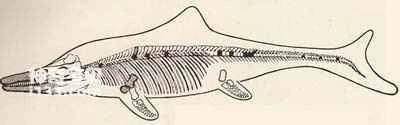
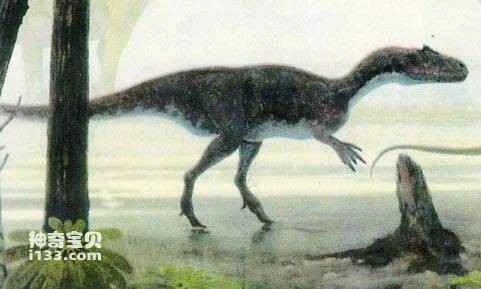
Reconstruction of Himalayan ichthyosaur fossil
Along the fault-bounded zone on the northern slopes of the Himalayas and in southern Tibet, lakes are interspersed in strips, like silver beads, adorning southern Tibet with exceptional beauty. Although the Gangdise Mountains, Tanggula Mountains, and Kunlun Mountains already existed at that time, they were not very high; the average altitude of the Himalayas is less than 3,000 meters. The climate is relatively humid in winter and warm in summer, with an average annual temperature difference of only about 6°C between north and south. In this relatively uniform climate, the three-toed horse fauna became dominant. The humid and warm climate caused the soil to develop a red color, and this red weathered crust can still be seen in many places today.
The discovery of the three-toed horse fauna fossils provides insights for our research and reconstruction of the Pliocene paleogeographic environment of the Tibetan Plateau. Their extinction reflects a new stage in geological history, namely, intense crustal uplift, which gradually formed the Tibetan Plateau as we know it today.