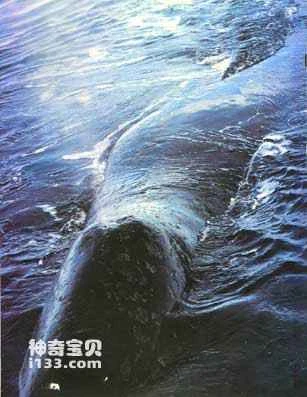
Whaling is central to Inuit culture; their history is inextricably linked to it, or rather, they survived thanks to whales in the Arctic waters. The whales the Inuit refer to are primarily bowhead whales, or Arctic right whales. The Arctic right whale has a spindle-shaped body, a large head that can account for more than a quarter of its body length, long, thin, and highly elastic baleen plates, and an indistinct neck. Adult right whales average 15-18 meters in length, with older whales reaching up to 21 meters. When a right whale surfaces, almost half of its back is above water, and its broad back gives it its name. Furthermore, the right whale has a unique characteristic—it spouts two jets of water, while other whales spout only one.
Arctic right whales sometimes feed alone and sometimes in groups. When feeding, they swim leisurely, calmly raising their heads above the water and opening their mouths wide. Their lower jaws can droop at different angles, sometimes forming a 60-degree angle with the upper jaw. Each group of right whales ranges from two to more than ten individuals. When feeding, they automatically form a line, much like the formation of geese in flight, with each whale following behind the one in front, positioned to the side by half to three body lengths. Sometimes, when some right whales leave the group, others automatically rejoin, maintaining the formation. This formation can last for several days, during which time large amounts of water and fish/shrimp enter their wide-open mouths. Group feeding allows Arctic right whales to catch prey that cannot be obtained by other means.