Arctic hares are larger than domestic rabbits, with a plump body and relatively small ears and hind legs. Of course, the fact that "rabbits' tails don't grow long" is a common characteristic of all rabbits. Arctic hares have a thick, fluffy coat of fur that acts like an insulation layer, effectively preventing energy loss, which is crucial for surviving the harsh Arctic cold.
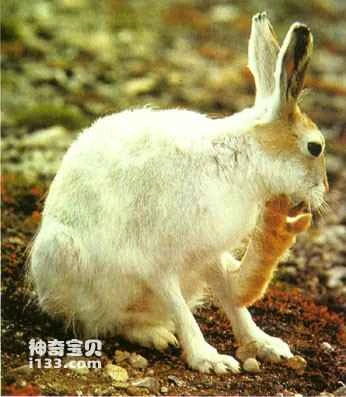
Arctic hare
In the Arctic, the herbivore slightly larger than the lemming is the Arctic hare. However, its numbers are far fewer than those of lemmings. The Arctic hare population is very limited, even fewer than that of foxes. This is because Arctic hares have a low reproductive rate. Limited by climate and food, they can only produce one litter per year, with only 2-5 offspring per litter. However, their survival rate is relatively high, so their numbers are relatively stable, unlike the lemming population which experiences dramatic fluctuations and mass suicides. Consequently, they don't have the same level of notoriety as lemmings.
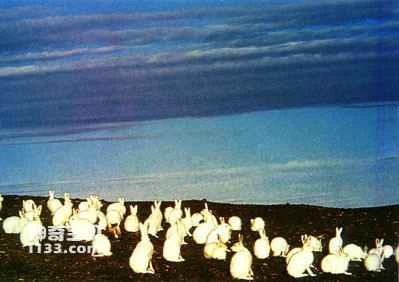
Arctic hare group
Arctic hares have various names; in some places they are called mountain hares or blue hares, while in North America they are called snowshoe hares. This is because these North American hares not only have large hooves but also long fur underneath them, which helps reduce pressure, making them less likely to sink into snow even when running. These hares share a common characteristic, or rather, a survival skill: they can change their fur color with the seasons. They are grayish-brown in spring, summer, and autumn, and turn pure white in winter. This not only facilitates camouflage but also provides optical reflection, making them difficult for predators to spot.
In addition, Arctic rabbits have a unique ability: their offspring can see immediately after birth, which is essential for survival. Domestic rabbits, on the other hand, always keep their eyes closed after birth and only open them to see after 12 days.
Arctic hare meat is delicious, and its fur is valuable. Therefore, it has become a target for hunting.