Arctic foxes belong to the Canidae family. They have a narrow forehead, a pointed muzzle, rounded ears, and a bushy tail with a white tip.
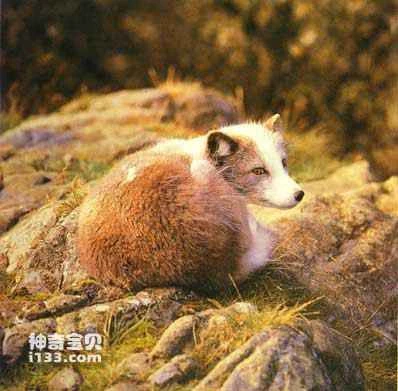
Foxes are the true masters of the Arctic grasslands. They have lived there for generations and have virtually no natural predators besides humans. Therefore, before fur traders arrived in the Arctic, foxes lived freely and carefree. While they were powerless against large herbivores like reindeer, they were adept at catching small birds, collecting bird eggs, hunting rabbits, and gathering mollusks for food on the shore. In autumn, they could also change their diet, foraging for berries in the grass to supplement their vitamin intake.
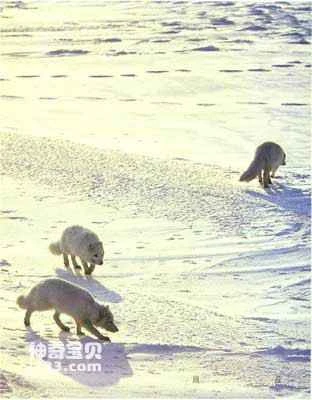
Foraging in the snow
The primary food source for Arctic foxes is lemmings. When encountering lemmings, the Arctic fox will leap with remarkable accuracy, pounce, pin the lemming to the ground, and devour it. Interestingly, when the Arctic fox smells the scent of lemmings in their burrows and hears their squeaks, it will quickly dig up the lemming burrows hidden under the snow. Once it has dug nearly enough, the Arctic fox will suddenly leap high into the air, using the momentum of its jump to collapse the snow-covered burrow with its legs, catching and eating the entire lemming family one by one.
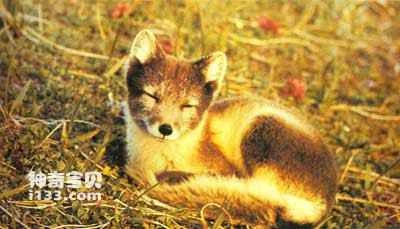
Arctic foxes in summer
The Arctic fox population fluctuates in sync with the lemming population. Typically, years with low lemming mortality coincide with peak Arctic fox populations. Driven by survival needs, the foxes migrate to other areas. During these times, a disease called "mad dance" inexplicably spreads among the fox population. This disease is caused by a virus invading the nervous system. Infected Arctic foxes become abnormally agitated and excited, often losing control and running amok, even daring to attack passing dogs and wolves. Most die in the first winter, with carcasses numbering as high as two per square kilometer. Local hunters then harvest the pelts from these carcasses.
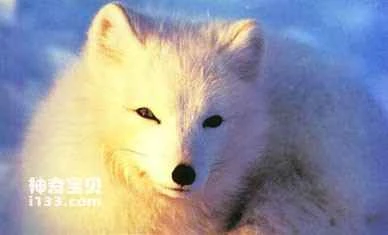
Arctic fox in winter
Arctic foxes are covered in long, soft, and thick fur, allowing them to thrive even in temperatures as low as -45°C. This has enabled them to survive for generations in the harsh Arctic environment. Although people don't have a fondness for foxes themselves, they are well aware of the value and uses of fox fur. Wealthy and powerful individuals consider wearing fox fur coats a mark of prestige and prestige. The quality of fox fur varies; the further north one goes, the better the quality and the softer the fur, making it more valuable. Therefore, Arctic foxes have naturally become a sought-after target for hunters.