To understand and evaluate the phylogenetic position of the Tibetan woolly rhinoceros within the Rhinocerotinae subfamily, Deng Tao et al. analyzed a group comprising 17 rhinoceros genera and species, including all five extant rhinoceros species and twelve extinct species, including all four known woolly rhinoceros species. In the resulting phylogenetic tree, the positions of extant rhinoceroses were consistent with analyses by molecular biologists based on mitochondrial genome sequences and paleontologists based on morphological characteristics. However, regarding the question of which extant rhinoceros species the woolly rhinoceros is most closely related to, Deng Tao et al.'s analysis differed from previous findings. They discovered that the Sumatran rhinoceros (Dicerorhinus sumatrensis) is a sister group to both the two extant one-horned rhinoceroses (Indian rhinoceros Rhinoceros unicornis and Javan rhinoceros Rhinoceros sondaicus) and the woolly rhinoceros lineage; or, the two one-horned rhinoceroses first formed a sister group relationship with the woolly rhinoceros lineage, while the Sumatran rhinoceros is a sister group to this larger lineage. Conversely, previous morphological analyses considered the woolly rhinoceros to be a sister group to the African rhinoceros (Diceros bicornis and Ceratotherium simum), while molecular biology results indicate that the woolly rhinoceros is a sister group to the Javan rhinoceros. However, in other analyses, the woolly rhinoceros is the only extinct type. Therefore, adding extinct rhinoceros species to phylogenetic analyses will inevitably impact the morphological relationship between the woolly rhinoceros and extant rhinoceroses. If molecular data from more fossil taxa are incorporated into phylogenetic analyses, the results will clearly change as well.
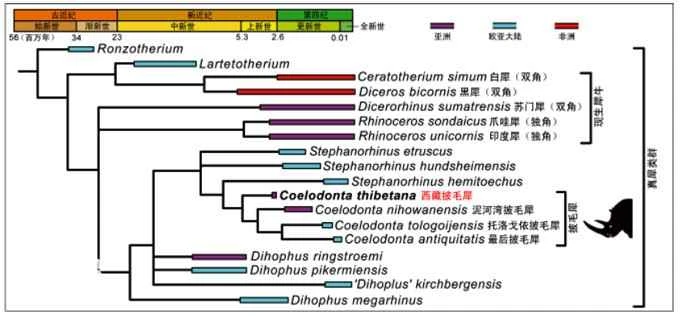
Phylogenetic relationships of woolly rhinoceroses
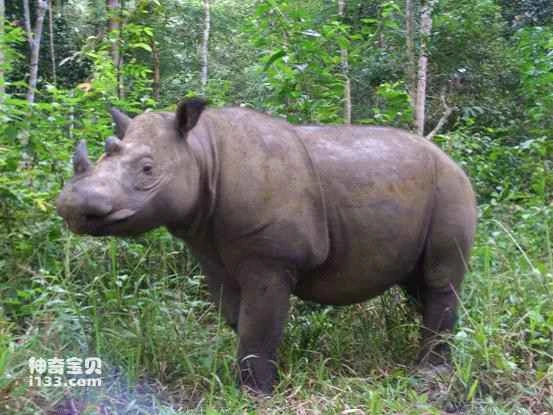
Sumatran rhinoceros
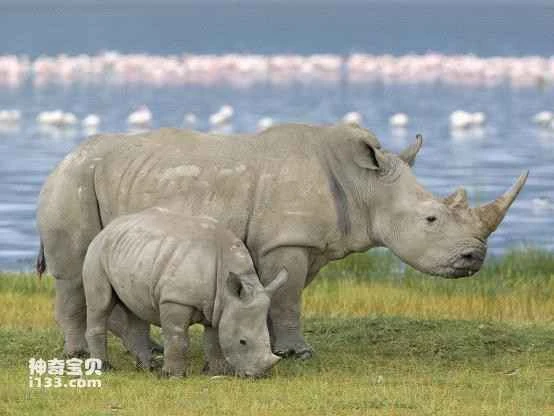
White rhinoceros
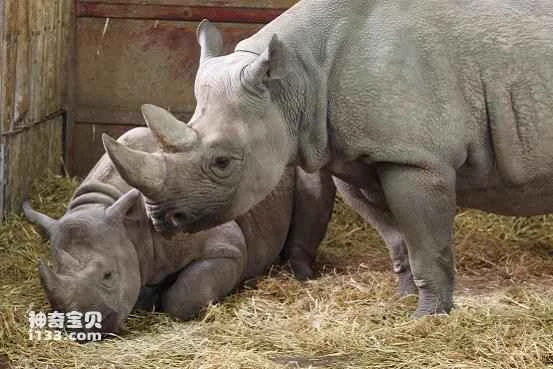
Black Rhino
4 types of woolly rhinoceroses
1. Tibetan woolly rhinoceros (Coelodonta thibetana) Deng et al., 2011
The Tibetan woolly rhinoceros, discovered in the Pliocene sediments of the Zanda Basin in the Ngari region of Tibet, dates back approximately 3.7 million years and is the earliest and most primitive known woolly rhinoceros. It possesses a series of typical characteristics of woolly rhinoceroses, including a long head, ossified nasal septum, a broad and laterally flattened nasal horn base, downward-sloping nasal bones, an elevated and posteriorly extended occipital crest, large tooth crowns, and well-developed tooth sockets. However, the Tibetan woolly rhinoceros differs from other more advanced woolly rhinoceroses primarily in its weaker ossification of the nasal septum, occupying only one-third of the length of the nasal notch; anterior displacement of the mandibular symphysis; sparse chalky coverage on the cheek teeth, with slight external ridge folds; a weak medial cusp of the second upper molar; a triangular outline of the third upper molar; a blunt anterior ridge of the lower cheek tooth's anterior cusp, with a recurved lower ridge and a significantly curved posterior end; and weak anterior ribs of the second and third lower molars. The skull of the Tibetan woolly rhinoceros had a remarkably long face; a rough surface covered the entire back of the nasal bone, indicating that it possessed a large nasal horn when alive; a broad, low ridge on the frontal bone indicated that it also had a smaller frontal horn. The nasal horn was larger in relative size than that of most extant and extinct rhinoceroses, and similar to that of the Elasmodium and Diplodocus, but narrower in shape. As the Ice Age began to appear around 2.8 million years ago, the Tibetan woolly rhinoceros left the high plateau region, went through several intermediate stages, and finally arrived in the low-altitude, high-latitude regions of northern Eurasia, becoming an important member of the flourishing mammoth-woolly rhinoceros fauna during the Middle and Late Pleistocene, along with yaks, argali sheep, and blue sheep.
2. Coelodonta nihowanensis Kahlke, 1969
The woolly rhinoceros of Nihewan lived during the Early Pleistocene, 2.6 to 2 million years ago. It was first discovered in the Nihewan Basin of Yangyuan County, Hebei Province, and later found in Linyi County, Shanxi Province, and Gonghe County, Qinghai Province. The most complete skull and mandible specimens were found in the Wucheng loess of Dongxiang County, Linxia Basin, Gansu Province. It was a relatively small and structurally primitive woolly rhinoceros. The skull was not particularly narrow or long, with the occipital base approximately 65 cm long; the face was relatively short, with the length of the face anterior to the orbit being about 7/10 of the length of the cranium posterior to the orbit; the anterior nasal bone was rounded and located far from the premaxilla; the distance from the nasal notch to the anterior orbital margin was particularly short, with the anterior orbital margin located anterior to the third molar; the zygomatic arch was curved; the occipital roof was not particularly strongly tilted backward. The vertical ramus of the mandible was also not strongly tilted backward. The lower incisors still had alveoli in adults; the cheek teeth had a very thin chalky covering; the upper and lower premolars, especially the lower second premolar, were relatively large; the upper third molar was triangular.
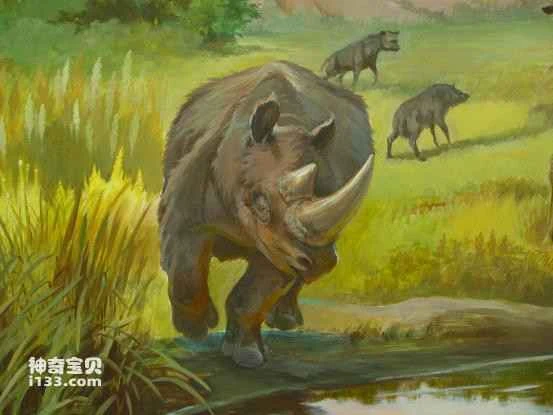
Reconstruction of the woolly rhinoceros from Nihewan
3. *Coelodonta tologoijensis* Beljaeva, 1966
The Tologoi woolly rhinoceros was first discovered in Tologoi, near Ulan-Ude on the eastern shore of Lake Baikal in Russia. Later reports indicate it was also found near Ulaanbaatar in Mongolia and Thuringia in Central Europe. Its earliest known existence dates back to the Middle Pleistocene, about 750,000 years ago, and it spread from Siberia to Europe about 460,000 years ago. Its skull was relatively broad and short, with a posteriorly tilted occipital surface and an occipital crest hanging over the occipital condyle. The occipital region was significantly narrower than the frontal bone portion of the top of the head. The zygomatic arch was strongly curved; the eye sockets were quite high, almost reaching the forehead; the nasal bone tip tilted downwards, causing the nasal horn base to tilt forward; the rough nasal horn base occupied the entire surface of the nasal bone, and the frontal horn base also spanned the width of the frontal bone; the posterior part of the skull was relatively long. The anterior part of the upper cheek teeth was significantly outwardly flared, and the complex structure of the teeth indicates its further development of a completely herbivorous diet. The limb bones of the Tologoi woolly rhinoceros also evolved synchronously with the skull, exhibiting slender and agile characteristics suitable for running.
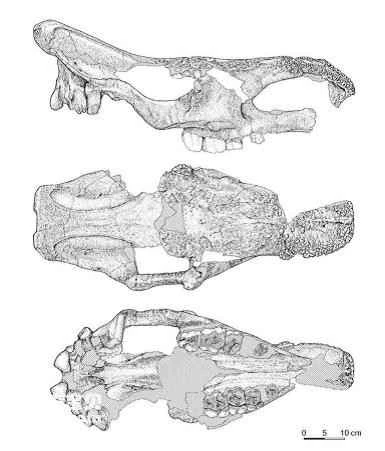
Tologoi woolly rhinoceros skull
4. Finally, the woolly rhinoceros Coelodonta antiquitatis (Blummenbach, 1799)
The woolly rhinoceros lived during the Late Pleistocene epoch. It was the most widely distributed woolly rhinoceros, with fossils found throughout northern Eurasia, from the Korean Peninsula in East Asia to Scotland in Europe, until its extinction about 10,000 years ago. Its fossils are also abundant in Northeast China, with typical locations such as Yushu County in Jilin Province and the Salawusu region of Inner Mongolia. It is one of the most famous Ice Age animals, possessing a very robust skeleton, thick fur, and a large nasal horn, and was the largest of all woolly rhinoceroses. Paleontologists have a very detailed understanding of the woolly rhinoceros's anatomy, as mummies have been found in permafrost or bitumen deposits, preserving their blanket-like fur and bony horns, unlike other rhinoceros horns which have not been fossilized. Early humans once coexisted with the woolly rhinoceros, depicting it in cave paintings, preserving what it looked like in its natural habitat.
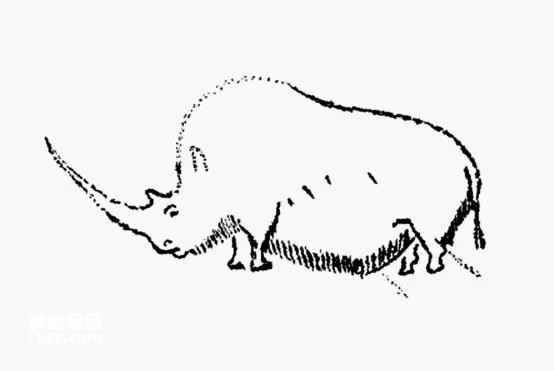
Woolly rhinoceros painted by Stone Age humans in cave paintings