The Tibetan woolly rhinoceros possesses typical characteristics of woolly rhinoceroses, such as a long skull, ossified nasal septum, broad and flat nasal horn base, downward-sloping nasal bones, raised and extended occipital crest, large tooth crowns, and well-developed tooth sockets.
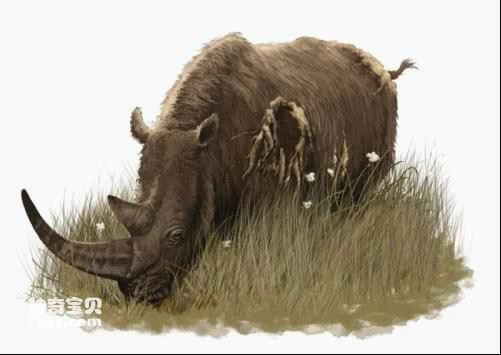
Reconstruction of the Tibetan woolly rhinoceros
On the other hand, the Tibetan woolly rhinoceros differs from other advanced woolly rhinoceroses in that its nasal septum is less ossified, accounting for only one-third of the length of the nasal notch; the mandibular symphysis is shifted forward; the chalky coating on the surface of the cheek teeth is sparse, and the external ridge folds are slight; the central cusp of the second upper molar is weak, and the third upper molar is triangular; the lower cheek teeth have a recurved lower ridge with a significantly curved posterior end; and the anterior ribs of the second and third lower molars are weak.
The skull of the Tibetan woolly rhinoceros has a rather long face, with a rough surface covering the entire back of the nasal bone, indicating that it possessed a large nasal horn when alive; a broad, low ridge on the frontal bone suggests that it also had a smaller frontal horn. The nasal horn was larger than that of most living and extinct rhinoceroses, and similar to that of the Elasmodon and Diplodocus, but narrower in shape.
The Tibetan woolly rhinoceros, based on skull size estimates, could weigh up to 1.8 tons. Body size is crucial in determining a mammal's metabolic rate; the need for heat retention per unit of body weight decreases with increasing size. In herbivores, this means that absolute body size is a key factor in determining the fiber/protein ratio an animal can tolerate; larger animals require a lower proportion of protein and can tolerate a higher proportion of fiber. The Tibetan woolly rhinoceros was similar in size to the Nihewan woolly rhinoceros but smaller than the Late Pleistocene woolly rhinoceros, which reached a much larger weight in colder climates.
The cheek teeth of some primitive rhinoceroses began to gradually change with the changes in the natural environment. By the Late Pleistocene, the woolly rhinoceros had evolved into an animal that fed entirely on herbaceous plants: the molars became taller, developed chalky white, and the enamel in the tooth sockets thickened—all adaptations to a rougher diet. The upper molars of the Tibetan woolly rhinoceros had been significantly worn into rounded cusps, neither as sharp as those of rhinoceroses that fed on leaves nor as blunt as those that fed purely on herbaceous plants, indicating a diet primarily composed of herbaceous plants but mixed with shrubs. These characteristics are similar to those of the Nihewan woolly rhinoceros and the Tologoi woolly rhinoceros.
The snow-scraping ability of its large, forward-pointing nasal horn was likely the most crucial feature enabling the Tibetan woolly rhinoceros to adapt to the harsh winters of the Qinghai-Tibet Plateau, representing a unique evolutionary advantage within the woolly rhinoceros lineage. This simple yet significant "innovation," occurring before the formation of the permanent Arctic ice cap, laid an important foundation for the woolly rhinoceros's successful flourishing in the Late Pleistocene glacial fauna.