Around 208 million years ago, a mysterious global catastrophe caused the extinction of many species. This catastrophe marked the end of the Triassic period and the beginning of the Jurassic period.
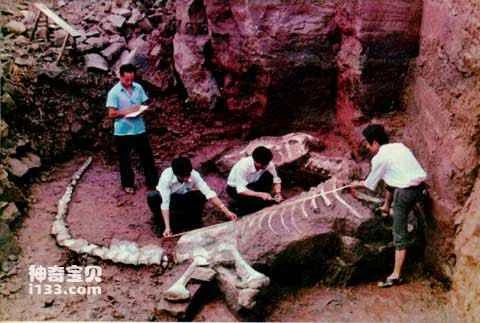
Dashanpu Dinosaur Excavation Site
What caused this mass extinction? Scientists have offered several possible explanations. One explanation suggests that it may have been caused by a massive asteroid impact, or by changes within the Earth that triggered a series of large-scale volcanic eruptions, leading to drastic climate changes and ultimately mass extinction. Another explanation proposes that the collapse of Pangaea at that time caused regional environmental changes in the various continental blocks that broke apart, resulting in mass extinction.
Whatever the reason, the result was that many large reptiles went extinct, while many species of small dinosaurs, small terrestrial crocodiles, and mammal-like reptiles survived the catastrophe and continued to evolve and develop over the years.
Among these survivors, one evolutionary path led to extreme gigantism, and this is the sauropod family.
The sauropod dinosaur family certainly evolved from some kind of archaeopod dinosaur in the Early Jurassic. However, due to the extreme scarcity of fossils of terrestrial vertebrates from the Early Jurassic, we know very little about the details of the origin and early evolution of sauropods at that time. There may be many reasons for this extreme scarcity of fossils, but one reason cannot be ignored: the expansion of Earth's seas at the beginning of the Jurassic. The expansion of seas caused shallow seas to encroach on the interior of many continents, a phenomenon known as marine transgression. Conversely, at some point in Earth's history, there were also periods when seas shrank, exposing former shallow seabeds as land, a phenomenon known as marine regression. While the marine transgression of the Early Jurassic submerged much of the land that had been inhabited during the Late Triassic, the Jurassic landmass itself contained vast areas of desert environments, as evidenced by the widespread distribution of ancient sand dune deposits in the Early Jurassic strata of western North America. Under these environmental conditions, animals faced many adverse challenges to survival, and their burial and fossil formation after death were equally difficult.
The global scarcity of terrestrial strata and terrestrial vertebrate fossils during the Middle Jurassic period has not improved significantly. However, in Zigong, Sichuan Province, my country, nature has left behind a treasure trove of historical relics, a place called Dashanpu.
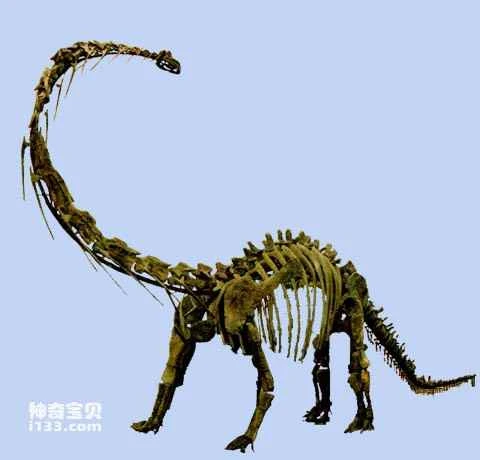
Shulong
The rock strata of Dashanpu contain numerous complete fossil skeletons of herbivorous dinosaurs, as well as fossilized trunks of many enormous coniferous trees. These dinosaur fossils tell us about the populations of many previously unknown large dinosaurs (especially quadrupedal herbivorous dinosaurs). These dinosaurs lived in lowland forests with abundant water, and the plentiful food and suitable environment allowed them to grow to enormous sizes. Especially the long-necked sauropod dinosaurs, which could stretch their necks to reach leaves high in the trees, out of the reach of other animals.
These sauropod dinosaurs include many species such as Shu-saurus, Qiu-saurus, and Emei-saurus. The discovery of so many species in the same location and strata of the same period indicates that sauropod dinosaurs had already diversified into many evolutionary branches by the Middle Jurassic period, thus suggesting that the origin of this large family must have been earlier than the Middle Jurassic period.