The December 8, 2000 issue of the prestigious American scientific journal *Science* will publish a research paper by Zhang Fucheng and Zhou Zhonghe, young scientists from the Institute of Vertebrate Paleontology and Paleoanthropology, Chinese Academy of Sciences, reporting their discovery of the world's most primitive enantiornithine bird to date—*Protopterornis*. The fossil of *Protopterornis* possesses a previously unknown type of feather, providing crucial evidence for the early evolution of feathers.
Feathers have long been considered a unique structure of birds, distinguishing them from all other vertebrates. However, the scientific community previously knew very little about the origin of bird feathers, with the only existing theory being that "bird feathers and reptile scales are homologous" or "feathers originated from reptiles." In recent years, the discovery of feathered dinosaurs in western Liaoning, my country, has made the origin of feathers a hot topic in paleontology and a subject of public interest.
Archaeopteryx is recognized as the most primitive bird, but it doesn't provide much information about the origin of feathers because its feathers are almost completely different from those of modern birds.
The skin derivatives on the bodies of feathered dinosaurs such as *Sinosauropteryx*, *Beipiaosaurus*, *Sinornithosaurus*, and *Microraptor* bear a striking resemblance to bird feathers, making these hair-like structures on these small theropod dinosaurs easily mistaken for primitive feathers. However, these hair-like structures on these species, which link dinosaurs to birds, do not establish a strong connection between bird feathers and reptile scales. Firstly, no branching structures have been found on these dinosaur hair-like structures to date, preventing a direct link to branched feathers in birds; secondly, these hair-like structures are also difficult to directly connect to reptile scales.
The recently discovered feathers of Caudata and Archaeopteryx were once considered the strongest evidence for the existence of feathers in dinosaurs. However, some scientists believe that Caudata was a secondary degenerate bird, and its feathers were therefore secondary degenerate, rather than representing a type of primitive feather. Since Caudata is generally considered to be more closely related to Oviraptorosaurs, and less closely related to birds than Sinornithosaurus, which belongs to the dromaeosaurid group, its feathers are thought to have likely developed independently or been degenerate, and therefore have no direct relationship with the origin of bird feathers.
Scientists discovered a species of long-scaled dinosaur in Central Asia with elongated scales. The similarity of these scales to modern bird feathers suggests that the early stages of feather evolution in birds were far more complex than previously thought. Feathers may have already appeared in reptiles even more primitive than dinosaurs.
This newly discovered Protoptera fossil exhibits a novel feather type never before observed. The proximal end (closer to the body) lacks barb-like branching structures, while the rachis is flanked by homogeneous vane structures, remarkably similar to reptile scales. The distal end (farther from the body) differentiates into barbs, but the space between the barbs and the rachis also exhibits the same homogeneous vane structure as the proximal end, perfectly mirroring the feather structure of modern birds. This skin derivative, resembling both reptile scales and typical bird feathers, directly links reptile scales to bird feathers.
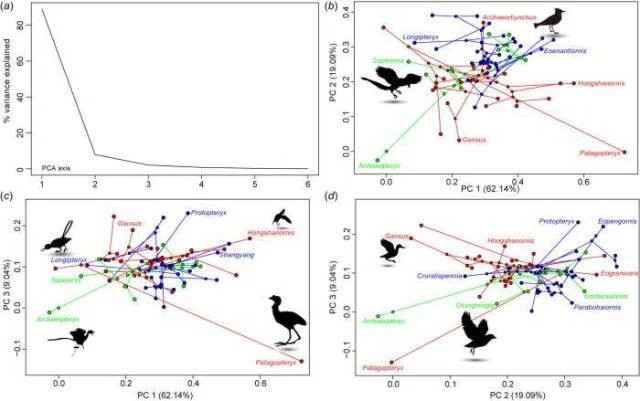
Based primarily on their research on this unique feather type, Zhang Fucheng and Zhou Zhonghe proposed a model for the evolution of early bird feathers. They argued that bird feather evolution mainly went through four stages: 1) scale elongation; 2) thickening of the central part of the scales, resulting in the appearance of the rachis; 3) differentiation of barbs; and 4) the growth of barbules and hooks, ultimately forming the typical feathers of modern birds. Furthermore, another important argument of Zhang Fucheng and Zhou Zhonghe is that prism feathers and down feathers rapidly differentiated in the early stages of feather evolution and then evolved independently to the present day.
Through morphological studies and systematic analysis of *Protoceratops*, Zhang Fucheng and Zhou Zhonghe discovered that *Protoceratops* is the most primitive enantiornithine discovered to date. Enantiornithines were the most important bird group of the Mesozoic Era, once widely distributed throughout the world, but later became extinct. *Protoceratops* itself was also a specialized type, most notably characterized by its relatively long hand bones and wingtips, a feature very similar to *Archaeopteryx* and *Confuciusornis*, and different from other enantiornithines. Clearly, *Protoceratops* represents an intermediate type between *Archaeopteryx* and other more advanced birds.
The structure of the coracoid bone on the chest of the Protopoda shows some characteristics of the protocoracoid process, suggesting that it is the earliest bird discovered to date with a protocoracoid process. The appearance of the protocoracoid process in fossil birds and the related three-bone-hole structure demonstrate for the first time that the Protopoda already had a strong ability to fly actively.
Another important characteristic of protoplanet is the preservation of the pygmy wingtip, a flight structure not found in Archaeopteryx and Confuciusornis. Pygmy wingtip is the structural basis for slow flight and aerial maneuvers in modern birds, playing a crucial role in takeoff, hovering, and landing.