Nodosaur lived in the Late Cretaceous period and was named by the famous paleontologist Marsh in 1889, meaning "a lizard with nodules or nodes".
Ankylosaurus, approximately 4-5 meters long, was primarily found in North America. Its head and body were covered with tuberculate bony plates; spike-like protrusions were distributed along its sides. It lacked a hammer-like protrusion at the tail end. Its back was arched, its body rounded, its head small, and its limbs robust. However, unlike other ankylosaurus, it lacked erect bony plates on its back, instead being covered from head to tail by thick bony plates. These plates were small and densely packed, resembling tank treads. Small bony protrusions were regularly distributed on these plates, as if a "bone blanket" covered its back. Although ankylosaurus had bony plates covering their backs, they lacked sharp teeth and primarily fed on tender leaves and roots of plants.
Interestingly, the nodosaur resembles a stegosaur in appearance, with an arched back and walking on four legs, but its hind limbs are roughly the same length as its forelimbs, and it has short, wide feet. Its head is also larger than that of the stegosaur. A key difference from the stegosaur is that instead of upright sword-like plates, it has wide, flat bony plates covering its back, each with small bony protrusions. The nodosaur's limbs and torso are quite strong, capable of supporting the weight of these plates.
During the period when the ankylosaur lived, many predators roamed the land, the most famous of which was the infamous Tyrannosaurus Rex. When the small ankylosaur encountered a Tyrannosaurus Rex, it would usually lie down and remain motionless immediately. Unlike the ankylosaur, it did not have a bony mace on its tail, which was the only way it could effectively deal with large predators.
The ankylosaur group, represented by *Arthrosaurus*, is a unique member of the ankylosaur family. They are easily distinguished from other ankylosaurs due to a feature not found in other ankylosaurs: protruding bony spikes on their shoulders and neck. They also lack the club-shaped tail tip found in other ankylosaurs.
The nodosaur group first appeared during the Albian stage (a geological stage, the last stage of the Early Cretaceous, approximately 90 million to 112 million years ago), among which *Scutosaurus septemlobus* is the most famous. *Scutosaurus septemlobus* is a large nodosaur group, with its fossils measuring approximately 5.5 meters in length.
The origin of ankylosaurs is generally believed to be somewhere in Europe, but this remains a subject of much debate in paleontology. Evidence suggests that ankylosaurs and spiny ankylosaurs are the only ankylosaur species that migrated throughout Europe. Most ankylosaurs did not have this habit. Recent research even suggests that these wandering ankylosaurs reached Antarctica via the Pampas region at the southern tip of South America.
The extinction of South American arthrosaurids is confirmed to have occurred during the Maastrichtian stage (a geological phase, the last stage of the Cretaceous, approximately 65 to 71 million years ago), while large numbers of South American dinosaurs had already begun to disappear during the K/E boundary period prior to this. The extinction of arthrosaurids in North America and Eurasia occurred around the same time.
Most nodosaurs were accustomed to inhabiting low-lying coastal areas, although some species lived in high-altitude environments. Therefore, it is reasonable to believe that sea-level changes in the late Mesozoic era may have been one of the reasons for their extinction.
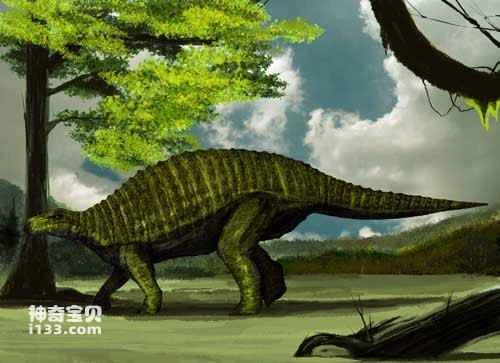
Chinese name: Nodosaurus
Latin name: Nodosaurus
Age of existence: Late Cretaceous
Fossil origin: North America, Wyoming and Kansas, USA
Physical characteristics: 4-6 meters in length
Diet: Plants
Species: Ankylosaurus
Definition: A lizard with nodes or nodes.