Tuojiangosaurus is a medium-sized stegosaur that lived in the Sichuan Basin during the Late Jurassic period. It is named after Zigong City in the Tuojiang River basin, where its fossil specimens were first discovered.
In 1974, the Chongqing Museum led a project to systematically excavate the Wujiaba area near Zigong in Sichuan Province. After three months of excavation, 106 wicker boxes containing skeletal fossils weighing 10 tons were unearthed from the Late Jurassic strata of the upper Shaximiao Formation. These specimens, studied by Dong Zhiming, led to the reconstruction of two Emeisaurus skeletons, one Sichuanosaurus skeleton, and one Tuojiangosaurus skeleton. The Tuojiangosaurus skeleton is the first complete stegosaur skeleton ever discovered in Asia.
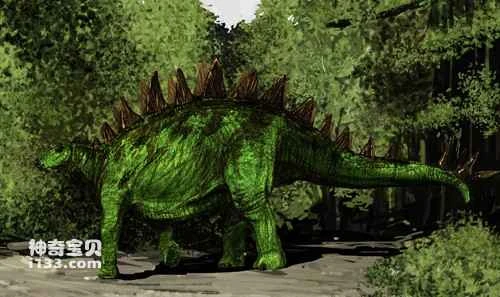
Currently, a fossil of a Tuojiangosaurus is on display in the dinosaur museum of the China Dinosaur Park. It is 7.5 meters long, with a small head, a low, flat top, a long, pointed snout, a high-arched back, and a tail that drags on the ground, its overall shape resembling an ancient Chinese arched bridge. The Tuojiangosaurus has large, varied scutes: those on the neck are thin and peach-shaped, those on the back are triangular, and those on the sacrum and tail are high-spined, flattened conical. From the neck to the sacrum, the scutes gradually increase in height, size, and thickness, with the largest pair located on the sacrum. These scutes are symmetrically arranged on both sides of the midline of the Tuojiangosaurus's back. It has more scutes than other stegosaur species, reaching 15 pairs. The teeth in the upper and lower jaws are small, leaf-shaped, but numerous and closely arranged. Although it was almost entirely armored, ferocious carnivorous dinosaurs were still its natural enemies.
Tuojiangosaurus was closely related to Stegosaurus, which lived in North America at the same time. From its neck and back to its tail, Tuojiangosaurus had 15 pairs of triangular back plates, sharper than those of Stegosaurus, used for defense. At the end of its short, powerful tail were two pairs of upward-pointing barbs, which Tuojiangosaurus could use to strike any carnivorous predators that dared to approach.
Chinese name: Tuojiang Dragon
Latin name: Tuojiangosaurus
Age of existence: Late Jurassic
Fossil origin: Sichuan, China
Physical characteristics: 7.5 meters long
Diet: Plants
Species: Stegosaurus
Meaning: Dedicated to the Tuo River (a tributary of the Yangtze River)