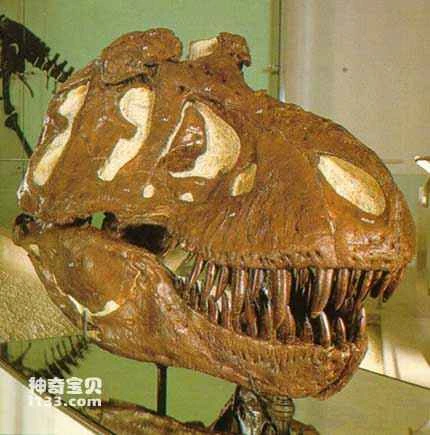
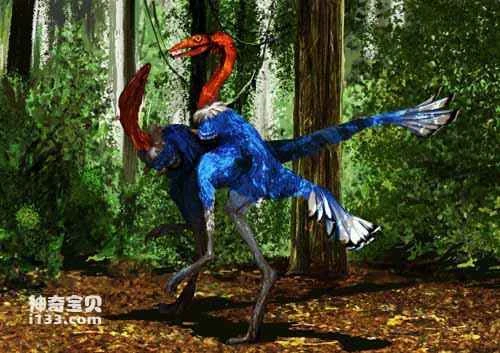
Tyrannosaurus Rex, also known as Tyrannosaurus Rex, was the largest land carnivore ever to have ever existed, weighing between 5 and 7 tons and possibly reaching 15 meters in length. This behemoth seemed designed specifically to prey on other dinosaurs. It had a long, narrow head with well-developed cheek muscles, a massive 1.2-meter-long lower jaw, and a head that was 1.5 meters long. Its eye sockets, measuring 10.2 centimeters in diameter, housed eyeballs with diameters of 7.6 centimeters. It had a short, thick neck and a sturdy body. Its hind limbs were strong and robust, and its tail, though not very long, could be extended backward to balance its body. It had a wide-open mouth with sharp teeth about 23 to 33 centimeters long. However, its forelimbs were disproportionately small, measuring only 1 meter in length, and had only two rather weak fingers.
Although it is more commonly known as Tyrannosaurus Rex, we call it Tyrannosaurus Rex. We have two reasons for this. First, for some species, there is sufficient evidence to identify the genus, but not the species. Second, this prevents confusion. While everyone is familiar with the name Tyrannosaurus Rex, it would be inappropriate to give all animals its full name.
The Tyrannosaurus Rex's diet consisted primarily of ceratopsians and hadrosaurs. This dietary hypothesis has been confirmed. Ericsson of the Rocky Mountain Museum in Montana discovered numerous tooth marks on the hip bone of a Triceratops. Clearly, these large carnivorous dinosaurs preyed on Triceratops. To determine the specific carnivore, Ericsson filled one of the deeper bite marks with dental putty, producing a model that clearly resembled a Tyrannosaurus Rex's teeth. This further illustrates their actual feeding method: they didn't carefully peel the meat from the bone, but rather forcefully bit through the meat and bone, then tore off large chunks of meat.
Similar to modern large carnivorous felines, fighting between individuals was a prominent characteristic of Tyrannosaurus Rex. Their skulls and skeletons bear numerous gruesome wounds and bite marks. Furthermore, numerous examples suggest that these were not caused by their carcasses being disturbed after death; we have evidence of healing (such as newly grown bone) proving that the wounds were inflicted while the dinosaurs were still alive.
In fact, these tooth marks also reveal another key element of Tyrannosaurus Rex's movement characteristics—its head was its primary weapon. If we compare the body shape of Tyrannosaurus Rex with other carnivorous dinosaurs, we will clearly see that its arms were much shorter, its teeth much larger, and its jaw more powerful. Because its arms were so short, when it bit other dinosaurs, its arms could only be used as claws. In the paleontological community, there is a debate about whether Tyrannosaurus Rex was truly an active predator. The renowned paleontologist Holm disagreed, believing that Tyrannosaurus Rex was merely a scavenger. However, we have learned from numerous sources that, given its characteristics, Tyrannosaurus Rex was definitely more than just a scavenger. Of course, like many modern carnivores, it would sometimes eat carrion.
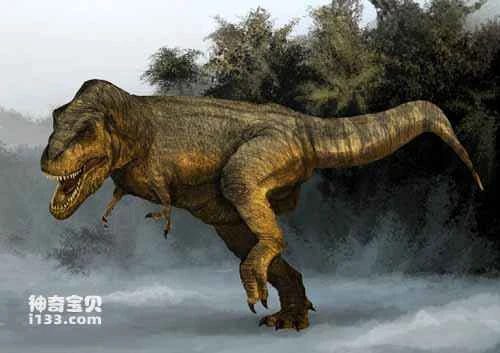
Chinese name: Tyrannosaurus Rex
Latin name: Tyrannosaurus
Age of existence: Late Cretaceous
Fossil sites: Alberta, Canada; New Mexico, Montana, Colorado, Wyoming, and other states in the United States.
Physical characteristics: 12 to 15 meters in length
Diet: Carnivorous
Type: Theropod
Meaning: a brutal lizard