The numerous fossil skeletons of primitive mammals discovered in the Triassic strata of South Wales, UK, represent the earliest mammals on Earth. Paleontologists named them Morgania and classified them in the subclass Ethyrithidae and order Cyclodontia.
Morganus was small in size, and its slender lower jaw clearly belonged to mammalian types—composed of a single dentary bone, rather than several bones like dentary bones and articular bones as in reptiles. However, a groove on the inner side of Morganus's lower jaw still retains a small remnant of an articular bone, suggesting a reptilian origin. One of the more primitive features of Morganus compared to later mammals was that the connection between its lower jaw and skull was still double-jointed, somewhat similar to the last mammal-like reptile, Disegamata, but the two differed in which joint played a dominant role.
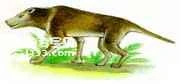
Morgan Beast
Morganus's teeth are mammalian-type, with small incisors, single, large, sharp canines, and premolars and molars with two roots and numerous cusps on their upper surfaces. These cusps are more or less aligned along the central axis of the teeth.
The entire mammalian family that subsequently developed through the "Long Night" gradually differentiated and evolved based on the physical characteristics of Morganus. In this sense, Morganus represents the ancestral type of the entire mammalian family, including humans.