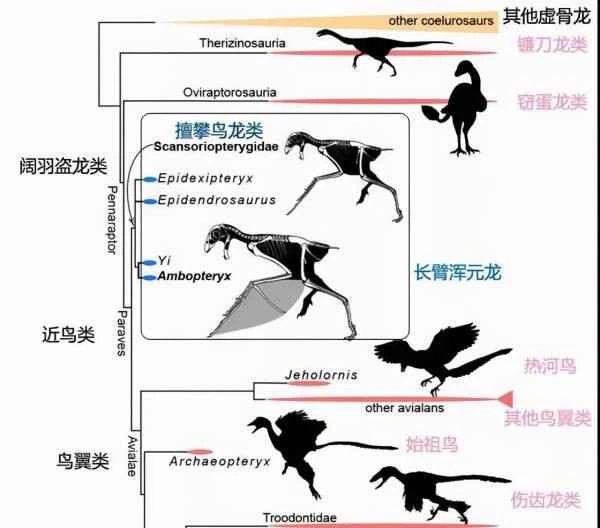
1. Archaeopteryx specimen, gradual evolution, from dragon to bird
With the discovery of more and more feathered dinosaur and primitive bird fossils, scientists have found increasing similarities between the two, such as body structure (size, degree of bone fusion, etc.), lifestyle (diet, nursing, etc.), and age. Therefore, many dinosaur fossil species were initially mistaken for birds, such as *Sinosauropteryx*, *Protarchaeopteryx*, and *Jinfengopteryx*.
More and more scientific discoveries and research are blurring the lines between dinosaurs and birds. Was Archaeopteryx the oldest bird, or a feathered dinosaur? Perhaps the answer to this question is not important. What is important is the continuous evolutionary process formed by the fossils of primitive birds, including Archaeopteryx, and the fossils of feathered dinosaurs, proving that birds originated from a small, feathered theropod dinosaur. In this gradual evolutionary process, birds evolved a series of features adapted for flight, ultimately conquering the skies.
2. Classification of extant birds
Based on their habitat and physical characteristics, birds of the superorder Protuberance (excluding ostriches, rheostodactyls, cassowaries, anaplasms, avian birds, and penguins) can be divided into six major ecological groups:
Waterfowl: Birds that can swim on the water surface and mainly swim on the water surface, including ducks, geese, gulls, etc.
Wading birds: These birds wade in mudflats and wetlands but cannot swim. They are often characterized by "three longs"—long legs, long necks, and long beaks. They include cranes, storks, and shorebirds.
Songbirds: Passerine birds, which are the most evolved group of birds.
Climbing birds: Birds adapted to climbing often have zygodactyl or rotatoid feet, including woodpeckers and parrots.
Landfowl: Birds that live on the ground, whose physical characteristics are adapted to walking on the ground, and who are usually not good fliers, including pheasants, quails, and pigeons.
Birds of prey: Birds that feed on other animals and have features adapted to hunting, such as sharp claws and beaks, and keen eyesight. They mainly include eagles, falcons, harriers, ospreys, buzzards, and owls.
3. Functional inferences about the origin of feathers
Functional theories regarding the origin of feathers often revolve around three hypotheses: flight function; thermal insulation function; and sexual display function. Recent discoveries of Late Cretaceous feathered dinosaurs in China suggest that feathers likely originated from a taxonomic unit that preserved numerous primitive non-avian features. Recent evidence strongly indicates that birds are theropod dinosaurs, and the most primitive known feathers have been found in flightless animals. This further suggests that the initial function of feathers was not flight, thus thermoregulation, sexual display, and biomechanical support remain possible explanations for their origin. Since the earliest function of feathers was not for flight, it can be inferred that the transitional animal reconstructed from fossils found in China likely possessed features similar to reptilian skin derivatives, which later elongated and acquired the characteristics of feathers.
4. Radiation and adaptation of extant birds
There are over 9,000 species of birds living today, belonging to 33 orders. Their body size, proportions, plumage color, song styles, and flight abilities vary greatly. The largest living bird, the ostrich, can weigh over 60 kilograms and has completely lost the ability to fly. The smallest living bird, the hummingbird, weighs less than 30 grams. However, if calculated relative to its body size, it is undoubtedly the fastest vertebrate in the world (flying 385 body lengths per second).
To adapt to different living environments, birds have evolved a variety of body shapes. For example, wading birds often have the characteristics of "three longs"—long legs, long necks, and long beaks—because they wade in mudflats and wetlands. Climbing birds are adapted to climbing life, and their toes are mostly zygodactyl or rotatoid. Birds of prey often have sharp claws and beaks adapted to hunting, as well as keen eyesight.