1. The history of pterosaur research
Pterosaurs were discovered about half a century earlier than dinosaurs, and they were found on every continent in the world. The first pterosaur fossil was discovered in Solnhofen, Germany, between 1757 and 1784. When the Italian scholar Collini described this fossil in 1784, he couldn't even determine its classification. Some believed it lived in the ocean, others thought it was a transitional form between birds and bats, and some scientists even suggested that pterosaurs might be the "phoenix" of traditional Chinese culture. It wasn't until 1801 that the famous French anatomist Cuvier identified it as a pterodactyl, classifying it as a reptile, and named this entirely new creature "Pterodactyl." Later, this type of flying reptile was collectively referred to as "pterosaur."
Since Cuvier named the first pterosaur specimen, scientists have discovered pterosaur fossils on every continent except Antarctica. Their research on pterosaurs covers almost every aspect of the species. This includes their kinship with other animals, physical characteristics, their geographical and ecological environments, lifestyles, locomotion, feeding methods, reproductive methods, and whether they were cold-blooded or warm-blooded.
2. China's Pterosaur
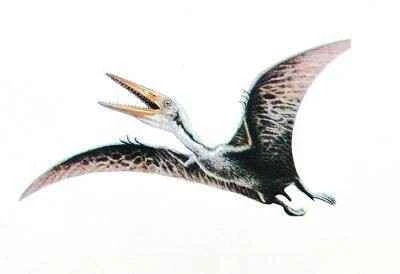
The earliest pterosaur fossils discovered in my country are the *Dzungar pterosaur* and *Fuzhihu pterosaur*, studied by the renowned paleontologist Academician Yang Zhongjian. *Dzungar pterosaur* was a large pterosaur with a wingspan of up to 4 meters. Subsequently, *Huanhe pterosaur* from Qingyang, Gansu; *Narrow-nosed pterosaur* from Zigong, Sichuan; and *Zhejiang pterosaur* from Taizhou, Zhejiang were discovered.
Since the 1990s, numerous pterosaur fossils, such as *Haugami*, *Sinosaurus*, and *Pteranodon*, have been discovered in the Jehol Biota of western Liaoning, making this region one of the richest pterosaur fossil sites in the world. The first pterosaur in China, *W. weigei*, from the Tugulu Group in the Junggar Basin of Xinjiang, is the earliest pterosaur fossil studied in China. The genus name *Junggar* refers to the fossil's location, and the species name *W. weigei* was given to Mr. Wei Jingming of the Paleontology Group of the Exploration Department of the Xinjiang Petroleum Research Institute. In the summer of 1963, he entrusted these specimens to Mr. Yang Zhongjian of the Institute of Vertebrate Paleontology and Paleoanthropology, Chinese Academy of Sciences, for study. Numerous similar pterosaurs have been discovered in the Urho area of northwestern Junggar Basin, Xinjiang, suggesting they lived during the Early Cretaceous period. *W. weigei* was a relatively large pterosaur, with a wingspan exceeding 5 meters. Its head had a sharp, toothless snout that curved upwards, a key feature distinguishing it from other pterosaurs. However, the purpose of this distinctive snout for hunting remains a mystery.
3. Evidence that pterosaurs were warm-blooded animals
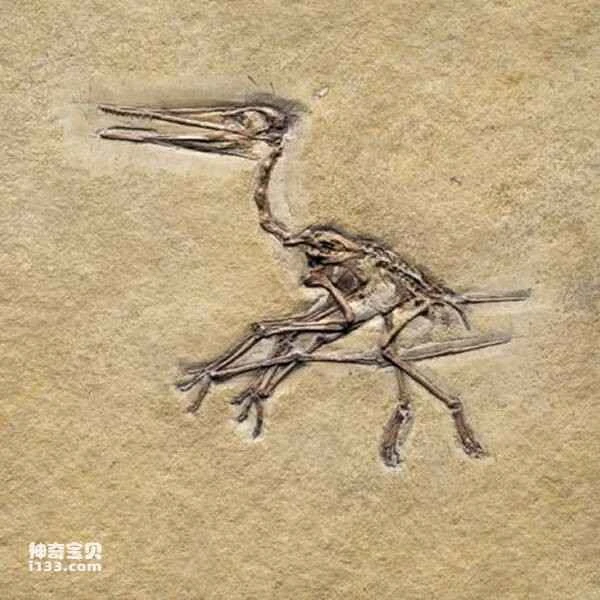
In the early 20th century, British paleontologists believed that pterosaurs, possessing the ability to move rapidly, like bats, with fur on their bodies, and bird-like lifestyles, should be warm-blooded animals with a constant body temperature. Later, imprints of fur were found on a *Rhizophora stylosaur* fossil discovered in Germany. In 1970, a relatively complete pterosaur fossil with "fur" was discovered in Kazakhstan. British paleontologists, through studying the fur-like structures and wing membranes of this specimen, concluded that it was undoubtedly a warm-blooded animal. These "fur" on the pterosaur's body provided insulation, preventing heat loss and regulating body temperature, directly proving that pterosaurs were warm-blooded, homeothermic animals. More recently, the discovery of *Jeholopterus* with "fur" in western Liaoning and other species further proves that at least some small pterosaurs were warm-blooded. Imprints of blood vessels regulating body temperature were found on the large head ridge structure of *Pteranodon spp.* in Brazil. Another piece of evidence comes from the fact that pterosaur skeletons, like birds, have small air sacs for regulating body temperature. These are all direct evidence that pterosaurs were warm-blooded.
4. Pterosaur wings
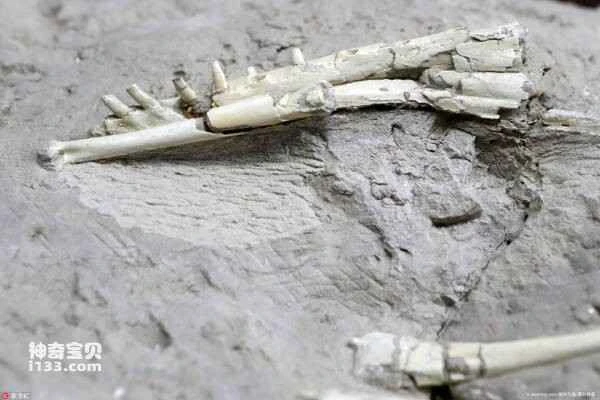
Pterosaurs had highly specialized forelimbs, with the fourth digit elongated and thickened to become a flight phalanx. This phalanx, composed of four phalanges, lacks a claw at the tip and, together with the forelimb, forms the sturdy leading edge of the wing, supporting and connecting the membranes of the body's sides and hind limbs, creating a wing membrane similar to that of birds, enabling flight. Pterosaurs also developed a unique wing bone extending forward towards the shoulder on their wrist, which supported the wing membrane. The first to third digits grew on the outer side of the wing membrane, becoming small, hook-like claws, while the fifth digit degenerated and disappeared.
The wing membrane structure supporting pterosaur flight was completely different from the wing structures of later flying vertebrates—birds and bats. Birds have feathers on their wings that are highly effective for flight and body insulation, while bats, although lacking feathers, have three phalanges that play a crucial role in flapping their wings for support. In contrast, the pterosaur's wing membrane contained only fibers and lacked skeletal support. Therefore, the traditional view held that pterosaurs could not soar freely over long distances like birds, but could only glide or hover over water near their habitat, such as on rocks or in forests by the sea or lake. However, recent studies using CT scans of the pterosaur's brain and its shoulder girdle suggest that pterosaurs were not only capable of short-distance gliding, but likely possessed powerful flight capabilities.