The Chinese have a long history of recognizing pandas, with various names recorded as early as the beginning of writing. The Book of Documents calls them Pi, the Book of Songs calls them Bai Bi, the Records of Mount Emei calls them Pi Xiu, the Book of Beasts calls them Mo, the Praise of the Tapir Screen calls them Tapir, and Li Shizhen's Compendium of Materia Medica calls them Black and White Bears, etc.
The local Tibetans call it Dudongga, while the Yi people call it Equ.
These names were not established based on scientific research, and therefore can only be common names. The reason for this is that China's feudal society was in a closed and backward state for a long time, which prevented Chinese scientists from giving pandas a scientific and widely known name.
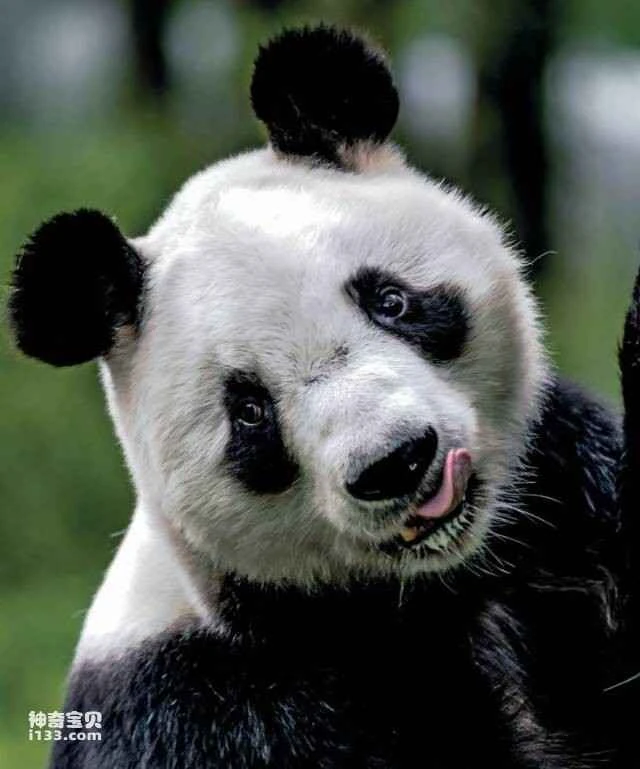
Before we continue discussing the names of pandas, let's briefly mention something unrelated. In vertebrate zoology, when discussing the systematic classification of a species, many technical terms are inevitably involved. These terms are not easily understood by the general public, except for professionals. Therefore, we will try to use as few of these terms as possible in this book, such as Latin words like family, genus, and species.
Having understood the meanings of these biological terms, let's continue with the names of pandas.
The study of pandas through biological morphology began in the late 19th century. In 1869, the French priest David studied a black and white bear skin he had collected from Muping (Baoxing), Sichuan, China. He concluded that this species from Muping, Sichuan, differed from the black bears of western China; its face was rounder, its snout shorter, and its teeth wider. Although different from bears, its overall morphology had not deviated from bear characteristics, and it still belonged to the genus *Ursus* in phylogenetic analysis. However, it was a new member, so he gave it the scientific name *Ursus melanoleucus* (Latin for black and white bear).
In 1870, Alphonse Milne-Edwards, director of the Paris Museum of Natural History, re-examined the "black and white bear" specimen collected by Father David from Muping, China, and published his findings in 1871:
The species named Ursus melanoleucus by David differs in appearance from bears; it closely resembles the red panda (also known as the red panda, first discovered in 1825 on the southern slopes of the Himalayas, and later widely found in Sichuan). In English, the red panda is called a little panda.
In terms of systematic classification, the red panda is a descendant of a common ancestor of bears and raccoons. Simply put, the black and white bear Father David collected from Muping, China, is a species closely related to the red panda.
Based on the above reasons, Miller Edwards changed the genus name Ursus, which David had named the black and white bear, to Ailuropoda, while retaining the species name melanaleuca, resulting in Ailuropoda melanoleuca (Latin for black and white panda).
The name *Ailuropoda melanoleuca* has been used ever since. In all versions of books, whenever the scientific name of the panda is mentioned, it invariably reads *Ailuropoda melanoleuca*.
In English, the panda is called "Cat Bear," which is translated into Chinese as "猫熊" (māoxióng). This is because its face resembles a cat and its body resembles a bear. However, unfortunately, when the "Cat Bear" was first exhibited at the Western China Science Museum in Beibei, Chongqing in December 1944, the title of the exhibit was written horizontally, simply as "猫熊" (māoxióng). At that time, Chinese characters were generally written vertically and read from right to left. As a result, visitors, by habit, read the horizontally written "猫熊" as "熊猫" (xióngxióng, meaning panda). So, they had to go with the flow and accept the mistake. From then on, "猫熊" became "熊猫" (xióngxióng, meaning panda), which is an interesting example of how trends can not be stopped.