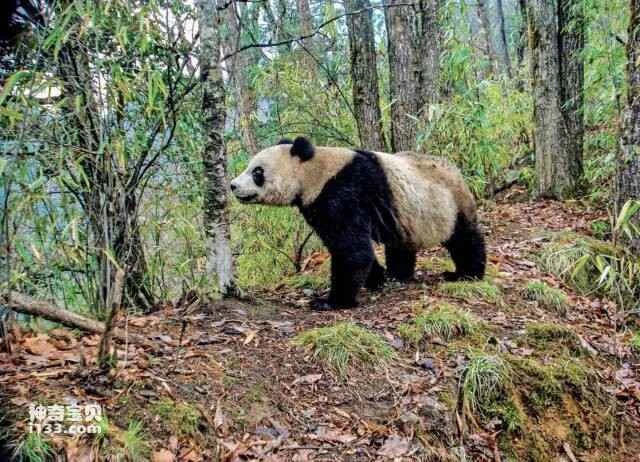
The panda is a mammal unique to my country and one of the most familiar species to people. One reason for its popularity is its dwindling population in the wild; it is estimated that no more than 1,000 remain, putting it on the verge of extinction. However, a look at the panda's history reveals a period of prosperity. From the Late Miocene onwards, the panda roughly experienced the following evolutionary pattern: initiation, growth, peak, and decline.
1. Initial stage: Late Miocene
The initial period began in the Late Miocene (7-8 million years ago), represented by the early panda.
As mentioned earlier, pandas evolved from the ancestral bear (Ursavus) of the Miocene. The earliest type was called *Ailuropoda spp.* This panda was about the size of an obese dog. Its teeth, adapted to bamboo consumption, featured well-developed premolars with a few enamel protrusions on the chewing surfaces. To meet functional needs, the "lobed lobes" disappeared, and the zygomatic arch base shifted forward to the position of the fourth premolar to the second molar. Ecological observations of extant pandas by the China Conservation and Research Center for the Panda (1987) revealed that these animals relied primarily on the tearing and cutting functions of their premolars for food in the wild. In addition to these bamboo-eating characteristics, *Ailuropoda spp.* retained some primitive morphological features, such as sparsely spaced premolars, molars longer than wide, and a nearly rounded lower third molar. These changing and unchanging morphological features of *Ailuropoda spp.* precisely indicate that it was intermediate in phylogenetic relationships between the ancestral bear and the panda, representing the ancestor and early stage of panda-like animals in China.
2. Developmental stage: Early Pleistocene
Their growth period roughly began in the Early Pleistocene (about 2 million years ago), with the red panda as a representative example. Their physical characteristics include the following:
(l) The body size is slightly larger than that of the original panda; (2) The premolars have well-developed anterior cusps, the upper third premolar has a robust anterior inner cusp, and the fourth premolar has a tendency to molarize; (3) The width of the molars is slightly greater than the length; (4) The diameter of the tooth enamel prisms is reduced and the density is increased; (5) The temporal fossa is deep.
Points (l) to (5) show that the evolutionary level is far more advanced than that of the early panda, especially in terms of molars, which have fully developed in the direction of bamboo consumption, that is, they have strong crushing and grinding power. The geographical distribution of the little panda is also more extensive than that of the early panda. To date, its footprints have been found in Anhui, Guangxi, Guizhou, Hubei, Shaanxi, Chongqing and other regions.
However, the skull, teeth, chewing muscles, and mandibular symphysis length of the red panda are far less developed than those of the Bashi subspecies and extant species. In comparison, it can only be considered to be in the developmental stage at an evolutionary level.
3. Peak Period: Late Early Pleistocene (Expanding stage)
The golden age roughly began in the late Early Pleistocene (about 1 million years ago), represented by the giant panda of Bass.
Since the Pleistocene, with the re-uplift of the Qinghai-Tibet Plateau, the Yunnan-Guizhou Plateau in the west and the Qinling Mountains in the north have risen, hindering the expansion of the dry and cold northwest monsoon to the southeast, resulting in significant changes in the ecological environment. The Ba's panda, which evolved from the lesser panda, is one-third larger than the lesser panda, leading to increased food requirements. This, in turn, altered its isolated and closed distribution pattern, and it began to gradually spread from the plateau (Yunnan, Guizhou, Sichuan) to open areas, including the Pearl River Basin in South China, the Yangtze River Basin in Central China, and parts of North China, extending into South Asia to the Mekong River Basin in Vietnam.
At its peak, the panda had a robust, short, and wide skull, with the zygomatic arch plate exceeding 75 mm in height, twice that of the lesser panda. The forward shift of the base of the zygomatic arch concentrated the force for crushing and cutting food onto the fourth premolar and first molar. This chewing mechanism allowed the forces of the masseter muscle, joint, and mandible to be concentrated in one place, conserving muscle biting force. The lingual posterior projection of the mandibular joint and the semi-circular articular surface greatly enhanced the fixation between the head and socket of the joint. The well-developed sagittal ridge, nuchal ridge, and coronoid process expanded the attachment surface for the powerful masticatory and occipital muscles. Compared to later, more advanced bears, the molars of the panda were particularly large. In terms of chewing surface size, the polar bear was quite small; its first molar chewing surface was 1.9 square centimeters, while that of the panda was 5.46 square centimeters. The polar bear was more than twice as heavy as the panda (Zhang Heyu et al., 1960). This demonstrates that although both are carnivores, bears have not changed much in the chewing surface of their teeth after evolving from carnivorous ancestors to omnivores. In contrast, pandas have further specialized, developing large molars and well-developed internal dentition adapted to grinding bamboo or hard plant roots and stems.
It can be inferred that these physical structures of the Bashi ape developed synchronously with its bamboo-eating lifestyle. This allowed it to flourish once it found a suitable living space and had access to more new food sources, reaching the peak of panda evolution.
4. Decline stage: Late Pleistocene
The decline began at the end of the Late Pleistocene (20,000 years ago), represented by the modern panda.
Climate factors played a role in the decline of pandas. Research data shows that during the Last Glacial Maximum, sea levels dropped by 130-140 meters, and the average annual temperature was about 5 degrees Celsius lower than today. This temperature drop prompted some mammals from North China to migrate south. For example, Przewalski's horses, mammoths, and water buffaloes have been found on the seabed between Hujing Island and Wang'an in the Penghu Channel of Taiwan Province; their cheek teeth have a high-crowned grinding type structure. This north-to-south migration was clearly to maintain a relatively stable living environment and meet their food needs. These environmental changes also affected panda territory, as evidenced by a significant reduction in fossil evidence found in various regions (south of the Qinling Mountains).
Entering the early Holocene, approximately 8000 years later, panda subfossils were unearthed at Neolithic sites such as Shuanglong Cave in Jinhua, Zhejiang (7800 years ago), Xiawanggang in Xichuan, Henan (7000 years ago), Bala Cave in Laibin, Guangxi (6500 years ago), and Dashidong Cave in Wushan, Chongqing (6000 years ago), but their numbers were even fewer. Historical records indicate that during the Kangxi era, when my country's population reached 100 million, primitive agriculture experienced a significant period of development, leading to the reclamation of large areas of forest and shrinking living space. Pandas living in open areas gradually became extinct; those in their ancestral homeland (Yunnan, Guizhou, and Sichuan) also declined. Their size was about 1/8 smaller than that of *Panda bashi*, with a posteriorly shifted sagittal and frontal ridge junction, a relatively smaller temporalis muscle attachment surface, and fewer folds on the chewing surfaces of their teeth. These characteristics are evident in panda skulls, mandibles, and teeth unearthed from burial pits at Puding, Guizhou, and the Han Dynasty Southern Mausoleum in Shaanxi.
Besides the factors mentioned above, the decline of pandas also has its own causes, such as low reproduction rate and cub survival rate, and poor self-defense capabilities.
The above evolutionary pattern reveals the entire process of the panda's decline, from its inception to its growth, peak, and eventual fall. Hopefully, pandas can overcome their difficulties and coexist with humans.