Qiao Tuo and colleagues from the Institute of Vertebrate Paleontology and Paleoanthropology, Chinese Academy of Sciences, recently reported online in the journal *Alcheringa* the discovery of *Cathlorhynchus zengi*, a lungfish from the Lower Devonian Yujiang Formation in Guangxi, my country, providing definitive evidence for the discovery of Dipnorhynchidae fossils outside of Australia.
Lungfish are one of only three extant lobe-finned fishes (lungfish, coelacanths, and tetrapods), and are renowned "living fossils." The study of lungfish has played a crucial role in the history of evolutionary biology. Currently, only 3 genera and 6 species of lungfish exist, but they were extremely abundant during the Devonian period. Since 1811, approximately 80 genera and nearly 250 species of fossil lungfish have been discovered, with 49 genera found in Devonian strata. Typical lungfish are highly specialized, possessing unique features such as palatal dental plates; fused quadrate palatine bones and internal skull; and two pairs of nostrils opening on the ventral side of the braincranium, adapting them to crushing feeding and living in the water-land interface. The earliest lungfish are Diabolepis, discovered in the Early Devonian Lokhokovian strata of Yunnan, and Uranolophus and Westolphus, discovered in the Braggian strata of North America and Europe. The postcranial skeleton of these primitive lungfish was still similar to that of other early lobe-finned fishes, but their teeth and skulls had already become morphologically specialized for typical lungfish.
Lungfishes (Dipnorhynchus) are primitive Devonian lungfish, with typical representatives including *Dipnorhynchus*, *Cathlorhynchus*, and *Speonesydrion*. Previously, these three genera of lungfish were only reported in Australia and were considered endemic to the country. Although Zhang Miman et al. previously classified *Erikia*, found in the Amesian strata of Yunnan, my country, into the Lungfish family, this classification has been controversial due to the absence of its dental plates. The *Cathlorhynchus zengeri* reported by Qiao Tuo et al. is a well-preserved lower jaw dental plate specimen provided by Zeng Guangchun, a fossil enthusiast from Guangxi. This specimen is extremely similar to the type species of the *Cathlorhynchus* genus in terms of tooth texture, tooth row, and ventral commissure, undoubtedly classifying it as belonging to the *Cathlorhynchus* genus, providing definitive evidence of the Lungfish family being found outside of Australia. The article also conducted a phylogenetic analysis of Devonian lungfish, confirming the conclusion that *Erikia* belongs to the Lungfish family. Fossil evidence of lungfish suggests a close paleogeographic connection between the South my country Plate and the Australian Plate during the Early Devonian Ames period, confirming the hypothesis that southern my country was the origin and evolutionary center of lobe-finned fishes.

Figure 1. Specimen of *Cassellus zenis*
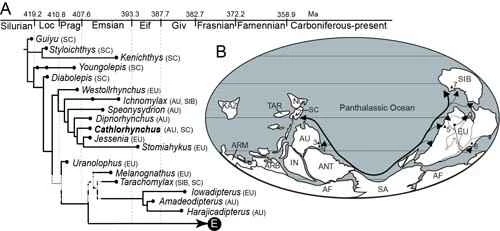
Figure 2. Phylogenetic relationships and evolutionary pathways of lungfish from the Early Devonian period.