A team led by Zhu Min from the Institute of Vertebrate Paleontology and Paleoanthropology, Chinese Academy of Sciences, reported on the discovery of the largest Silurian vertebrate to date, a bony fish named *Megamastax amblyodus*, published in *Nature Scientific Reports* on June 12. Current evidence shows that *Megamastax amblyodus*, dating back 423 million years, could reach a length of 1.2 meters, occupying a high position in the food chain. This is another important discovery in the Xiaoxiang Fauna of the Silurian period in Qujing, Yunnan (following *Dreamlike Ghost Fish* and *Early Holojawfish*). This discovery challenges the traditional view that large vertebrates did not exist before the Amesian stage of the Early Devonian and prompts researchers to rethink the relationship between changes in oxygen levels and vertebrate evolution.
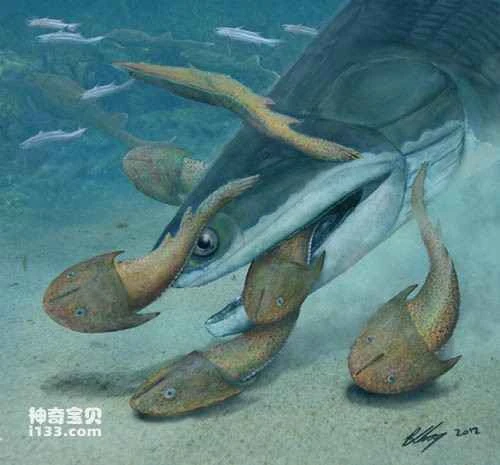
Reconstruction of a blunt-toothed macrojawed fish
After nearly eight years of continuous field investigation and excavation, Zhu Min and his research team have made several groundbreaking scientific discoveries in the Xiaoxiang Fauna of Qilin District, Qujing City, including the placoderm *Entelognathus primordialis*, which possesses bony fish-like marginal jawbones, and the world's earliest complete preserved bony fish, *Guiyu oneiros*. Zhu Min said, "In this treasure trove of Silurian fossils, even scattered bone fragments contain a wealth of scientific information. Although only two lower jaws and one upper jawbone specimen of the blunt-toothed macrognathus reported this time have been discovered so far, the detailed study of it provides crucial evidence for the hot topics of early vertebrate evolution and paleoenvironmental evolution."
Changes in atmospheric oxygen levels are a key concern in paleoenvironmental studies. Paleoenvironmentalists believe that there was a significant increase in atmospheric oxygen levels between the Late Silurian and Early Devonian periods. However, two different theoretical models exist regarding the specific timing of this oxygen increase. Geochemical evidence from molybdenum isotopes suggests that this event occurred in the Early Devonian, about 400 million years ago, which aligns with past fossil records. Traditional paleontology holds that the flourishing of terrestrial vascular plants led to an increase in atmospheric oxygen levels, which in turn allowed jawed vertebrates to grow larger after the Ames stage of the Early Devonian (408 million to 393 million years ago), eventually dominating the Earth's waters; the Devonian period is therefore known as the "Age of Fishes."
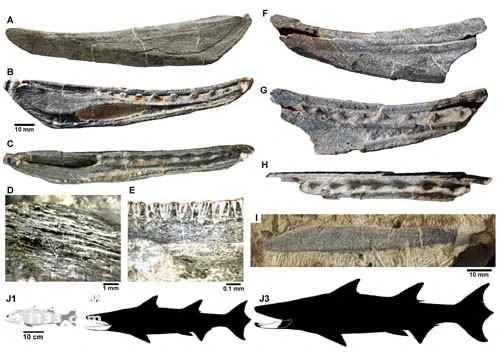
Fossil specimen of blunt-toothed macrojawed fish
However, the discovery of the blunt-toothed macrognathus from the Silurian period, dating back 423 million years, challenges this view. The blunt-toothed macrognathus had a lower jaw over ten centimeters long. Based on the body proportions of the *Dreamfish* and other well-preserved early bony fish, its body length should have exceeded 1 meter, with the largest individuals possibly reaching around 1.2 meters. This far exceeds all previously discovered Silurian vertebrates, thus refuting the assertion that large vertebrates did not exist before the Ames stage of the Early Devonian. Recent paleobotanical studies also indicate that terrestrial vascular plants were already quite abundant by the Late Silurian. These findings all support the model of oxygen content changes shown by the paleoash evidence, namely that the Paleozoic oxygen increase event occurred approximately 420 million years ago in the Late Silurian.
Jawbone features indicate that *Megalodon blunt-toothed macrognathus* was a typical bony fish. The lower jaw consisted of two rows of bones. The outermost part, near the mouth, was a single, elongated dentary bone, the same bone that forms the human lower jaw, covered with layers of bone tissue containing numerous pores. Adjacent to the inner side of the dentary bone was the coronal bone, composed of a series of bones arranged anteriorly and posteriorly. The teeth on the inner and outer jaws were completely different in shape: the dentary bone had several rows of small, fine, sharp teeth, while the coronal bone had eight much larger, blunt-tipped teeth. Researchers speculate that they clearly had different purposes; the outer teeth may have been used to capture and grip prey, while the large, blunt teeth on the inner side were used to crush its hard shell.
In the shallow seas of eastern Yunnan during the Silurian period, shelled brachiopods, bivalves, and trilobites could all have been prey for *Dunyu longiforus*. However, given its size, it was also fully capable of preying on armored fish that lived in the same waters, such as the jawless *Dunyu longiforus* and the jawed *Dunyu primiforus*. *Dunyu longiforus* may have been the earliest apex predator in the vertebrate family.
Traditional views depict Silurian waters as dominated by invertebrates, with small jawless armored fish and the earliest jawed fish living in the shadow of predatory giant cephalopods and sea scorpions. The Xiaoxiang Fauna provides evidence that by the Late Silurian, a thriving school of fish already existed in Yunnan, China, located near the equator. Jawed vertebrates had diversified into many groups, occupying multiple ecological niches, and some were already quite large, potentially pushing the "Age of Fishes" back to the Silurian. The discovery and study of the Xiaoxiang Fauna will continue to significantly change the scientific community's understanding of the early evolutionary history of vertebrates.