*Tsaidamotherium* is a medium-sized bovine species belonging to the order Muscicapidae, living during the early Late Miocene. Its horns are uniquely complex and can be described as "horn organs": a large, disc-shaped bony structure above the parietal bone, called the posterior horn disc; the true horn center is degenerate, located anterior to the horn disc and above the eye socket, and the two horn centers are asymmetrical. This near-unicornal horn center morphology is unique among all bovine species. The earliest *Tsaidamotherium* fossils were discovered in the Qaidam Basin of Qinghai, China, but the material is scarce, and no similar fossils had been found since Bu Lin's first report in 1935. The discovery of *Tsaidamotherium* in the Linxia Basin marks the second discovery of this type of bovine species in over seventy years.
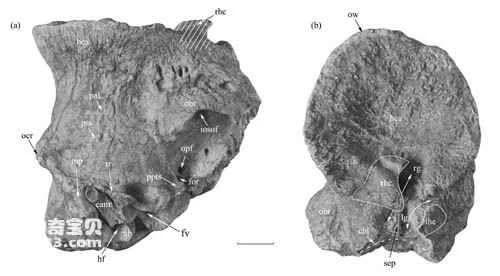
Figure 1. Holotype specimen of *Tsaidamotherium brevirostrum*.
A new species of *T. brevirostrum* from the Linxia Basin is roughly contemporaneous with the genus type, but the true horn core of this new species is more reduced, and the frontal sinus is narrowed and located below the horn organs, representing a more specialized type. The discovery of this new species also supplements the facial features of *T. brevirostrum*, including extremely reduced and thickened nasal bones, osteophytes growing on the lateral margins of the nostrils, and a short and high maxilla, all of which are also highly specialized and rare.
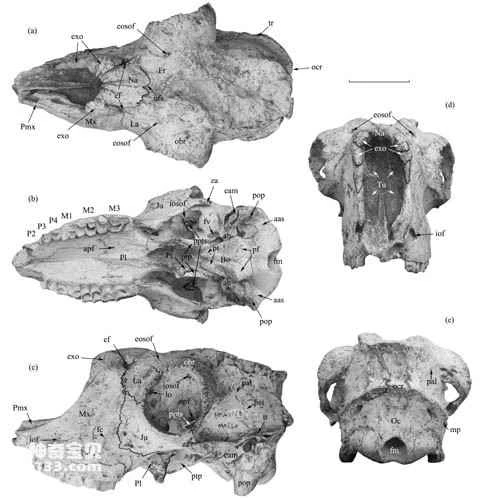
Figure 2. Skull of a female *Tsaidamotherium brevirostrum*.
The posterior morphology of the horn organs of *Qaidamusaurus* resembles the osteophytes at the base of the horn of modern musk oxen. Therefore, the morphology of its horn sheath may also be similar to that of the musk ox horn sheath, being a rounded ridge rather than the more common upright horn sheath. Although there is a slight twist between the horn disc and the longitudinal axis of the skull, both the horn disc and the skull are symmetrical. *Qaidamusaurus* had a short face and narrow, high nostrils, suggesting that it may have had an enlarged nasal cavity, similar to modern saiga antelopes and takins, to adapt to relatively cold climates. The fossil site of *Qaidamusaurus* in the Linxia Basin is located on the southwestern edge of the basin, and its environmental characteristics may differ slightly from those in the central basin. Although fossil material of *Qaidamusaurus* is very rare, its distribution range was relatively wide, and it may have been distributed in the narrow mountainous forest area on the northern edge of the Qinghai-Tibet Plateau.
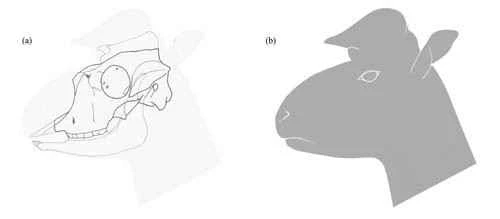
Figure 3. Composite image of the skull and mandible lines of the Qaidam beast (a) and reconstruction image of the head (b).