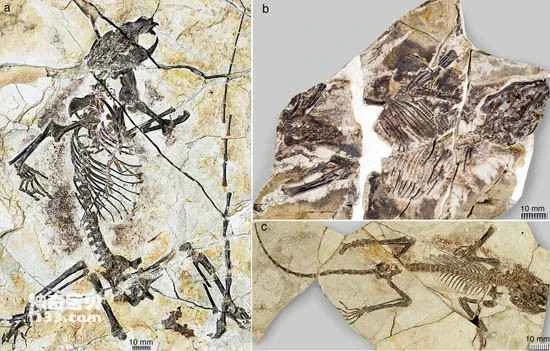
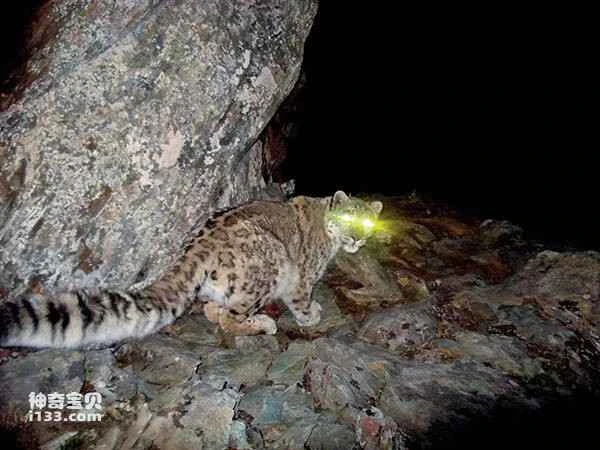
When we hear the name "saber-toothed tiger," many people immediately think of Diego, the character from the animated film "Ice Age." In fact, "saber-toothed tiger" is not the name of a single species, but refers to a group of felines with huge canines that appeared in the Cenozoic era, the most famous of which is Smilodon .
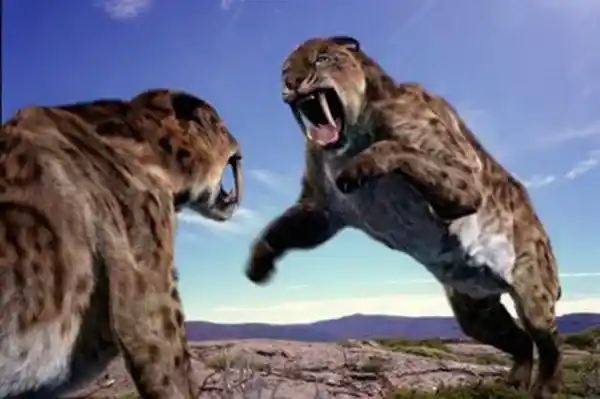
These prehistoric behemoths were once the top predators in North and South America, but ultimately disappeared at the end of the Pleistocene, approximately 10,000 to 12,000 years ago . How did they live? What was the function of their enormous canines? Most importantly, why did they go extinct? This article will use the latest research to reveal the answers.
Further Reading: Prehistoric Animals: Examples of Extinct and Surviving Animals
Basic Overview of the Saber-toothed Tiger
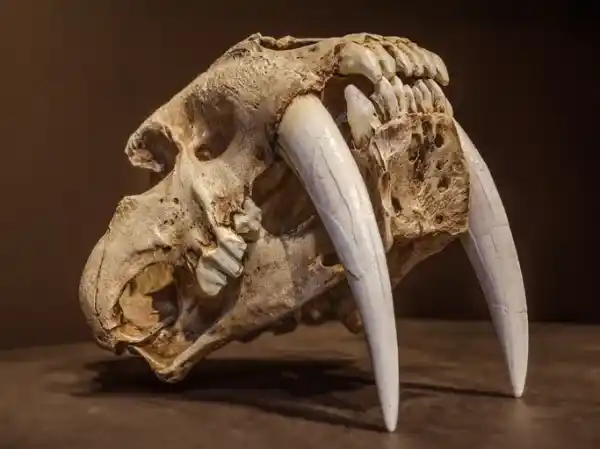
"Saber-toothed tiger" is a general term, mainly referring to several genera and species under the subfamily Machairodontinae . Their most distinctive feature is their extremely long, curved canines, which look like two scimitars stuck in their mouths.
Unrelated to modern tigers : Despite having "tiger" in their names, they are not close relatives of modern tigers. Modern ligers and other felines belong to the Felinae subfamily , while saber-toothed cats belong to the Machairodontinae subfamily. Their common ancestor can be traced back to the Late Oligocene epoch, about 23 million years ago .
Representative species : The most famous are those in the genus * Smilodon *, which include:
S. populator (largest, canines can reach 20–26 cm)
S. fatalis
S. gracilis
Size : Adult individuals stand about 1–1.1 meters tall at the shoulder and can weigh up to 300 kilograms, slightly smaller but more robust than modern lions.
Distribution : The fossil record shows that they were found almost throughout the entire Americas.
Uses of giant canines
Modern lions and tigers typically suffocate their prey by biting its throat or snout. However, saber-toothed tigers had teeth that were too long and too fragile; biting directly into hard bone could cause them to break.
Therefore, they developed a special hunting method :
Prey selection : Primarily target large herbivores (such as bison, camels, juvenile mammoths, etc.), avoiding hunting small animals.
Bite angle : Their jaws can open to an angle of up to 120° , far exceeding the 65° of modern lions.
The fatal blow : Scientists speculate that they pounce on large prey, bite down on their throat from below, and quickly sever the trachea and carotid artery, causing the prey to lose consciousness and bleed to death rapidly.
Specialized teeth : Some individuals have serrated edges on their canines, which allows for cleaner cuts and reduces the danger of prey struggling (such as kicking or butting).
This method reduces prolonged entanglement and energy consumption, enabling them to efficiently hunt animals larger than themselves.
Other physical characteristics
Compared to modern felines, saber-toothed cats have some unique characteristics:
Not a fast-moving hunter : with a stocky body and a short tail (about 35 cm), lacking the agility of modern lions and tigers when running.
Highly developed sense of smell : more reliant on odor tracking.
Smaller brain size : intelligence and social skills may not have been as advanced as those of modern felines.
Strong and powerful limbs : suitable for close-range poaching rather than long-distance chasing.
Retractable claws : similar to those of a cat, but different from those of modern lions and tigers.
Possibly social : Some scholars believe they live in groups and would care for injured or elderly members.
The extinction of the saber-toothed tiger
The saber-toothed tiger went extinct at the end of the Quaternary Ice Age , approximately 10,000 to 12,000 years ago . Scientists generally believe that this was due to a combination of factors:
Climate change
Glaciers retreated, and global temperatures rose by more than 6°C over the course of approximately 5,000 years.
The distribution of large herbivores became scattered, and the number of prey decreased sharply.
Changes in vegetation structure have reduced ambush opportunities, making hunting more difficult.
Ecological competition
At that time, there were many large predators in the Americas (cougars, short-faced bears, giant wolves, etc.).
When prey is scarce, competition among predators becomes exceptionally fierce.
Human factors
The earliest humans to enter the Americas began hunting large animals such as mammoths, bison, and horses, which were the main food of saber-toothed tigers.
Humans' efficient hunting has further exacerbated their food crisis.
Ultimately, under the dual pressures of extreme climate and human activities, the saber-toothed tiger failed to adapt and went extinct.

New research findings
A research team from Vanderbilt University in the United States used the Tooth Micro-Wear Texture Analysis (DMTA) technique to study saber-toothed tiger fossils.
principle :
If food is scarce, predators will crush bones along with their teeth, leaving deep, rough wear marks on the surface of their teeth.
If you mainly eat meat, your teeth will wear down less and be more parallel.
result :
The wear pattern of saber-toothed tiger teeth is similar to that of modern African lions, suggesting that they occasionally crushed bones.
However, evidence suggests that in the final stages before their extinction, the proportion of carcass bones consumed actually decreased, indicating that prey was becoming scarcer.
This result further confirms that food scarcity and ecological competition were the key factors that brought down the saber-toothed tiger.
Summarize
The saber-toothed tiger was not "suddenly wiped out" by a single factor, but rather:
Rapid climate warming → Scattered prey distribution
Changes in vegetation and ecosystems → Increased difficulty of hunting
The emergence of humans → Increased competition at the top of the food chain
Species lacking flexibility (such as saber-toothed tigers) → were eliminated in the struggle for survival.
Ultimately, these prehistoric behemoths disappeared from the earth, leaving behind only awe-inspiring fossils and legendary images.
References
DeSantis LRG, Schubert BW, Scott JR, Ungar PS (2012) The impact of diet on the extinction of saber-toothed cats and cougars. PLoS ONE 7(12): e52453. https://doi.org/10.1371/journal.pone.0052453