A new bird fossil site has recently been discovered near Sihedang Town, Lingyuan City, Liaoning Province. Initial reports suggested that all the bird fossils found at this site belonged to the same ornithoid group: *Iteravis huchzermeyeri*. Early Cretaceous bird fossil sites, in terms of both quantity and species diversity, are generally dominated by enantiornithine fossils. Therefore, the Sihedang site is one of the very few Early Cretaceous bird fossil sites discovered to date that primarily contains ornithoid fossils.
Recently, Hu Han and Zou Jingmei from Zhou Zhonghe's research group at the Institute of Vertebrate Paleontology and Paleoanthropology, Chinese Academy of Sciences, reported the first enantiornithine specimen from this site in the British journal *Journal of Systematic Paleontology*, and established a new genus and species, *Monoenantiornis sihedangia*. This discovery of an enantiornithine provides important evidence for bird diversity at the Sihedang site, and also offers important clues for exploring the fusion sequence of complex bones in Early Cretaceous enantiornithines.
To reduce weight and strengthen the bones required for flight, modern birds exhibit far greater levels of skeletal fusion and degeneration than other animal groups. In Archaeopteryx, the oldest and most primitive bird, none of these complex bones fused. Among basal birds slightly more advanced than Archaeopteryx, skeletal fusion varies, while the more diverse enantiornithines and ornithoids simultaneously show a broader trend towards skeletal fusion.
The newly discovered holotype of *Tetramorpha enantiornithine* was at a previously undiscovered, unique, and rare ontogeny stage when it died. Its intermediate cartilage had ossified but had not yet fused with other proximal tarsal bones and tibia, exhibiting a skeletal fusion pattern similar to that of Neornithes. To investigate the fusion sequence of complex bones in enantiornithines, this study selected published enantiornithine specimens representing different ontogeny stages and observed the fusion of five major complex bones and the sternum in these specimens. Preliminary conclusions were drawn regarding the fusion sequence of complex bones in Early Cretaceous enantiornithines: the vast majority of Early Cretaceous enantiornithine specimens can be classified into four major ontogeny stages: all bones were unfused; the sacrum and pygostyle were fused; the tarsus was fused; and the tibia, tarsus, and carpal metacarpal bones were fused.
This research was supported by the Ministry of Science and Technology's 973 Program and the National Natural Science Foundation of China.

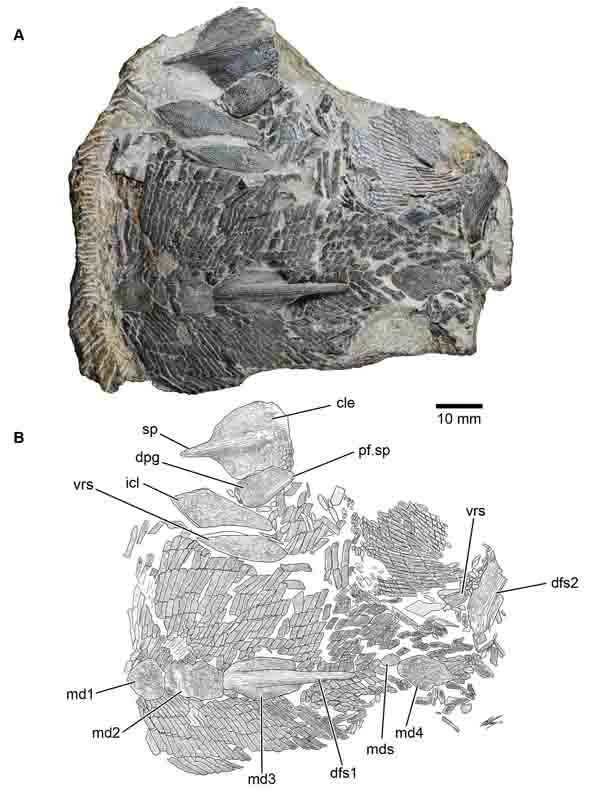
Figure 1. Photograph and line drawing of the holotype of the Four-fold Revolutor Bird (Photo provided by Hu Han)
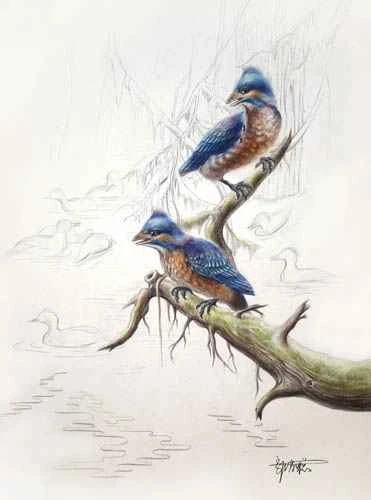
Figure 2. Ecological restoration of the Siamese lobebird (illustrated by Guo Xiaocong)