The ocean is the origin of life, home to countless mysterious and unique creatures. Sea spiders , also known as marine spiders, are a very ancient and obscure marine animal, with a history dating back over 500 million years. If you are unfamiliar with this "alternative spider," this article will take you on a journey to understand its definition, morphological characteristics, habitat, food sources, and reproductive methods , unveiling the mysteries of this obscure marine creature.
What are sea spiders? — Morphological characteristics and classification
Sea spiders are not the terrestrial spiders we commonly see, but rather marine creatures belonging to the phylum Arthropoda, subphylum Chelicerata, and class Pycnogonida. They possess the following distinctive characteristics:
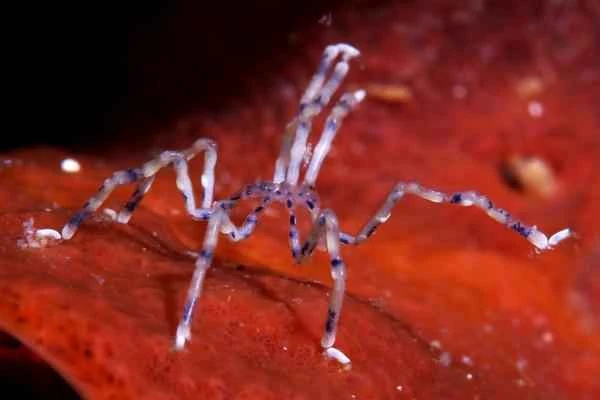
Body structure : The body is extremely small, mainly composed of a head, a torso that is highly integrated with the chest and abdomen, and slender legs. The legs account for a large proportion of the body weight, hence the name "pantopoda".
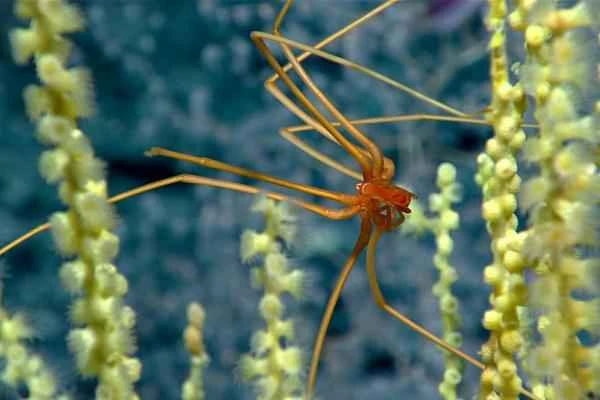
External morphology : Most sea spiders are brownish in color, which they use to camouflage themselves and hide in environments such as seaweed and rocks. Species living in coral reefs often have bright colors to adapt to the colorful background.
Number of legs : They usually have three to four pairs of long, slender legs, and some species even have legs that can reach tens of centimeters in length. Some internal organs extend into the legs.
Special mouthparts : Instead of conventional chelicerae, they have evolved straw-like mouthparts (beak or snout) for sucking up prey fluids.
Breathing method : It has no gills or lungs and relies on its skin to absorb oxygen directly.
Size : Most species are no more than 1 cm in length, but deep-sea giant species can reach 6 cm in length and have a leg span of up to 50 cm.
Are sea spiders poisonous?
Unlike many terrestrial spiders and scorpions, sea spiders lack the structure for injecting venom and do not have venom glands. Their proboscis is only used to suck the bodily fluids of their prey; they do not need venom to subdue their prey.

Sea spider habitat distribution
Sea spiders are entirely aquatic animals with an extremely wide distribution. You can find them in oceans, estuaries, shallows, seaweed beds, rocky reefs, and even coral reefs around the world.
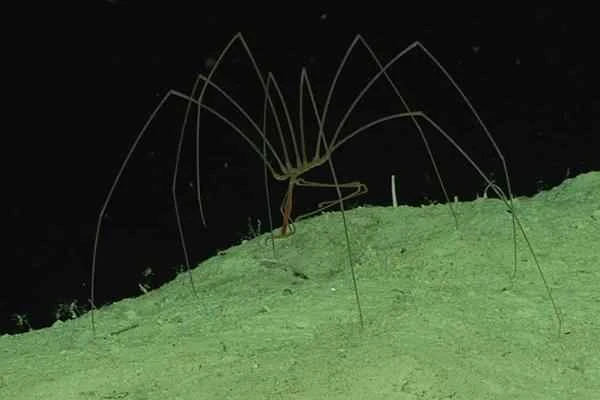
Distribution range : It can be found from shallow intertidal zones to depths of 7,000 meters, making it a true "oceanic cosmic being".
Environmental adaptability : Deep-sea species often exhibit extreme "deep-sea gigantism," such as the giant sea spider Colossendeis megalonyx in the Antarctic Ocean, whose leg span can reach half a meter.
Adaptation mechanism : Scientists speculate that the low temperatures of the polar seas promoted this gigantification phenomenon.
Sea spiders' food sources and feeding methods
Sea spiders have evolved unique beak-like mouthparts—suckers—for feeding:
Feeding structure : The front of the mouthparts has short hairs and hook-like structures, which can pierce the skin of mollusks like a syringe and suck out internal body fluids.
Main diet : Primarily marine invertebrates, including sponges, corals, sea anemones, jellyfish, and polychaetes, with a particular fondness for soft tissues.
Feeding behavior : They often lurk near their prey, slowly crawling with their long legs, and when they find a suitable prey, they insert their snout to absorb nutrients.
Sea spider reproduction and development
Sea spiders are dioecious, with the vast majority of species having a clear division of labor between males and females, and only a very few being hermaphroditic.
Reproduction method : In vitro fertilization is used, and both males and females can possess an "oviger" to carry and protect the eggs.
Paternal care : Males attach fertilized eggs to an incubator and care for them personally until the offspring hatch. This type of paternal care is extremely rare among invertebrates.
Larval development : The hatched larvae are prolarvae, possessing only a head and appendages. Different species of larvae develop in different ways; some continue to attach to their parents, some parasitize other marine organisms, and some live directly in the seabed environment until they develop into adults.
summary
Sea spiders (Pycnogonida), as extremely ancient and widely distributed marine arthropods, have adapted to various marine ecosystems worldwide thanks to their unique physiological structure and reproductive strategies. Although they have an unusual appearance and are not widely known, they are an indispensable part of the marine ecosystem. If you are curious about the marine animal world, sea spiders are definitely worth paying attention to!
References
Beatty, R., Beer, A., and Deeming, C. (2010). The Book of Nature. Dorling Kindersley, UK.
ScienceDirect. (2022). Pycnogonida—An Overview. Accessible at: https://www.sciencedirect.com/topics/agricultural-and-biological-sciences/pycnogonida
Myers, P. (2001). “Pycnogonida”. Animal diversity website. Accessible at: https://animaldiversity.org/accounts/Pycnogonida/