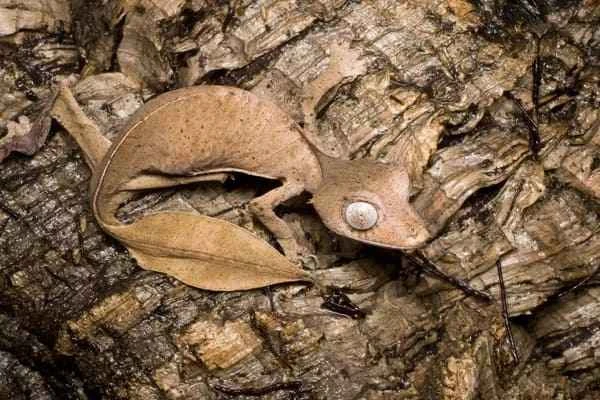
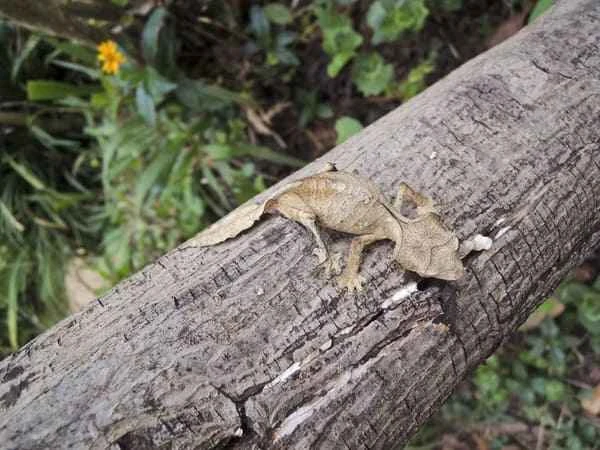
The wicked leaf-tailed gecko (Uroplatus phantasticus) is a gentle reptile that, despite its name, prefers to nap quietly in the forests of Madagascar. It has evolved an extreme method of camouflage: transforming into a dead leaf.
Overview: Satanic Leaf-tailed Gecko
Scientific name: Uroplatus phantasticus
Common name: Satanic Leaf-tailed Gecko
Elementary Animal Group: Reptiles
Size: 2.5–3.5 inches
Weight: 0.35–1 ounce
Lifespan: 3-5 years
Diet: Carnivorous
Habitat: Mountain rainforests in eastern Madagascar
Protection status: No worries
describe
The devil leaf-tailed gecko is one of 13 recognized species belonging to the genus *Uroplatus*, which were discovered on the island of Madagascar in the 17th century. These 13 species are divided into several groups, partly based on the vegetation they mimic. *U. phantasticus* belongs to the group called *U. ebenaui*, which consists of three members: *U. malama* and *U. ebenaui*, all of which resemble dead leaves.
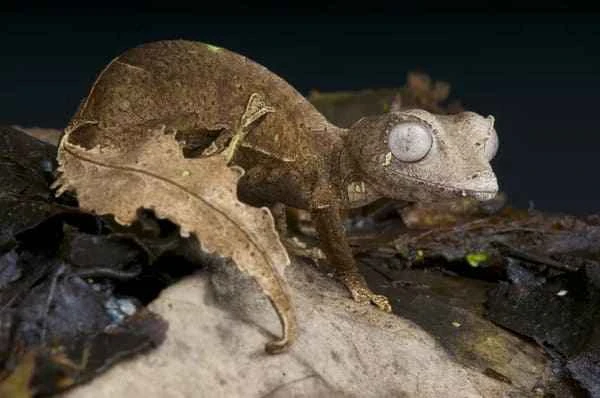
All leaf-tailed geckos have long, flat bodies and triangular heads. The grotesque leaf-tailed gecko is mottled brown, gray, tan, or orange, the same color as decaying leaves in its natural environment. The gecko's body curves like the edge of a leaf, and its skin has lines mimicking the veins of a leaf. But the most striking accessory in the leaf-tailed gecko's camouflage is undoubtedly its tail: among all Ebenai gecko groups, the leaf-tailed gecko has the longest and widest tail. The lizard's tail not only resembles a leaf in shape and color, but also has notches, folds, and imperfections, making it look even more like a withered leaf gnawed by insects.
Like other members of the group, the Satanic Leaf-tailed Gecko is relatively small compared to other Uroplatus groups, measuring between 2.5 and 3.5 inches in length, including its tail.
Habitat and Distribution
This dreadful leaf-tailed gecko is found only in the mountainous rainforests of the eastern and southern two-thirds of Madagascar, a large island nation off the southeastern coast of Africa. It is found at the base of trees, camouflaged as leaf litter, reaching up to about 6 feet in height from the trunk. Madagascar's forests are renowned for their unique wildlife, home to lemurs, nesting nymphs, and hissing cockroaches, and are also the habitat of the world's only known dreadful leaf-tailed gecko.
Diet and behavior
The wicked leaf-tailed gecko rests all day, but once the sun sets, it roams in search of food. Its large, eyelidless eyes are designed to spot prey in the dark. Like other lizards, this gecko is believed to feed on anything it can catch and put in its mouth, from crickets to spiders. However, little is known about the Satanic leaf-tailed gecko in its native environment, so we cannot determine what else it eats.
The cunning leaf-tailed gecko doesn't rely on passive camouflage for protection. Even when resting, it behaves like a leaf. When sleeping, the gecko lies flat on a tree trunk or branch, head down, leaf-tail up. If needed, it will twist its body to accentuate the leaf-like edge and help it blend in.
Its ability to change color is limited. When its camouflage fails, it will swing its tail upward, tilt its head back, open its mouth to reveal a bright orange-red interior, and sometimes even emit a loud distress signal.
Reproduction and offspring
In their native Madagascar, the start of the rainy season also marks the beginning of the gecko's breeding season. When sexually mature, male Satanic Leaf-tailed Geckos have a bulge at the base of their tails, while females do not. Females are oviparous, meaning they lay eggs, and the young develop fully externally.
A gecko mother lays a clutch of two to three spherical eggs in the leaf litter or among dead leaves on the ground. This allows the hatchlings to remain hidden until they emerge after about 95 days. She may lay two to three clutches a year. Little is known about this mysterious animal, but it is believed that the mother leaves the eggs for the hatchlings to incubate themselves.
Protect the status quo and threats
Despite currently being listed as one of the least concerned species by the International Union for Conservation of Nature (IUCN), this unusual lizard may soon face danger. Madagascar's forests are degrading at an alarming rate. High demand for the species, driven by exotic pet collectors and currently illegal, is also likely to continue to decline.